How can a 1xN splitter expand a single physical channel of an interrogator to multiple groups of measurement points?
A 1xN optical splitter expands a single physical channel of an interrogator to multiple groups of measurement points by dividing the interrogator’s light source output into N separate paths. Each of these N paths can then be connected to an independent string or group of Fiber Bragg Grating (FBG) sensors.
The interrogator sends a broadband light signal into the splitter. The splitter then distributes this signal to each of the N connected FBG sensor groups. The reflected wavelengths from the FBGs in each group travel back through the splitter (or a corresponding combining mechanism) to the interrogator. To ensure distinct measurements, a strict wavelength design is crucial. This means that each FBG sensor or sensor string connected to a different output of the splitter must operate within a unique, non-overlapping wavelength range. This allows the interrogator to identify and process the signals from multiple sensor groups as if they were on separate channels, effectively multiplying the number of measurement points accessible via a single physical channel, which can significantly reduce the overall system cost for large-scale deployments.
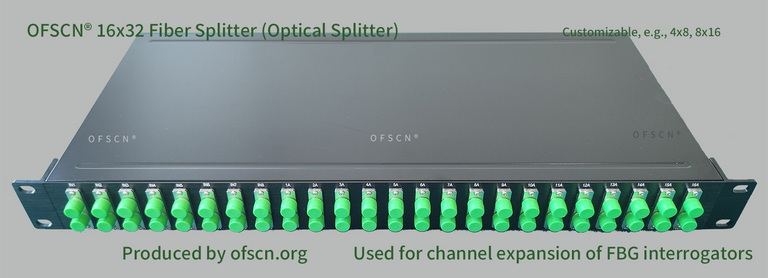
For such applications, OFSCN® Optical Fiber Splitters are commonly used.
Here is a standard image of an OFSCN® Optical Fiber Splitter: