cmh
Last Updated: 09 November 2025
In fields such as semiconductor manufacturing, high-energy physics experiments, and aerospace ground simulation, the purity of the vacuum environment is the lifeline for the success of experiments and processes. When introducing or extracting optical signals into or out of a Vacuum Chamber, the most critical challenge lies in ensuring that the connection component does not become a source of leaks or a source of contamination (outgassing).
This is a companion discussion topic for the original entry at https://www.ofscn.org/encyclopedia/489-fiber-optic-sealed-flange-01.html
The introduction of optical signals into Ultra-High Vacuum (UHV) environments indeed presents a significant challenge, particularly regarding the trade-off between hermetic sealing and material outgassing.
In UHV applications, standard epoxy-based or polymer-heavy connectors often fail because they release volatile organic compounds (VOCs) under low pressure, which can contaminate sensitive semiconductor wafers or high-energy physics detectors.
Technical Solution: OFSCN® Fiber Optic Vacuum Sealed Flange
To address these challenges, we utilize specialized sealing technologies that ensure a vacuum leak rate of better than 1×10⁻⁹ Pa·m³/s (for high-spec versions) or standard 1×10⁻⁵ Pa to 1×10⁻⁷ Pa levels.
Key Technical Features:
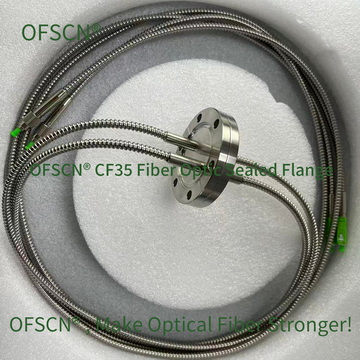
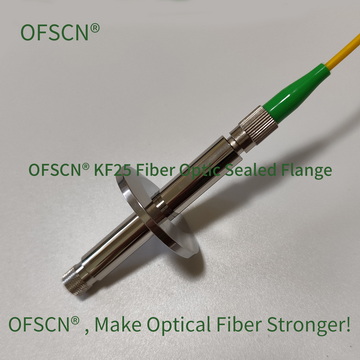
- Material Integrity: Available in CF (ConFlat) and KF (Klamp Flange) series using 304 or 316L stainless steel to meet the stringent requirements of UHV environments.
- Thermal Resilience: While standard models operate at ambient temperatures, we offer customized versions capable of withstanding up to 250°C, which is essential for “bake-out” processes used to reach ultra-high vacuum levels.
- Configuration Versatility: Support for single-channel or multi-channel feedthroughs with FC/APC or other standard interfaces to minimize insertion loss.
Product Visuals:
For detailed specifications regarding flange sizes (CF16, CF35, KF25, etc.) and fiber types (Single-mode, Multi-mode, or FBG-integrated), you may refer to the technical documentation:
OFSCN® Fiber Optic Vacuum Sealed Flange
If you are evaluating this for a specific chamber setup, could you specify the required vacuum degree and whether the system requires high-temperature bake-out?