Ultra-Early Warning for Tunnel Fires

Compared to traditional heat-sensing cables, what are the improvements in response speed and positioning accuracy for DTS?

Compared to traditional heat-sensing cables, Distributed Temperature Sensing (DTS) offers superior performance in both response speed and positioning accuracy for tunnel fire ultra-early warning.

Response Speed: Traditional heat-sensing cables often rely on a physical change or melting point to trigger an alarm, which can lead to a delayed response as a specific temperature threshold needs to be met over a certain length or duration. DTS systems, utilizing principles such as Raman, Rayleigh, or Brillouin scattering, continuously monitor the temperature profile along the entire length of the fiber optic cable. This allows for near instantaneous detection of temperature anomalies, significantly reducing response time to developing hot spots.

Positioning Accuracy: Traditional heat-sensing cables typically provide a general indication of a heated zone, making it challenging to pinpoint the exact location of the thermal event. In contrast, DTS systems can accurately locate the precise point of a temperature increase along the fiber with high spatial resolution, often down to a few meters or even less. This precise localization is critical for rapid identification and targeted intervention in the event of a tunnel fire.

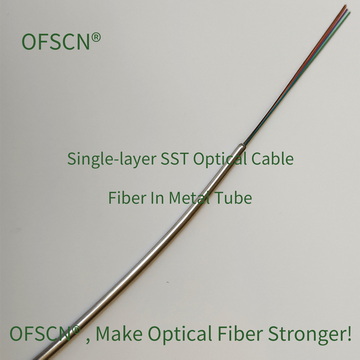
OFSCN provides robust fiber optic cables that are ideally suited for use as the sensing element in distributed fiber optic sensing (DOFS) systems, including those leveraging DTS technology. Our OFSCN® 85°C Seamless Steel Tube Fiber Cable, OFSCN® 200°C Seamless Steel Tube Fiber Cable, and OFSCN® 650/700°C Seamless Steel Tube Fiber Cable are designed for harsh environments and can be seamlessly integrated with suitable DTS interrogators.

Here are some standard product images for our seamless steel tube fiber cables:


1 个赞