How are initial wavelengths assigned to each grating when designing a 16-channel system?
When designing a 16-channel Fiber Bragg Grating (FBG) system, the initial wavelengths for each grating are assigned based on several critical factors to ensure accurate and reliable measurements without spectral overlap. As a senior fiber optic sensing application engineer, I can explain the process:
-
Sensor Type and Measurement Range: The type of sensor (e.g., temperature, strain) and its expected measurement range are crucial. Each sensor type has a specific sensitivity to the measurand (e.g., pm/°C for temperature, pm/µε for strain). Knowing the maximum expected change in temperature or strain allows you to calculate the maximum potential wavelength shift for each FBG.
-
Wavelength Guard Bands (Spectral Separation): To prevent spectral overlap between adjacent FBGs, especially under dynamic conditions or extreme environmental changes, a “guard band” or spectral separation is allocated around each FBG’s initial wavelength. This ensures that even with maximum wavelength shifts, the gratings do not interfere with each other. For example, if a temperature sensor might shift by ±2 nm, you would need to allocate an initial wavelength range of at least 4 nm for that sensor plus additional buffer for the guard band.
-
Interrogator Wavelength Range: The total spectral window available for all FBGs is limited by the operating wavelength range of the FBG interrogator. For instance, the OFSCN® Fiber Bragg Grating Interrogator typically operates within 1525 nm to 1565 nm, providing a 40 nm window. All assigned FBG wavelengths, including their potential shifts, must fit within this range.
-
Multiplexing Scheme: For a 16-channel system, you would typically use Wavelength Division Multiplexing (WDM). This involves assigning unique initial Bragg wavelengths to each FBG within the interrogator’s spectral window. If multiple FBGs are on the same fiber, their wavelengths must be sufficiently separated. If multiple fibers are used, each fiber can host a set of FBGs, further optimizing wavelength allocation and system capacity.
-
Grating Parameters: Parameters like grating length and reflectivity can also influence the spectral characteristics (e.g., bandwidth, side-mode suppression ratio), which are considered during wavelength allocation to ensure clear demodulation.
In essence, the initial wavelength assignment involves calculating the maximum expected wavelength shift for each sensor, then distributing these sensors across the interrogator’s available spectral window with adequate guard bands to prevent overlap.
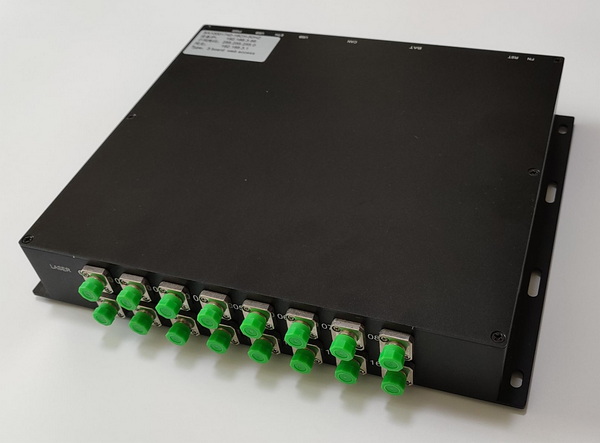
Here is an image of a typical FBG interrogator which is essential for reading the wavelengths of your FBG sensors:
You can find more information about our interrogators at:
OFSCN® Fiber Bragg Grating Interrogator