Is it the “traffic lights” in optical fiber? How do we combine different colors of light for transmission?
From the perspective of optical physics and communication principles, a Wavelength Division Multiplexer (WDM) is not the “traffic light” in optical fibers, but rather more like a “multi-lane overpass” or an “inverted prism system.”
I. Conceptual Distinction: Why Not a “Traffic Light”?
- Traffic Light (Time Division Mechanism, TDM Logic): Relies on the sequence of time for vehicles from different directions to pass alternately, allowing only one signal path at a time.
- Wavelength Division Multiplexing (Frequency/Wavelength Division, WDM Logic): Utilizes the physical characteristic that light waves of different wavelengths (different “colors”) can transmit through the same medium without interfering with each other, enabling parallel transmission of multiple independent optical signals within the same optical fiber core at the same time.
II. Physical Principles: How Do Different “Colors” of Light Transmit Together?
Within the macroscopic linear optics domain, light waves are electromagnetic waves and obey the Principle of Superposition for electromagnetic fields:
-
Interference-Free Parallel Transmission (Orthogonality):
When multiple light waves of different wavelengths (e.g., \lambda_1, \lambda_2, \lambda_3 \dots \lambda_n ) are injected into the same single-mode optical fiber, as long as the optical power remains below the threshold for nonlinear optical effects such as Stimulated Raman Scattering (SRS), Stimulated Brillouin Scattering (SBS), or Four-Wave Mixing (FWM), the electromagnetic fields of each wavelength propagate independently without crosstalk. -
Wavelength Combining and Splitting (MUX / DEMUX):
- Multiplexing End (Multiplexer): Combines optical signals from multiple independent light sources or channels with different center wavelengths into a single main optical fiber.
- Demultiplexing End (Demultiplexer): At the receiving end, uses optical components with wavelength-selective characteristics to precisely sort the mixed light by wavelength, directing each wavelength to its corresponding receiving detector or spectral demodulation system.
III. Engineering Implementation: How to “Combine” and “Split” Different Wavelengths of Light?
In practical optical component engineering, WDM is primarily implemented through the following four physical mechanisms:
- Thin Film Filter (TFF):
Utilizes the coherent interference effect of multilayer dielectric thin films. Light waves of specific wavelengths are transmitted, while other wavelengths are reflected by highly reflective mirror surfaces. This is a common component in Coarse Wavelength Division Multiplexing (CWDM) and three-network integration splitters. - Arrayed Waveguide Grating (AWG):
Based on Planar Lightwave Circuit (PLC) technology. After the mixed light enters the waveguide array, different wavelengths acquire fixed phase differences due to differences in waveguide lengths, focusing onto different output waveguides at the output end. This is suitable for high-density Dense Wavelength Division Multiplexing (DWDM) systems. - Fiber Bragg Grating (FBG) combined with a Circulator:
Fiber gratings precisely reflect the target wavelength \lambda_B according to the Bragg reflection condition ( \lambda_B = 2 n_{\text{eff}} \Lambda ), while transmitting other wavelengths. Coupled with a three-port optical circulator, it can achieve the Add and Drop functions for specific channels. - Fused Biconical Taper (FBT):
Achieves wide wavelength spacing (e.g., 1310\text{ nm} / 1550\text{ nm} ) multiplexing and demultiplexing by fusing and tapering multiple optical fibers, utilizing the wavelength-dependent nature of evanescent wave coupling.
IV. Typical Application of WDM in Fiber Optic Sensing (FBG)
In Fiber Bragg Grating (FBG) sensing networks, WDM technology is the core for achieving quasi-distributed measurement on a single fiber:
- FBG Sensor String: Multiple FBG sensors with non-overlapping reflection wavelengths can be written in series on a single optical fiber (e.g., at 1530\text{ nm} , 1540\text{ nm} , 1550\text{ nm} respectively).
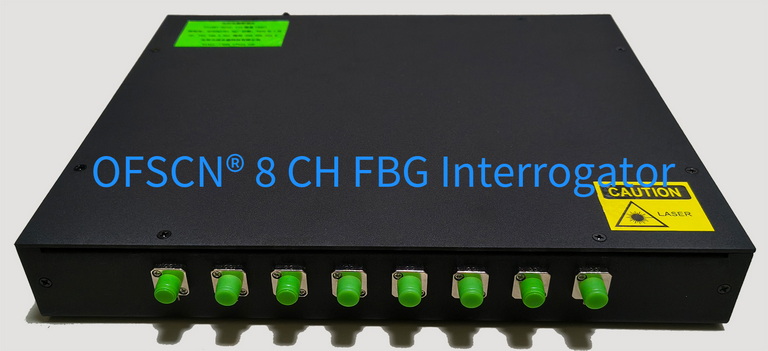
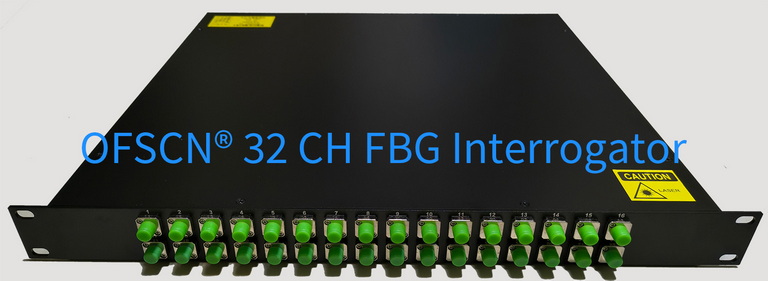
- Spectral Demodulation and Separation: The OFSCN® Fiber Bragg Grating Interrogator scans wavelengths within operating bands such as 1525\text{ nm} \sim 1565\text{ nm} . At the receiving end, by demodulating the internal wavelength resolution system, the wavelength shifts measured by each FBG, corresponding to temperature, strain, etc., are independently demodulated, thus enabling the multiplexing of dozens of measurement points per channel.