How does it differentiate sensors in different locations by assigning different colors (wavelengths)?
In Fiber Bragg Grating (FBG) sensing systems, Wavelength Division Multiplexing (WDM) is a technique that enables independent identification and measurement of multi-point, multi-location sensors by assigning different, non-overlapping reflection wavelengths (i.e., “colors”) to different sensors on a single optical fiber. The specific physical principles and mechanisms for distinguishing locations are as follows:
1. “Wavelength Characteristic Encoding” of Individual Sensors
When manufactured, each Fiber Bragg Grating (FBG) has a specific refractive index periodicity in its grating region. According to the Bragg reflection principle, when light from a broadband source is incident on an FBG, only light that satisfies the specific Bragg condition is reflected back, while light of other wavelengths is transmitted directly. The central Bragg wavelength satisfies the formula:
\lambda_B = 2 n_{eff} \Lambda
where \lambda_B is the central Bragg reflection wavelength, n_{eff} is the effective refractive index of the fiber core, and \Lambda is the grating period. By adjusting the period \Lambda of each grating during manufacturing, we can artificially assign a unique “initial reflection color (wavelength)” to each sensor on a single optical fiber.
2. Binding the Mapping of Spatial Position to Wavelength
During the production and laying of optical fibers, technicians write FBGs with different wavelengths sequentially at different physical locations on a single optical fiber. For example:
- Location 1, 10 meters from the start, deploys a sensor with a reflection wavelength of \lambda_1 = 1530\text{nm} ;
- Location 2, 20 meters from the start, deploys a sensor with a reflection wavelength of \lambda_2 = 1540\text{nm} ;
- Location 3, 30 meters from the start, deploys a sensor with a reflection wavelength of \lambda_3 = 1550\text{nm} .
This one-to-one correspondence between “physical spatial position” and “specific spectral wavelength” is recorded as prior data in the demodulator’s system software during system deployment.
3. Dynamic Demodulation and Channel Isolation (Wavelength Bandwidth Allocation)
When the external environment (such as temperature or strain) changes, it causes a slight change in the period \Lambda or refractive index n_{eff} of the FBG at the corresponding location, thus causing the reflection wavelength to drift (i.e., a wavelength change \Delta \lambda occurs).
To ensure that sensors at different locations do not experience “signal overlap” or “collisions” during drift, the system assigns a dedicated “wavelength channel” (safe bandwidth) to each sensor. For example:
- The wavelength of sensor 1 is allowed to drift with physical quantity changes only within the range of 1528\text{nm} to 1532\text{nm} ;
- The wavelength of sensor 2 is allowed to drift only within the range of 1538\text{nm} to 1542\text{nm} .
By setting such safe protection frequency bands, even if physical quantities at multiple locations change drastically simultaneously, the demodulator can clearly determine which specific wavelength (i.e., which specific physical location) the signal change originates from by the interval in which the reflected light wavelength falls.
OFSCN® Official Supporting Technical Products
In practical engineering applications, achieving the WDM discrimination and high-precision demodulation described above requires professional Fiber Bragg Grating demodulators (analyzers) and multi-measurement point Fiber Bragg Grating sensors. Dacheng Yongsheng (OFSCN®) provides the corresponding professional-grade equipment and sensor components:
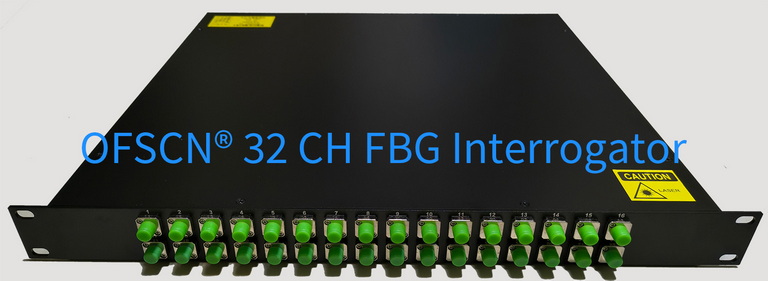
1. OFSCN® Fiber Bragg Grating Interrogator
This is the core of the entire WDM system. It emits broadband light into the fiber and uses its built-in high-resolution spectral analysis module to detect real-time changes in the reflection peaks of each wavelength (“color”) in each channel.
- Wavelength Range: Default 1525\text{nm} to 1565\text{nm} , or 1528\text{nm} to 1568\text{nm} (multiple FBG sensors can be demodulated in parallel within a bandwidth of approximately 40\text{nm} );
- Number of Channels: Supports 4-channel, 8-channel, 16-channel, and 32-channel customization, with each physical channel capable of accessing multiple sensors via WDM;
- Wavelength Resolution: Default 1\text{pm} or 0.1\text{pm} .
2. Multi-Measurement Point FBG Sensors (WDM Series Connection)
Due to the limitation of the interrogator’s swept wavelength range (e.g., 40\text{nm} ), each measurement point requires a certain wavelength interval for full-scale change (e.g., for every 100°C change in temperature, the wavelength shifts by approximately 1\text{nm} ). Dacheng Yongsheng supports the customization of multiple FBG measurement points with different wavelengths in series on a single fiber optic sensor:
- OFSCN® 300°C Fiber Bragg Grating Temperature Sensor: It is recommended to integrate a maximum of 10 FBG temperature measurement points within a single sensor;
- OFSCN® 500°C Fiber Bragg Grating Temperature Sensor: It is recommended to integrate a maximum of 5 FBG temperature measurement points within a single sensor.
Through precise Wavelength Division Multiplexing (WDM) design, these multi-measurement point sensors can use a single fiber core to simultaneously and independently measure the precise physical quantity changes at various points over a range of meters or tens of meters.