Why are rodents prone to chewing on fiber cables? How does stainless steel armoring provide a physical defense against them?
Rodents, such as rats and squirrels, are naturally inclined to chew on fiber optic cables for several biological and environmental reasons. Understanding these factors helps in designing effective defenses like stainless steel armoring.
Why Rodents Chew Fiber Cables
- Constant Tooth Growth: Rodents have incisors that grow throughout their entire lives. To prevent these teeth from overgrowing and becoming unusable or painful, they must constantly gnaw on hard materials to wear them down.
- Texture and Size: The diameter and semi-rigid texture of standard plastic-jacketed fiber cables are often ideal for a rodent’s grip.
- Environmental Obstacles: In many deployments (ducts, ceilings, or underground), cables are simply in the way of a rodent’s established path, leading them to “clear” the obstruction by chewing.
How Stainless Steel Armoring Provides Defense
Stainless steel armoring serves as a high-strength physical barrier that traditional plastic (PVC/LSZH) or aramid yarn (Kevlar) cannot provide. Here is how it functions:
- Mechanical Hardness: The hardness of 304 or 316L stainless steel exceeds what rodent teeth can effectively penetrate. When a rodent attempts to gnaw on the armor, it provides immediate resistance that does not yield, typically causing the animal to abandon the cable.
- Seamless Protection: Products like the OFSCN® Seamless Steel Tube Fiber Cable use a continuous laser-welded tube. This design leaves no gaps or “edges” for a rodent to catch its teeth on, unlike spiral-wrapped armoring which can sometimes be unraveled.
- Tensile and Compressive Strength: Beyond just bite protection, the steel tube provides immense crush resistance, ensuring the internal glass fibers remain intact even under significant external pressure.
Recommended Solutions
For environments prone to rodent activity, we recommend the following armored solutions:
- OFSCN® 2.0mm Micro Steel Armored Fiber Optic Patch Cord: This patch cord incorporates a 0.6mm stainless steel seamless tube inside a PVC jacket, combining flexibility with robust rodent protection.
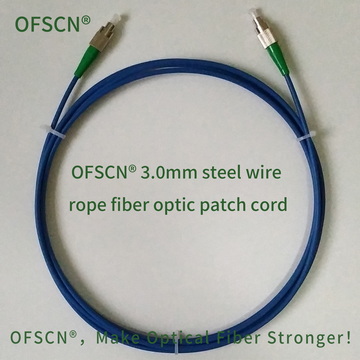
- OFSCN® 2.0mm Steel Wire Rope Fiber Optic Patch Cord: Features an all-metal structure with a 1.0mm stainless steel seamless tube and additional steel wire braiding for maximum durability.
- OFSCN® 85°C Seamless Steel Tube Fiber Cable: A dedicated sensing and communication cable using a seamless steel tube as the primary protective layer.
Product Visuals:


By replacing standard patch cords with these armored versions, you can significantly reduce network downtime caused by environmental pests.