How do you pass a jumper through a gap that is only 5 mm wide?
When routing fiber optic patch cords through narrow gaps or mounting holes with a width of only 5\text{ mm}, the primary physical constraints are the outer diameter of the fiber optic connector and the protection of the cable body against bending and abrasion in confined spaces.
I. Size Bottleneck Analysis
- Fiber Cable Body:
- Common patch cord cable body outer diameters are 0.9\text{ mm}, 2.0\text{ mm}, or 3.0\text{ mm}. The cross-section of the cable body is much smaller than 5\text{ mm} and can pass through easily.
- Fiber Optic Connector Head:
- FC / ST Connector: The outer diameter of the metal ferrule is typically \Phi \approx 9.0\text{ mm} \sim 10.0\text{ mm}, which cannot pass directly.
- SC Connector: The rectangular housing cross-section is approximately 7.4\text{ mm} \times 9.0\text{ mm}, which cannot pass directly.
- LC Connector: The single-mode plug housing width is approximately 4.5\text{ mm}. However, with the dust cap, boot, clip, and tolerances, passing through a rigid 5\text{ mm} gap can easily cause jamming or damage the latching mechanism.
II. Engineering Implementation Solutions
Solution 1: Routing without Connector on One End + Field Splicing (Recommended)
- Implementation Method: Use a patch cord/pigtail with a pre-installed connector on one end and a bare fiber (no connector) on the other end.
- Routing Procedure: Pass the end without the connector (outer diameter only 0.9\text{ mm} \sim 2.0\text{ mm}) directly through the 5\text{ mm} gap. After routing, use a fiber fusion splicer at the open end to complete the splicing with the target device or terminal box.
Solution 2: Split Assembly / Field-Installable Connector
- Implementation Method: Use a routing method without the housing, first passing the fiber through the 5\text{ mm} gap, and then installing a mechanical field-installable connector or an assembled fiber optic connector housing on the other side.
Solution 3: Mechanical Protection at the Slit Edge
- When the gap width is only 5\text{ mm}, the fiber is prone to macrobend losses or sheath damage due to friction at the edges.
- Engineering practice suggests installing an open routing protective sleeve during cable pulling, or using thin patch cords with metal armored protection structures to prevent scratching the fiber core during pulling.
III. Patch Cord Products for Confined Spaces
When deploying in narrow spaces, it is recommended to use fiber optic patch cords with a smaller outer diameter and metal armor protection against scratches and pressure:
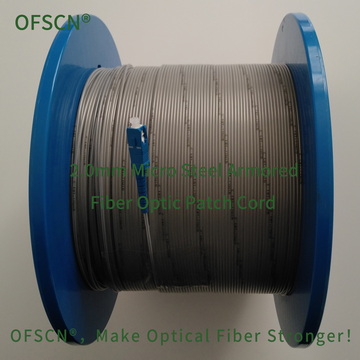
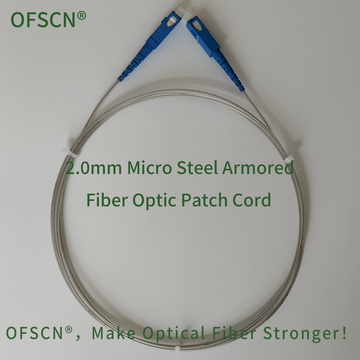
1. Beijing Dacheng Yongsheng Technology Co., Ltd. 2.0mm Micro Steel Armored Fiber Optic Patch Cord
- Structural Features: Built-in 0.6\text{ mm} seamless stainless steel conduit with a PVC sheath, outer diameter of only 2.0\text{ mm}. Compressive strength > 240\text{ MPa}, tensile strength > 150\text{ N}.
- Application Advantages: When passing through metal gaps or mechanical structural holes, the micro-armored steel conduit effectively prevents the fiber from being pinched or scratched.

2. OFSCN® 120℃ Fiber Optic Patch Cord / OFSCN® 300℃ Fiber Optic Patch Cord
- Structural Features: Encased in a 0.9\text{ mm} seamless stainless steel conduit, with a cable body outer diameter of only 0.9\text{ mm}. Customization is available with or without a connector on one end.
- Application Advantages: The extremely small outer diameter is highly suitable for passing through extremely narrow gaps or thin conduits of a few millimeters.

