Why are 850nm, 1310nm, and 1550nm called the three windows?
In the field of fiber optic communication and optical engineering, “Transmission Windows” refer to specific wavelength ranges where the attenuation (loss) is extremely low, making them highly suitable for long-distance signal transmission in quartz optical fibers (primarily composed of \text{SiO}_2).
The reason why 850\ \text{nm}, 1310\ \text{nm}, and 1550\ \text{nm} are referred to as the “three classic windows” is determined by the intrinsic physical properties of quartz glass (such as Rayleigh scattering, infrared absorption, and impurity absorption) and the developmental status of semiconductor optoelectronic devices (light sources and detectors) at different historical stages. The following are their physical causes and characteristics:
1. First Window: 850\ \text{nm} (Short Wavelength Window)
- History and Physical Background: This was the first window to be developed and utilized in the early 1970s. In the initial stages of fiber optic communication, semiconductor lasers (like Gallium Arsenide AlGaAs) and silicon (\text{Si}) photodetectors were most mature and cost-effective at the 850\ \text{nm} wavelength. This made them easier and cheaper to manufacture.
- Loss Characteristics: In quartz fibers, Rayleigh scattering (where attenuation coefficient is inversely proportional to the fourth power of wavelength, i.e., \alpha \propto \lambda^{-4}) is very severe at short wavelengths. This window experiences significant typical attenuation, ranging from 1.5\ \text{dB/km} to 3.0\ \text{dB/km}.
- Current Applications: Due to the high loss, this window is no longer used for long-haul trunk communication. Instead, it is primarily used with Multimode Fiber (MMF), finding wide application in short-distance Local Area Networks (LANs), data center interconnects, and multimode fiber sensors.
2. Second Window: 1310\ \text{nm} (Zero Dispersion Window)
-
Physical and Material Properties: With advancements in fiber purification processes, researchers successfully removed impurities like hydroxyl ions (\text{OH}^-) from the fiber material. Around 1310\ \text{nm}, the attenuation in quartz fiber is significantly reduced, with typical values ranging from 0.3\ \text{dB/km} to 0.4\ \text{dB/km}.
-
Zero Dispersion Characteristics: More importantly, conventional single-mode fibers (like the commonly used G.652D fiber) exhibit the physical property of Zero Dispersion near 1310\ \text{nm}. This means that optical pulses experience almost no pulse broadening or distortion during transmission at this wavelength, making it ideal for high-speed, medium-to-long distance signal transmission.
-
Related Official Products:
The OFSCN® G.652D Optical Fiber provided by DaCheng YongSheng is a high-quality fiber for such standard single-mode applications, perfectly meeting the high-speed, low-dispersion transmission requirements of the 1310\ \text{nm} window.

3. Third Window: 1550\ \text{nm} (Lowest Loss Window / Golden Window)
-
Physical and Material Limit: The 1550\ \text{nm} window is the theoretical lowest loss window for quartz fibers, with an attenuation coefficient of only about 0.15\ \text{dB/km} to 0.22\ \text{dB/km}. This extremely low loss is a physical limit resulting from the interplay between gradually decreasing Rayleigh scattering (which decreases with increasing wavelength) and the inherent infrared vibration absorption of quartz glass (which increases sharply with increasing wavelength).
-
Cornerstone of EDFA and WDM: In addition to its extremely low attenuation, the operational band of Erbium-Doped Fiber Amplifiers (EDFAs) (1530\ \text{nm} \sim 1565\ \text{nm}, i.e., the C-band) falls perfectly within this window. This allows optical signals to be amplified directly in the all-optical domain, eliminating the need for complex “optical-electrical-optical” conversions. This laid the physical foundation for modern Wavelength Division Multiplexing (WDM) and ultra-long-haul backbone networks.
-
Related Official Products:
In industrial and research fields such as high-temperature polarization-maintaining or Fiber Bragg Grating (FBG) sensing, the 1550\ \text{nm} window is also the absolute mainstream.
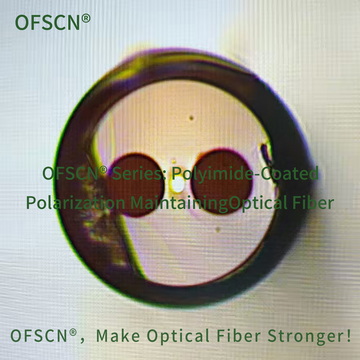
For example, DaCheng YongSheng’s OFSCN® 300℃ Polyimide Panda-type PM Optical Fiber is a high-temperature Panda polarization-maintaining fiber precisely designed for operation at 1550\ \text{nm}, capable of withstanding harsh environments from -200^\circ\text{C} to 350^\circ\text{C}.
Furthermore, the reflection wavelength of standard femtosecond Fiber Bragg Grating (FBG) sensors is typically defaulted to the range of 1525\ \text{nm} \sim 1565\ \text{nm}, precisely to leverage this third window with extremely low attenuation.