When is it necessary to use a double layer of steel pipe? Is it for increased strength or for corrosion protection?
This is a good engineering question. Simply put: the core design purpose of multi-layer steel tubes is the superposition of mechanical protection (pressure and tensile resistance) and barrier protection (hydrogen and moisture blocking), while anti-corrosion capability mainly depends on the selection of the metal material itself.
We can understand this from two perspectives: physical mechanisms and downhole working conditions.
1. The Essential Difference Between Single-Layer and Multi-Layer Steel Tubes
| Comparison Dimension | Single-Layer Steel Tube Fiber Optic Cable | Double / Triple-Layer Steel Tube Fiber Optic Cable |
|---|---|---|
| Typical Outer Diameter | \varnothing 2.0\text{--}3.0\ \text{mm} , thinner wall thickness (0.2\text{--}0.3\ \text{mm}) | Outer layer \varnothing 6.35\ \text{mm} , wall thickness 0.9\ \text{mm} ; inner layer \varnothing 3.0\text{--}3.6\ \text{mm} |
| Design Objective | General mechanical protection, communication/sensing | High-reliability sensing in deep wells / high-pressure / hydrogen-rich environments |
| Pressure Rating | Suitable for low pressure and shallow burial | Can withstand the extremely high hydrostatic pressure and squeezing loads of deep wells |
| Material Selection | 304/316L Stainless Steel | 316L Stainless Steel, optional 825 Alloy |
2. “To Be Stronger?” — Yes, That’s the Primary Reason
In the downhole environment, the core threats faced by fiber optic cables include:
- High Hydrostatic Pressure: The liquid column of hundreds to thousands of meters in deep wells generates extremely high external pressure. If a single-layer, thin-walled steel tube lacks sufficient rigidity, buckling of the tube wall (collapse) will occur, directly crushing the optical fiber. The thick outer steel tube (wall thickness 0.9 mm) provides the main barrier against external squeezing.
- Axial Tension and Lateral Squeezing: The pulling force during the lowering process, friction with the wellbore, and formation displacement all require the fiber optic cable to have high tensile strength and resistance to lateral pressure. The multi-layer nested structure, from a mechanical standpoint, divides labor layer by layer—the outer layer bears the load, and the inner layer protects the fiber.
Therefore, from a mechanical perspective, the multi-layer design is intended to provide far superior collapse resistance and tensile strength compared to single-layer tubes.
3. “Or to Prevent Corrosion?” — Synergistic Effect of Material and Structure
Corrosion resistance involves two aspects:
3.1 Chemical Corrosion — Relies on the Material Itself
- Downhole fluids may contain corrosive media such as \text{H}_2\text{S}, \text{CO}_2, and high concentrations of chloride ions (\text{Cl}^-).
- Single-layer steel tube fiber optic cables typically use 304 stainless steel (for general environments), with an option for 316L (containing molybdenum, offering better resistance to pitting and chloride corrosion).
- Double/triple-layer steel tube fiber optic cables are by default made of 316L stainless steel, and can be upgraded to 825 nickel-based alloy—a material specifically designed for harsh acidic oil and gas environments (sour service), offering excellent resistance to hydrogen sulfide stress corrosion cracking (SSC) and chloride pitting.
Conclusion: The level of corrosion resistance is primarily determined by the grade of the steel tube material (316L or 825 alloy), not by the number of layers itself.
3.2 Hydrogen and Moisture Barrier — Relies on Multi-Layer Barriers
In high-temperature downhole environments, there is a problem more troublesome than corrosion: Hydrogen Darkening.
- Under high temperature and pressure conditions downhole, \text{H}_2 molecules or \text{H}^+ ions can permeate through the stainless steel tube wall into the optical fiber core, reacting with defects in the glass to form \text{OH}^- absorption peaks. This leads to a sharp increase in transmission loss in the optical fiber.
- The multiple physical barriers provided by the multi-layer steel tubes significantly extend the diffusion path and time for hydrogen to reach the optical fiber, effectively delaying hydrogen-induced loss and ensuring the stability of the sensing signal during long-term service in downhole conditions.
Therefore, multi-layer tubes are not directly used for “anti-corrosion” but rather provide redundant diffusion barriers to combat the penetration of hydrogen gas and moisture.
4. When Are Double or Even Triple Layers Absolutely Necessary?
According to RAG technical documentation, the following scenarios are typical applications:
- Downhole Distributed Fiber Optic Sensing (DTS / DAS / DSS) in Oil/Gas Wells: Requires fiber optic cables to operate reliably for extended periods in high temperatures (200°C – 300°C), high pressures, hydrogen-rich, and acidic media. In such cases, the mechanical strength and barrier capabilities of single-layer tubes are insufficient.
- Deep Wells or Geothermal Wells Requiring Resistance to Extreme External Pressure: The thick outer layer resists collapse, while the inner layer minimizes micro-bending losses in the optical fiber.
- Applications with Extremely High Requirements for Sensing Lifespan and Signal Stability: The multi-layer structure offers redundant protection—even if the outer layer is damaged, the inner layer can still maintain the normal operation of the optical fiber.
5. Relevant Product References
OFSCN® offers a complete product gradient in steel tube encapsulated fiber optic cables, suitable for working conditions of varying severity:
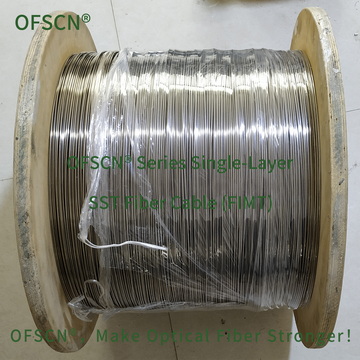
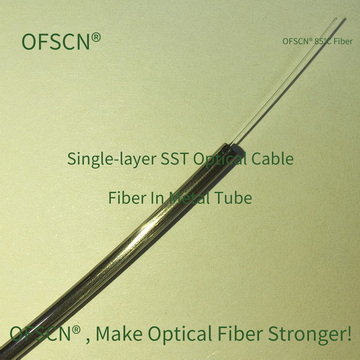
Single-Layer Steel Tube Fiber Optic Cable (General Scenarios)
OFSCN® 85°C Seamless Steel Tube Fiber Cable

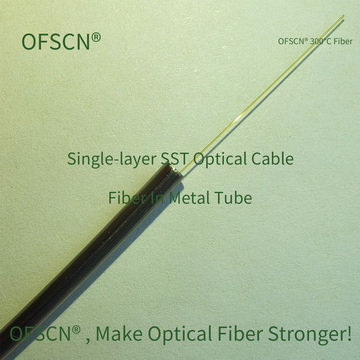
OFSCN® 300°C Seamless Steel Tube Fiber Cable

Double-Layer Steel Tube Fiber Optic Cable (Downhole High-Temperature and High-Pressure Scenarios)
OFSCN® Double-Layer High-Temperature Downhole Fiber Optic Cable

Triple-Layer Steel Tube Fiber Optic Cable (Most Extreme Downhole Environments)
OFSCN® Triple-Layer Downhole High-Temperature Fiber Optic Cable

In a Nutshell
Encasing with two (or even three) layers of steel tube is primarily “for robustness” — to meet the mechanical reliability requirements in deep wells with extremely high external pressure and tensile environments. Corrosion resistance relies on the metallurgical selection of materials (316L or 825 alloy). The multi-layer structure additionally provides physical barriers against hydrogen permeation and moisture diffusion, thereby ensuring the long-term optical stability of the fiber in harsh downhole conditions involving high temperature, high pressure, and acidic media.