Why can it withstand decades of moisture and pressure?
Monitoring systems for large hydraulic projects like dams require sensors with decades of long-term reliability. Fiber optic sensing technologies (including Fiber Bragg Grating sensors and distributed fiber optic sensors) can operate stably in harsh environments with years of high humidity, high hydrostatic pressure, and high mechanical stress, mainly relying on the intrinsic physical properties of their materials and a robust engineering encapsulation protection system:
1. Intrinsic Chemical Stability of Silicon Dioxide (SiO_2) Substrate
The core material of optical fibers is high-purity silicon dioxide glass (SiO_2). Compared to traditional metal resistance strain gauges or electrical sensors:
- Corrosion and Oxidation Resistance: Silicon dioxide glass exhibits extremely high chemical inertness in water, humid environments, and acidic/alkaline conditions, eliminating issues of metal corrosion or electrochemical degradation.
- Immunity to Electromagnetic Interference and Electrical Insulation: Optical fibers transmit optical signals, not electrical signals. This prevents leakage, short circuits, or ground loop electromagnetic interference caused by high humidity.
2. Hermetic Sealing with Seamless Steel/Elastic Alloy Tubes
In the highly humid interiors of dams or areas with high hydrostatic pressure infiltration, bare optical fibers are susceptible to slow crack growth (stress corrosion). OFSCN® employs a proprietary seamless metal tube encapsulation process:
- Hermetic Isolation: Optical fibers and Fiber Bragg Gratings (FBGs) are completely enclosed within seamless stainless steel tubes (e.g., 304 or 316L) or elastic alloy tubes, preventing the ingress of moisture and hydrogen.
- Exceptional Compressive Strength: Seamless steel and alloy tubes possess excellent radial and axial compressive strength (compressive strength > 150\text{ MPa}). They can withstand the stresses of concrete pouring within dams, the hydrostatic pressure of deep reservoirs, and the squeezing forces from dam settlement, thereby protecting the optical fibers from stress-induced damage.
3. Special Polymer Coating and Moisture-Proof Buffering Structure
Inside the metal tubes, the optical fiber surface is coated with polyimide or a water-resistant polymer. The tube is also filled with a special protective medium, which serves a dual purpose: providing moisture protection and buffering stress, effectively preventing external shear forces from being transmitted to the fiber surface.
Example Related Technical Products
In actual dam monitoring projects, the following OFSCN® official products with high moisture resistance and high-pressure tolerance are commonly used:
- OFSCN® Alloy Tube Packaged Fiber Bragg Grating strain sensor
Utilizes elastic alloy tube encapsulation technology, featuring a compact structure and high pressure resistance, suitable for strain and stress monitoring within dam structures.

- OFSCN® Polymer-encapsulated Fiber Bragg Grating Strain Sensor (0.7mm/1.2mm diameter)
Combines polymer materials with a seamless steel outer protective layer, offering extreme waterproof and moisture-proof capabilities along with mechanical tensile and compressive resistance.

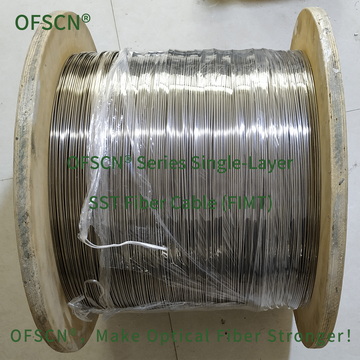
- OFSCN® 200°C Seamless Steel Tube Fiber Cable
Encapsulated in a single-layer seamless stainless steel tube (304/316L), specifically designed for long-distance distributed fiber optic sensing (compatible with monitoring systems based on Raman, Rayleigh, and Brillouin scattering), providing long-term hermetic protection.