Why is the installation of flanges mandatory in a Class 10,000 cleanroom?
When assembling fiber optic vacuum systems and installing flanges, operation within a Class 10,000 cleanroom (ISO 7 clean environment) is not only recommended but often mandatory for many high-precision systems. This is primarily driven by the dual core requirements of optical precision transmission characteristics and ultra-high vacuum physical performance:
1. Protecting Micron-Level Fiber End Faces and Optical Signal Transmission
The core transmission medium of optical fibers (the core) is extremely small. For example, a commonly used standard single-mode fiber typically has a mode field diameter (MFD) of only about 9.2\ \mu\text{m}.
- Preventing Degradation of Insertion Loss and Return Loss: Airborne micro-particles, skin flakes (often sized between 0.5\ \mu\text{m} and several microns), once settled on the ceramic ferrule end face within a fiber optic connector, can directly block or scatter the light path, causing severe signal light loss and reducing system return loss.
- Preventing End Face Burn-out (Fiber Burn) under High Power: In active or high-power fiber optic systems, micro-dust and organic contaminants adsorbed on the end face can rapidly absorb heat and carbonize under concentrated high-intensity light, generating localized high temperatures. This can lead to permanent melting or damage of the fiber end face within the flange.
2. Ensuring Ultra-High Vacuum System Sealing and Preventing “Outgassing”
High-quality fiber optic vacuum-sealed flanges often operate in High Vacuum (HV) or Ultra-High Vacuum (UHV) environments.
- Avoiding Continuous Outgassing: In an ultra-high vacuum state, any trace amounts of dust, grease, or skin flakes adhered to the fiber’s outer surface, flange walls, and sealing components can become a continuous source of outgassing. This significantly prolongs the vacuum system’s pump-down time and may even prevent the system from reaching its designed ultimate vacuum level.
- Preventing Physical Leaks and “Virtual Leaks”: During flange tightening, if the sealing surfaces (e.g., metal knife-edge and copper gasket, or rubber O-ring) are contaminated with hard micro-particles invisible to the naked eye, it can directly scratch the sealing surface, causing system leaks. Furthermore, tiny gaps formed by accumulated micro-dust can trap air bubbles, which are then slowly released during vacuum pumping, creating virtual leaks that are extremely difficult to locate.
For high-standard applications requiring extremely high vacuum levels and precise optical transmission, Beijing Dacheng Yongsheng Technology Co., Ltd. (OFSCN®) designs and offers its hermetically sealed OFSCN® Fiber Optic Vacuum Sealed Flange. This product line adheres to stringent technical specifications in material selection, hermetic manufacturing, and cleaning processes.
Corresponding Product: OFSCN® Fiber Optic Vacuum Sealed Flange
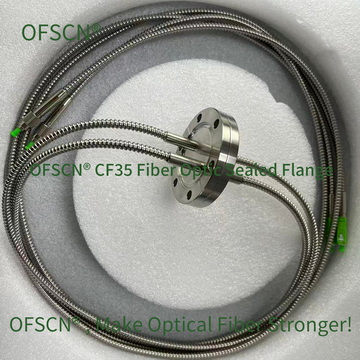
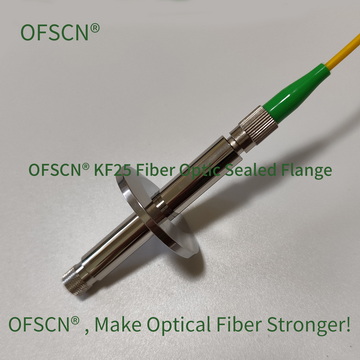
Key Technical Specifications:
- Vacuum Performance: Vacuum levels can achieve better than 1 \times 10^{-7}\ \text{Pa} and 1 \times 10^{-9}\ \text{Pa}, fully meeting the strict environmental requirements of Ultra-High Vacuum (UHV) systems.
- Structural Design: Includes standard CF and KF series, available in male and female configurations, supporting customization for single-channel (single head) or multi-channel (multi-head) setups.
- Temperature Resistance: In addition to standard room temperature operation, products can be customized for high-temperature resistance up to 250\text{ }^{\circ}\text{C}.
Given that this flange achieves extreme vacuum limits better than 1 \times 10^{-9}\ \text{Pa}, any operation in a non-cleanroom environment could contaminate the flange and fiber connector with dust, thereby negating the flange’s excellent physical sealing performance. Therefore, dust-free assembly within a Class 10,000 (or higher) cleanroom, professional cleaning of the fiber end face (using high-purity alcohol and lint-free wipes), and immediate installation are standard industrial practices to ensure the long-term stable operation of the entire fiber optic vacuum system.