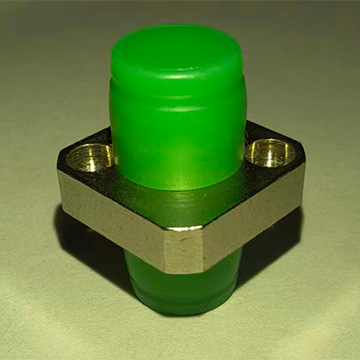
When tightening an FC connector, how can I tell if it’s fully seated?
In fiber optic connectivity and fiber optic sensing engineering, FC (Ferrule Connector) connectors rely on a threaded coupling mechanism and internal spring buffering to achieve physical contact (PC/APC) of the ceramic ferrule end face.
Determining whether an FC connector is correctly installed involves primarily assessing mechanical feel characteristics, standardized installation torque range, and optical signal status.
I. Installation Torque Specifications
According to general fiber optic connection specifications and precision instrument operation standards:
- Standard Operating Method: FC connectors are designed for finger-tightening. It is strictly forbidden to use high-leverage tools such as pipe wrenches or adjustable wrenches for forceful tightening.
- Recommended Torque Range: For precision measurement instruments or assembly environments equipped with a torque wrench, the recommended tightening torque is typically between 0.2\ \text{N}\cdot\text{m} \sim 0.4\ \text{N}\cdot\text{m} (approximately 1.8\ \text{in}\cdot\text{lb} \sim 3.5\ \text{in}\cdot\text{lb}).
- Risk of Overtightening: If the torque exceeds 0.5\ \text{N}\cdot\text{m}, it can easily lead to the cracking of the internal ceramic sleeve within the adapter, stripping of the connector’s threads, plastic deformation of the internal buffering spring, or even micro-cracks or stress concentration on the ceramic ferrule end face.
II. Mechanical Feel and State Assessment (Step-by-Step Guidelines)
During actual engineering installation, precisely judging whether the connector is properly seated can be achieved by feeling for two key points with your fingers:
-
Key-to-Keyway Alignment Feel
The FC connector housing has a key (定位销), and the adapter (flange) has a corresponding keyway (定位键槽) on its inner wall.- Operational Principle: Before rotating the threaded coupling, the connector ferrule must first be inserted into the flange. Gently rotate the housing until you feel the key fully slide into the keyway.
- Important Note: Especially for FC/APC connectors, which have an 8^\circ angled polish on their ferrule end face, attempting to force the threaded coupling to lock without proper keyway alignment will cause the angled end faces to collide incorrectly, resulting in irreversible mechanical damage to the ferrule end face.
-
Hard Stop Sensation
- Initial Stage: Use your thumb and index finger to grip the threaded coupling and rotate it clockwise. At this stage, resistance is very minimal, primarily due to thread engagement and the initial compression of the internal spring.
- Seating Indicator: When the end faces of both ceramic ferrules are fully mated, the internal preload spring is fully compressed, and the threaded coupling reaches its bottom limit, there will be a distinct sudden increase in resistance (a hard stop sensation). Once this point of resistance change is reached, apply moderate finger pressure to tighten; no further increase in force is needed.
III. Optical Signal Status Assessment
When a Fiber Bragg Grating (FBG) demodulator, optical power meter, or spectrum analyzer is in online monitoring mode, signal characteristics can aid in verification:
- Not Properly Seated State: A microscopic air gap exists between the ferrule end faces, leading to a significant increase in interfacial Fresnel reflection, a noticeably low received optical power, unstable FBG reflection peak energy, and often drastic amplitude fluctuations in the waveform when the patch cord is lightly touched.
- Properly Seated State: Once the end faces make physical contact, insertion loss is minimized. The readings on the demodulator or power meter are stable and reach the expected rated intensity. The signal shows no jumpiness when the connector’s rear boot is moved.
IV. Relevant Product Specifications Reference
In Beijing Dacheng Yongsheng Technology Co., Ltd. (OFSCN®) industrial-grade and high-temperature resistant sensing systems, connectors and adapters are manufactured to standard precision tolerances:
- Product Name: OFSCN® High Temperature Resistant Fiber Optic Adapter
High-temperature 300℃ fiber optic flange, supporting standard interface types such as FC/APC-FC/APC, with a built-in precision ceramic alignment sleeve.