Can you see the difference between this and a standard patch cord with the naked eye? Where does the speed advantage come from?
The primary difference between a 10G (10-Gigabit) fiber patch cord and a standard patch cord lies in the physical characteristics of the fiber core and the jacket color coding, although the optical fiber itself might look identical to the naked eye.
1. Can you see the difference with the naked eye?
In most cases, yes, but primarily through industry-standard color coding rather than the glass itself:
- Jacket Color: 10G multi-mode patch cords (OM3 and OM4) typically use an Aqua (light blue/green) or Violet/Magenta (for OM4/OM5) jacket. Standard multi-mode patch cords (OM1/OM2) are usually Orange.
- Laser-Optimized Core: The “naked eye” cannot see the internal refractive index profile, but 10G cables use Laser-Optimized Multi-mode Fiber (LOMMF). This is specifically manufactured to handle the high-speed laser pulses from 10G transceivers (VCSELs).
- Single-mode vs. Multi-mode: If you are comparing a 10G single-mode patch cord (OS2) to a standard single-mode patch cord, they are often physically identical (Yellow jacket) because single-mode fiber is inherently capable of much higher speeds than 10G over long distances.
2. Where does the speed advantage come from?
The “speed” advantage is actually an advantage in bandwidth and distance:
- Reduced Modal Dispersion: Standard multi-mode fibers (OM1/OM2) suffer from high modal dispersion, where different light rays (modes) arrive at the end at different times, “smearing” the signal. 10G (OM3/OM4) fibers have a more precise refractive index profile that ensures all modes arrive simultaneously, allowing for higher data rates (10Gbps, 40Gbps, 100Gbps) over longer distances (up to 300m-550m).
- Effective Modal Bandwidth (EMB): 10G fibers are tested and rated for higher EMB, ensuring they can support the high-frequency modulation used by modern 10G optical modules.
DCYS (OFSCN) Related Products
At OFSCN, we provide high-performance patch cords for various environments, including standard commercial use and extreme industrial conditions.
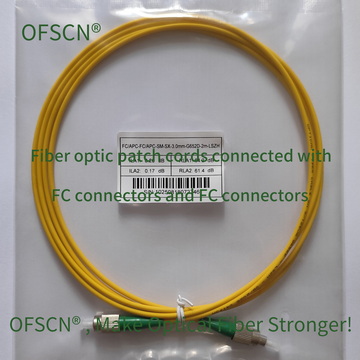
Recommended Products:
- For standard data center and laboratory environments: OFSCN® Standard Fiber Patch Cord
- For harsh industrial environments requiring high tensile strength: OFSCN® 2.0mm Micro Steel Armored Fiber Optic Patch Cord
If you are designing a system for high-speed data transmission in specialized environments (e.g., high temperature or high vibration), the choice of protective armor is as critical as the fiber grade itself.