Why are splitters core to building large-scale distributed monitoring systems?
In Fiber Bragg Grating (FBG) sensing networks and various fiber optic projects, optical splitters are often considered core components for building large-scale distributed monitoring systems. Their primary role extends beyond mere physical layer power division to encompass topological optimization, cost control, and system redundancy design.
The main technical reasons can be summarized as follows:
1. Channel Logic Expansion and System Cost Optimization
In large-scale fiber optic sensing projects, the number of channels in an FBG interrogator (such as the OFSCN® Fiber Bragg Grating Interrogator) is a key determinant of hardware costs. However, if each monitoring branch requires a dedicated physical channel, the overall system cost would be prohibitively high.
By employing optical splitters (e.g., OFSCN® Optical Fiber Splitter), a single physical channel of the interrogator can be “split” and logically extended to two or more channels (while still occupying the same physical channel’s data acquisition space). This approach can exponentially expand the measurement point coverage of a single interrogator, thereby significantly reducing the average cost per channel.
2. Multi-Branch Topology Construction and Spatial Adaptability
Monitoring sites for large structures (such as bridges, tunnels, dams, large power utility tunnels, etc.) often present complex spatial distributions. A purely “single-chain series” topology would result in exceptionally long fiber optic cable routes, facing intricate bends and mechanical stresses.
With optical splitters, the optical signal from the backbone fiber can be distributed to different geographical areas or structural cross-sections, enabling the flexible construction of a “star-bus” hybrid topology. This structure simplifies cabling, shortens the physical span of individual deployments, and offers greater spatial adaptability.
3. Enhanced System Resilience and Redundancy
In a “single-chain series” bus topology, a single physical break in the fiber optic cable would cause signal loss for all FBG sensors located after the break.
However, in a branched network incorporating splitters:
- If a specific branch experiences a physical break or damage, only the monitoring points on that particular branch will fail.
- Sensors on other split channels (branches) will continue to reflect optical signals normally and be demodulated.
This physical layer fault isolation capability significantly enhances the robustness of large-scale distributed monitoring systems.
4. Key Technical Constraints: Optical Power Budget and Strict Wavelength Design
While splitters offer advantages in topology and cost, as passive devices, they introduce inherent physical limitations that must be precisely calculated during engineering design:
-
Optical Power Loss (Insertion Loss):
Each splitting event causes optical power attenuation. For instance, an ideal theoretical 1 \times 2 splitter has an insertion loss of approximately 3\ \text{dB} (actual loss, including device loss, is typically around 3.2\ \text{dB} \sim 3.5\ \text{dB} ). Higher splitting ratios (e.g., 1 \times 8 , 1 \times 16 , or even 16 \times 32 ) result in greater attenuation per path. Therefore, precise planning of the overall optical path’s power budget is crucial to ensure that the optical signal level reflected back to the interrogator remains above the interrogator’s detection sensitivity threshold. -
Strict Wavelength Design:
Since multiple FBG sensors across different branches share a single physical channel for spectral scanning after being combined by the splitter, the reflection spectra of all FBGs within the same physical channel must not overlap. This necessitates meticulous, non-overlapping wavelength allocation for the center wavelength ( \lambda_B ) and the reflection wavelength range affected by temperature and strain for sensors on different split branches – a practice known as “strict wavelength design.”
OFSCN® Product Introduction
Addressing the practical engineering needs of large monitoring projects for channel expansion and multi-branch hybrid networking, Beijing Dacheng Yongsheng Technology Co., Ltd. provides high-performance splitter solutions:
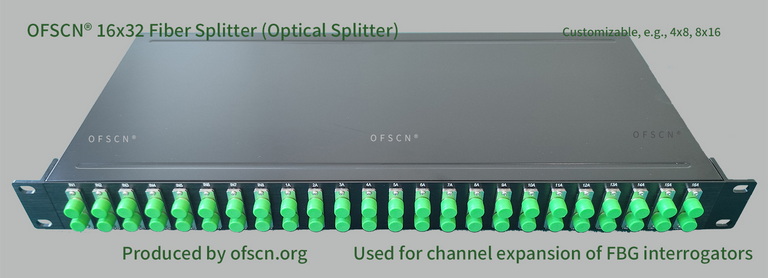
OFSCN® Optical Fiber Splitter
This series of optical fiber splitters includes standard models such as 16 \times 32 splitters, 8 \times 16 splitters, 4 \times 8 splitters, and 32 \times 64 splitters. They are designed to complement OFSCN® Fiber Bragg Grating Interrogators for multi-channel logic expansion, optimizing the per-channel cost for large-scale monitoring network deployments. They boast technical advantages of high return loss and low excess loss.
The analysis above is based on the physical and topological layers. Through a judicious combination of “splitters + wavelength planning,” an optimal balance of cost, reliability, and engineering implementation difficulty can be achieved in large-scale distributed fiber optic monitoring systems.