Why is the fiber clad in a
“
carbon coat
”
? Is it for moisture or hydrogen protection?
Why Give Optical Fibers a “Carbon Coat”?
In optical engineering, giving optical fibers a “carbon coat” (i.e., Carbon Hermetic Coating) is a very classic and effective technical measure.
To answer your question directly: the “carbon coat” is for both moisture (water) and hydrogen protection. It provides a dual barrier of physical and chemical protection on the fiber surface.
Here’s a detailed breakdown of its working principle from the perspectives of physics, material science, and optical engineering:
1. Moisture Protection: Inhibiting “Stress Corrosion” and “Static Fatigue”
The main component of quartz optical fiber is silicon dioxide (SiO_2). While quartz glass has extremely high strength in a dry environment, it’s not microscopically perfect and has minuscule cracks on its surface (Griffith cracks).
- Physicochemical Mechanism: When the fiber experiences mechanical tensile stress during deployment or use, if water molecules (H_2O) in the air come into contact with the crack tips, they react with the stressed siloxane bonds (Si-O-Si):
Si-O-Si + H_2O \rightarrow 2Si-OH
This reaction causes the siloxane bonds to break, leading to the slow expansion of cracks under stress far below their theoretical limit strength. This phenomenon is known academically as Stress Corrosion or Static Fatigue. - Role of the Carbon Coat: During the fiber drawing process, a very thin (typically 10\text{nm} to 50\text{nm}) amorphous carbon film is deposited directly onto the outside of the cladding using processes like Chemical Vapor Deposition (CVD). This carbon film is extremely dense and effectively blocks water molecules from contacting the quartz surface. Consequently, it elevates the fiber’s static fatigue parameter ( N value) from approximately N \approx 20 for standard fibers to $N
gr 100 or even higher. This significantly extends the fiber’s service life in humid and stressed environments.
2. Hydrogen Protection: Inhibiting “Hydrogen-induced Attenuation”
In harsh industrial environments such as oil and geothermal wells, deep-sea applications, power cables, or high-temperature and high-pressure conditions, free hydrogen gas (H_2) is often present.
- Physicochemical Mechanism: Hydrogen molecules are extremely small and can easily penetrate ordinary polymer fiber coatings, diffusing into the quartz core. Once inside the core:
- Hydrogen molecules dissolve physically in the glass network voids, creating characteristic absorption peaks around the 1.24\ \mu\text{m} wavelength.
- Hydrogen gas can also react with internal fiber defects (like non-bridging oxygen defects) to form hydroxyl (-OH) groups. Hydroxyl groups have a strong absorption peak at 1.38\ \mu\text{m}, and their absorption edge can even extend into the 1.55\ \mu\text{m} (C-band) commonly used for telecommunications and sensing, or even longer wavelengths, leading to a sharp increase in optical signal attenuation. This phenomenon is known as Hydrogen-induced Attenuation or Hydrogen Aging.
- Role of the Carbon Coat: The microscopic pores in the amorphous carbon film are smaller than the kinetic diameter of hydrogen molecules. Therefore, the carbon coat acts as an excellent “Hydrogen Barrier,” preventing hydrogen molecules from penetrating the fiber core and protecting the fiber from Hydrogen Aging.
Technical Upgrade Solutions for Extreme Industrial Environments
While carbon-coated fibers exhibit excellent performance in moisture protection and low-to-medium temperature hydrogen resistance, in extremely high temperatures (e.g., above 150^\circ\text{C} to 200^\circ\text{C}) or strongly oxidizing environments, the carbon coating can oxidize (forming CO or CO_2 gases), and its hydrogen barrier performance significantly decreases with rising temperatures.
It should be noted that Beijing Dacheng Yongsheng Technology Co., Ltd. (OFSCN®) does not currently include standard carbon-coated fiber products in its RAG core product line. However, for high-end industrial and scientific research scenarios requiring extremely high sealing and hydrogen resistance, we offer a superior metal hermetic coating solution – the OFSCN® Gold-coated Optical Fiber.
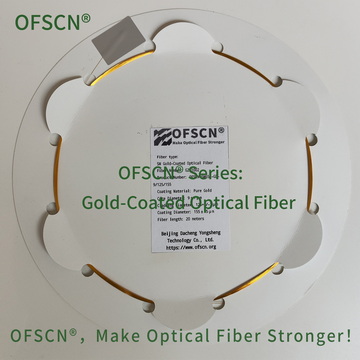
OFSCN® Gold-coated Optical Fiber
This product uses pure gold as the hermetic coating layer, specifically designed for extremely harsh physical environments:
- Temperature Range: Capable of long-term stable operation across a very wide temperature range (Single-mode gold-coated fiber: -270^\circ\text{C} to 700^\circ\text{C}).
- Ultimate Sealing Performance: The gold atomic layer completely blocks the penetration of water and hydrogen molecules, maintaining perfect zero Hydrogen Aging and zero static fatigue characteristics even under extreme high temperatures and pressures.
- Physical Parameters: Manufactured based on standard G.652D or G.657 A2 optical rods, with a core diameter of 9\ \mu\text{m} / cladding diameter of 125\ \mu\text{m} / coating outer diameter of 155\ \mu\text{m}.
Here are some actual product images:

In summary, the “carbon coat” is a brilliant invention in fiber optic protection, successfully balancing moisture and hydrogen resistance. For higher temperatures or more demanding environments where carbon coatings fall short, gold-plated or other metal-coated optical fibers represent the ultimate solution in optical engineering today.