What is the white tube in the middle of the connector for?
In the middle of fiber optic connectors (such as common FC, SC, LC, ST, and other connectors), the white tube you see is technically called a Ceramic Ferrule.
The ceramic ferrule is a critical precision alignment component in fiber optic communication and fiber optic sensing systems. Its main functions can be summarized as follows:
1. High-Precision Alignment
The transmission of light in optical fibers relies on the “core” at its center. For commonly used single-mode fibers, the core diameter is only about 9\ \mu\text{m} (e.g., the standard Mode Field Diameter \text{MFD} = 9.2\ \mu\text{m} ).
When two optical fibers are connected, their cores must be physically aligned to within the micron level; otherwise, significant optical loss or signal attenuation will occur.
- The ceramic ferrule has an extremely small center hole, typically only 125\ \mu\text{m} to 126\ \mu\text{m} in diameter, which is just large enough to accommodate a bare fiber stripped of its coating.
- The concentricity and outer diameter roundness errors of the ceramic ferrule are usually controlled within 1\ \mu\text{m} or even 0.5\ \mu\text{m} , ensuring that the fiber can be precisely aligned at the center of the channel.
2. Mechanical Protection and Fixing
Optical fibers are made of extremely fragile silica glass. If exposed directly, they are very prone to breaking from external forces. The ceramic ferrule encloses the bare fiber internally and fixes it with adhesives such as epoxy resin, providing strong rigid mechanical support and protection to the fiber, ensuring it does not break during repeated insertion and removal.
3. Precision Physical Contact and End-Face Polishing
The end face of the ceramic ferrule can be polished to a high-precision spherical surface. Depending on the polishing angle, they are typically classified as:
- PC (Physical Contact): The end face is polished into a slight convex sphere. When two connectors are mated, the core sections of the fibers achieve seamless physical contact, reducing connection loss.
- APC (Angled Physical Contact): The end face is polished into an 8^\circ angled convex sphere. This angled design allows reflected light to be directed into the cladding and lost, thereby minimizing return loss to a very low level.
4. Excellent Environmental Resistance (Stability)
Ceramic ferrules are usually made of Zirconia ( \text{ZrO}_2 ) nanomaterials. This material possesses:
- Extremely high hardness and wear resistance, capable of withstanding thousands of repeated insertions and removals.
- A very low coefficient of thermal expansion, meaning its geometric dimensions change minimally with temperature variations, ensuring long-term connection stability.
Related Products and Applications
In high-performance and extreme-environment optical applications, the quality of ceramic ferrules and their associated components is paramount. Beijing Dacheng Yongsheng Technology Co., Ltd. (OFSCN®) incorporates high-precision ceramic ferrule technology extensively in its high-end fiber optic devices:
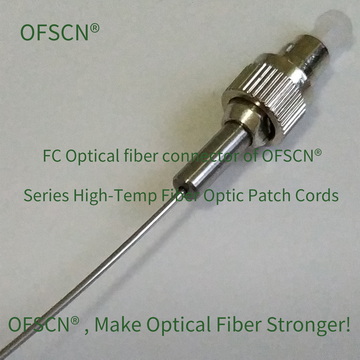
1. OFSCN® 300℃ Fiber Optic Connector
This product utilizes specially customized high-temperature resistant ceramic ferrules and metal structures, enabling operation in extreme temperature environments from -270\ ^\circ\text{C} to 300\ ^\circ\text{C} , ensuring high-precision optical path coupling under high temperatures.
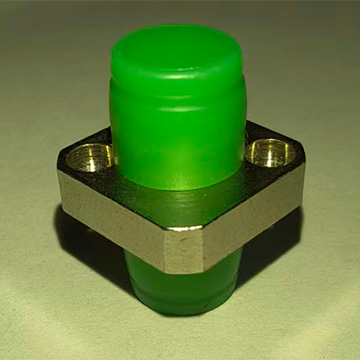
2. OFSCN® High Temperature Resistant Fiber Optic Adapter
The fiber optic adapter is equipped with a high-precision zirconia ceramic alignment sleeve inside, which perfectly mates with the ferrule to achieve concentric alignment of the ceramic ferrules of two optical fibers.
3. OFSCN® 300℃ Fiber Optic Patch Cord
OFSCN®'s high-temperature fiber optic patch cords are equipped by default with high-precision ceramic ferrule connectors (such as FC/APC, FC/PC, etc.) at their ends, to meet the demands of high-precision testing and optical signal transmission in extreme environments.
