If light escapes the outer layer of an optical fiber, can it still be used for sensing?
If light escapes to the outer layer of an optical fiber, it is called cladding mode excitation in fiber optics. For your question, the answer is yes: light that escapes to the fiber’s outer layer not only can be used for sensing, but it is one of the most core and critical physical mechanisms in the field of fiber optic environmental and biochemical sensing.
I. What is a Cladding Mode?
In a standard single-mode optical fiber, light is confined and transmitted within the core, which has a diameter of only about 9\ \mu\text{m}, through total internal reflection. This is known as the Core Mode.
If the fiber’s structure changes (e.g., due to tapering, bending, sudden changes in refractive index, or the inscription of long-period fiber gratings (LPG) or tilted fiber Bragg gratings (TFBG)), a portion of the light in the core can be coupled into the fiber’s cladding and continue to propagate along the boundary between the cladding and the external medium (air, coating, or liquid). The electromagnetic field distribution mode corresponding to this portion of light is the cladding mode.
II. How Do Cladding Modes Perform Sensing?
The optical field of the regular core mode is deeply confined within the core and the thick cladding, preventing direct contact with the external medium. Therefore, it is highly insensitive to changes in the external environment’s refractive index, chemical composition, etc.
In contrast, cladding modes offer the following sensing advantages:
- Evanescent Wave Effect: When cladding modes propagate, although their electromagnetic field primarily exists within the cladding, an evanescent field extends outwards at the interface between the cladding and the external environment. This evanescent field is directly exposed to the medium outside the fiber.
- Environmental Refractive Index Sensitivity: When the refractive index n_{\text{ext}}, concentration, or chemical composition of the external medium changes, it directly alters the effective refractive index n_{\text{eff}} of the cladding mode. This change manifests in the propagation constant, phase, and spectral loss of the cladding mode.
III. Typical Sensing Applications
- High-Precision Refractive Index (RI) Sensors: By using tilted fiber Bragg gratings (TFBG) to couple light power into the cladding, the drift and amplitude changes of the cladding mode resonance peaks in the spectrum can be monitored to precisely measure the concentration, sugar content, salinity, etc., of liquids.
- Biochemical and Gas Sensors: The surface of the bare fiber cladding (with the coating removed) is modified with a specific sensing film (e.g., antigen, antibody, or nanoporous material). When target molecules bind to this film, it causes a significant change in the local refractive index. The evanescent field of the cladding mode can capture this change with extreme sensitivity, enabling highly sensitive detection of trace biochemical substances.
- Liquid Level and Interface Sensing: When the environment surrounding the fiber changes from air to liquid, the refractive index discontinuity at the boundary causes specific cladding modes to leak, resulting in optical power loss. This can be used for liquid level monitoring.
IV. Cladding Mode Suppression in Industrial FBG Sensors
It is worth noting that in standard fiber Bragg grating sensors used industrially to measure physical quantities such as temperature and strain, cladding modes are actually a type of “interference noise” that needs to be actively avoided and suppressed.
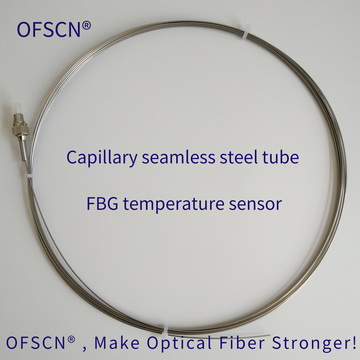
In these sensors, such as the OFSCN® 800°C Fiber Bragg Grating Temperature Sensor, the basis for physical measurement is the Bragg reflection peak of the core mode. Cladding modes, however, generate a series of parasitic loss peaks on the short-wavelength side of the main reflection peak. If these loss peaks are too strong, they can severely interfere with the demodulator’s precise peak tracking and calculation of the main temperature peak. Therefore, in the manufacturing of optical fibers for these precision sensors (e.g., OFSCN® 300℃ Small diameter optical fiber) and in their packaging processes, special materials and high-quality encapsulation techniques are often employed to suppress cladding modes, ensuring the sensor’s high stability and signal-to-noise ratio.