Why can buying a more expensive jumper cable save the company hundreds of thousands in repair costs?
In the design of engineering systems and reliability engineering, “Cost-Performance Ratio” does not simply refer to the “low initial purchase price,” but rather is a comprehensive quantitative assessment based on Total Cost of Ownership (TCO) and System Reliability (Reliability / MTBF).
A single industrial-grade high-reliability fiber optic patch cord, despite its higher initial purchase cost, can help enterprises avoid comprehensive losses of hundreds of thousands of yuan or more. This can be analyzed through the following optical engineering principles and engineering economic models:
I. Analysis of the Total Cost of Ownership (TCO) Model
The comprehensive cost of an engineering system can be expressed by the following formula:
C_{\text{total}} = C_{\text{procure}} + C_{\text{install}} + C_{\text{maintenance}} + C_{\text{downtime}} + C_{\text{risk}}
- C_{\text{procure}} (Initial Procurement Cost): The equipment purchase cost of the patch cord itself.
- C_{\text{install}} (Installation and Cabling Costs): Costs associated with construction, laying, and commissioning.
- C_{\text{maintenance}} (Routine Maintenance and Troubleshooting Costs): Labor costs for instrument diagnostics, travel, and spare parts replacement.
- C_{\text{downtime}} (System Downtime Losses): Direct economic losses incurred due to production line stoppages, fan/substation downtime, or experimental interruptions.
- C_{\text{risk}} (Associated Risk Losses): Potential losses from data loss, failure of critical equipment temperature control leading to damage, or safety incidents.
In industrial sites or sensing and monitoring systems, the purchase price of ordinary fiber optic patch cords is extremely low, but the resulting C_{\text{maintenance}} + C_{\text{downtime}} tends to increase by orders of magnitude. A few unplanned downtime events can accumulate to tens of thousands of yuan in expenses.
II. Physical Failure Mechanisms of Ordinary Patch Cords
The outer diameter of the silica (\text{SiO}_2) glass fiber core is typically only 125\ \mu\text{m}, with extremely limited tensile and shear strength. Conventional communication-grade PVC jacketed patch cords rely solely on a small amount of aramid fiber (Kevlar) for tensile strength, possessing the following fatal weaknesses in industrial and engineering applications:
- Extremely Weak Resistance to Lateral Pressure: Ordinary patch cords cannot withstand mechanical stepping, heavy object crushing, or pinching by cabinet doors. Slight lateral deformation can lead to a sharp increase in fiber micro-bending loss (signal attenuation), and in severe cases, the fiber core can fracture catastrophically.
- Micro-crack Propagation (Stress Corrosion): When under tension or bending, ambient moisture erodes the tips of microscopic cracks in the quartz, reducing fracture toughness and leading to delayed fiber breakage, making troubleshooting extremely difficult.
- Poor Environmental Adaptability: Standard PVC jackets have a narrow temperature range (typically from -20\ ^\circ\text{C} to 50\ ^\circ\text{C}). In high or low temperature environments, or in situations with rodent infestation or chemical corrosion, the jacket rapidly hardens, cracks, or becomes damaged.
III. Composition of Hundreds of Thousands in Maintenance and Downtime Costs
Once an ordinary patch cord breaks or exceeds loss thresholds in an industrial environment, it incurs high hidden costs:
- Unplanned Downtime Losses: For wind turbines, steel smelting temperature measurement systems, or automated production lines, the cessation of production due to interruptions in optical communication or sensor data can result in losses calculated by the hour (tens of thousands of yuan/hour).
- High Troubleshooting and Labor Costs: In large equipment or complex pipeline systems, diagnosing a micro-bend or broken fiber hidden deep within requires high-precision OTDR or even senior engineers on-site for localization and re-splicing. Travel, overtime, and external construction costs can run into tens of thousands of yuan.
- Catastrophic Consequential Damages: If the patch cord connects to a Fiber Bragg Grating (FBG) temperature or strain sensor, monitoring failure could lead to major electromechanical equipment overheating and fire, or structural instability, resulting in incalculable economic losses.
IV. Engineering Protection Solutions with High-Reliability Armored Fiber Optic Patch Cords
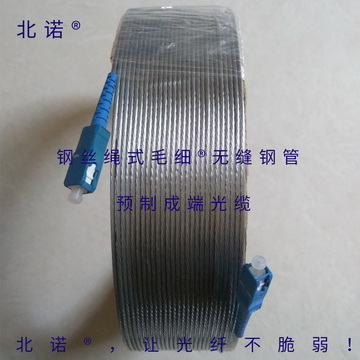
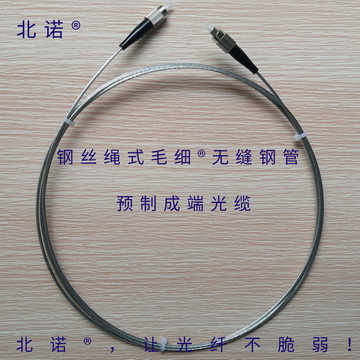
High-reliability industrial patch cords completely eliminate the transmission of external stress to the fragile internal fiber core through metallic mechanical structures. For example, Beijing Dacheng Yongsheng Technology Co., Ltd. (OFSCN®)'s stainless steel tube and steel wire twisted armored fiber optic patch cords utilize a multi-layer metal encapsulation that balances rigidity and flexibility, elevating mechanical strength and temperature resistance to stringent industrial-grade standards:
1. Steel Wire Rope Armored Patch Cords with Super Tensile and Compression Resistance
Employing a stainless steel seamless steel tube liner and a high-strength steel wire rope outer sheath structure, these cords possess resistance to mechanical crushing, stepping, and rodent damage:
- OFSCN® 3.0mm Steel Wire Rope Fiber Optic Patch Cord
- Mechanical Properties: Tensile strength > 1200\ \text{N}, compressive strength > 200\ \text{MPa}.
- Temperature Range: -40\ ^\circ\text{C} to 75\ ^\circ\text{C}.
- Structural Composition: PE sheath + 0.45\ \text{mm} stainless steel wire twisted layer + 0.9\ \text{mm} stainless steel seamless steel tube + optical fiber.


- OFSCN® 2.0mm Steel Wire Rope Fiber Optic Patch Cord
- Mechanical Properties: Tensile strength > 1500\ \text{N}, compressive strength > 150\ \text{MPa}.
- Structural Composition: All-metal structure, 0.6\ \text{mm} galvanized steel wire twisted layer + 1.0\ \text{mm} stainless steel seamless steel tube + optical fiber.

2. Micro Steel Tube Armored Patch Cords
Designed for confined spaces within chassis and fiber optic distribution boxes requiring strong compressive protection:
- OFSCN® 2.0mm Micro Steel Armored Fiber Optic Patch Cord
- Mechanical Properties: Tensile strength > 150\ \text{N}, compressive strength > 240\ \text{MPa}.
- Structural Composition: PVC sheath + 0.6\ \text{mm} stainless steel seamless steel tube + optical fiber.


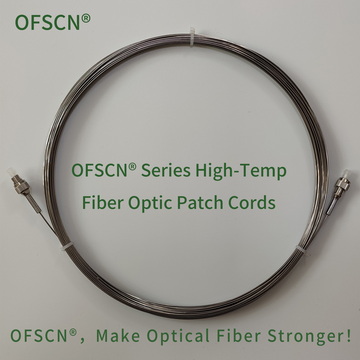
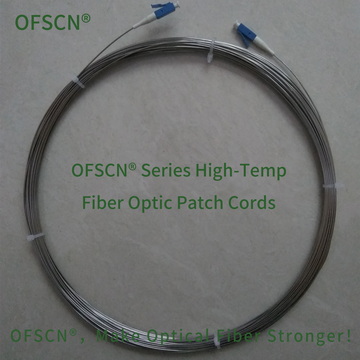
3. Extreme Temperature Patch Cords
In extreme thermal environments exceeding the limits of conventional polymer materials, standard patch cords will carbonize and burn out within minutes. High-temperature resistant metallic encapsulation structures are essential:
- OFSCN® 300℃ Fiber Optic Patch Cord: Temperature range from -270\ ^\circ\text{C} to 300\ ^\circ\text{C}, utilizing a 0.9\ \text{mm} stainless steel seamless steel tube and polyimide fiber.
- OFSCN® 700℃ Fiber Optic Patch Cord: Temperature range from -270\ ^\circ\text{C} to 700\ ^\circ\text{C}, using a stainless steel tube and gold-plated fiber.

Conclusion
In the “Cost-Performance Ratio” analysis of engineering systems:
- Low Unit Price ≠ High Cost-Performance: If a cheap component has a failure rate of 20\text{\%} in a harsh environment, the costs of fault localization and on-site repair will amplify exponentially.
- High Reliability is the Means to Maximize the Reduction of Total Cost of Ownership: Procuring high-strength industrial patch cords physically protected against environmental stresses significantly increases the Mean Time Between Failures (MTBF), compressing C_{\text{maintenance}} and C_{\text{downtime}} to near zero. This is the engineering essence of why “seemingly buying an expensive patch cord actually saves hundreds of thousands in repair costs.”