Why are some patch cords constructed with two fibers joined side-by-side? Is it mandatory to use them in pairs?
A “Duplex” patch cord consists of two optical fibers joined together by a thin strip of jacket material (often referred to as a “zipcord” structure). This design is primarily used for bidirectional communication or applications requiring two separate optical paths.
1. Why are they constructed side-by-side?
In most networking and communication systems, data is transmitted over one fiber and received over the other. By joining two fibers together, the Duplex construction ensures that:
- Organization: It prevents tangling and simplifies cable management in high-density environments like data centers.
- Polarity Management: It helps maintain the correct “Transmit (Tx) to Receive (Rx)” connection between devices, as the fibers are kept in a fixed parallel orientation.
2. Is it mandatory to use them in pairs?
No, it is not physically mandatory, but it depends on your system architecture:
- Standard Networking: For most Ethernet transceivers (like SFP modules), a duplex pair is required because these devices use separate ports for sending and receiving light.
- FBG Sensing Applications: In Fiber Bragg Grating (FBG) sensing systems—which the OFSCN® products specialize in—single-mode (Simplex) fibers are more common because the reflected signal (data) travels back through the same fiber that sent the laser pulse. However, duplex cords can be used if you are running two independent sensor strings or if your interrogator requires a dedicated return path.
3. DCYS (OFSCN) Related Solutions
While standard duplex cords are common in offices, industrial and sensing environments often require higher durability. We provide armored versions that offer much better protection than standard PVC duplex cables.
For instance, if you require high tensile strength or protection against mechanical crush, you might consider the following:
- OFSCN® 2.0mm Micro Steel Armored Fiber Optic Patch Cord: Features a 0.6mm stainless steel seamless tube for extreme protection.
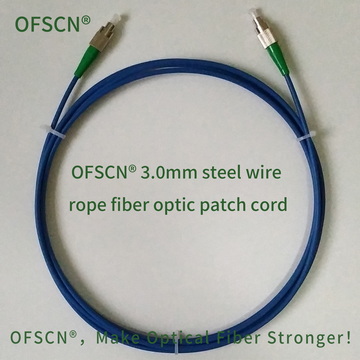
- OFSCN® 3.0mm Steel Wire Rope Fiber Optic Patch Cord: Designed for high-tension environments with an anti-pull strength >1200N.
Standard Product Visuals:

If you are designing a sensing system and are unsure whether to use Simplex or Duplex configurations, it is best to check the port requirements of your specific Fiber Bragg Grating Interrogator.