Why is it said that discarding the dust cap is equivalent to discarding the lifespan of the jumper?
In fiber optic communication and fiber optic sensing engineering, the saying “throwing away the dust cap is like throwing away the life of the patch cord” is not an exaggeration, but an objective physical fact determined by optical physical properties, precision mechanical contact, and material mechanics.
To gain a deeper understanding of this phenomenon, we need to analyze it from the following core technical dimensions:
1. Scale Comparison: Micron-sized Fiber Core vs. Dust Contamination
The core area (fiber core) of fiber optic patch cords that transmits optical signals is extremely small:
- For standard single-mode optical fibers (e.g., G.652D), the physical diameter of the fiber core is only about 9\ \mu\text{m} (Mode Field Diameter \text{MFD} \approx 9.2\ \mu\text{m}).
- For multi-mode optical fibers, the fiber core diameter is only 50\ \mu\text{m} or 62.5\ \mu\text{m}.
However, the diameter of dust particles, skin debris, or clothing fibers suspended in our daily air typically ranges from 1\ \mu\text{m} to 100\ \mu\text{m}. If the dust cap is removed, the exposed fiber end face will adsorb airborne particles in a very short time. A dust particle with a diameter of only a few micrometers, once it lands in the center of a single-mode fiber core, will directly block or scatter the optical signal, leading to a significant increase in Insertion Loss (IL) and deterioration of Return Loss (RL).
2. Mechanical Wear and Permanent Physical Damage
The connection of fiber optic connectors (such as FC/PC, FC/APC, etc.) is achieved through Physical Contact (PC) of the ferrule end face.
- Extremely High Contact Pressure: When two fiber connectors are mated and locked within a mating sleeve, the ceramic ferrule end face contact area experiences extremely high local mechanical pressure due to the internal spring, typically reaching tens of \text{MPa} or even \text{GPa} levels.
- Permanent Scratches: If the end face has hard dust particles (e.g., silica particles or metal debris in the air), under the immense pressure during mating, these particles act as “abrasives.” They will be forced into and abrade the high-purity silica glass fiber core and the ceramic ferrule, causing permanent scratches, pits, or chipping.
- Irreversible Consequences: Such physical damage cannot be removed by subsequent cleaning and can only be resolved by re-polishing or completely replacing the patch cord. Therefore, a single blind mating without a dust cap can directly end the physical lifespan of a patch cord within seconds.
3. High-Power Optical Damage (Thermal Effects and Fiber Fuse)
In many high-power application scenarios (such as high-power fiber optic sensing networks, optical amplifier systems, or fiber lasers), the optical power density transmitted within the fiber core is extremely high.
- Highly Concentrated Thermal Energy: Dust, grease (even fingerprint oils), or other contaminants on the fiber end face absorb photon energy and convert it into thermal energy.
- Fiber Fuse Effect: Within microseconds, the local temperature can rapidly soar to above 1000\ ^\circ\text{C}, directly causing the glass end face to melt, thermally fracture, or burn, and even trigger the fiber fuse effect that propagates into the optical fiber. This catastrophic optical damage will render the entire optical path unusable.
The Role of the Dust Cap and Protection by OFSCN® Industrial-Grade Products
The dust cap is not just a simple “packaging material” but an extremely important physical barrier for fiber optic connectors, maintaining a microclimate environment for the ferrule end face, protecting it from physical impact and atmospheric contamination.
As core components for high-quality industrial and special fiber optic transmission, OFSCN®'s various high-tensile strength and high-temperature resistant patch cords designed for harsh environments also rely strictly on the physical protection of the end face for their optical performance. For example:
- OFSCN® Standard Fiber Patch Cord — For routine precision measurement and communication applications.
- OFSCN® 2.0mm Micro Steel Armored Fiber Optic Patch Cord — Uses micro stainless steel seamless steel pipe armor, providing extremely strong tensile and compressive resistance.
- OFSCN® 120℃ Fiber Optic Patch Cord / OFSCN® 200℃ Fiber Optic Patch Cord — Designed for harsh high-temperature industrial environments.
The high-precision fiber optic connectors used in these patch cords (such as OFSCN® 120℃ Fiber Optic Connector) must be strictly fitted with dust caps during factory inspection, transportation, storage, and deployment.
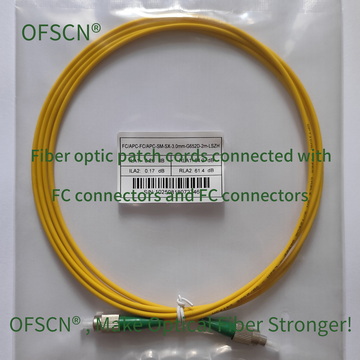
Figure 1: OFSCN® Standard Fiber Patch Cord (equipped with reliable dust sleeves/caps from the factory)
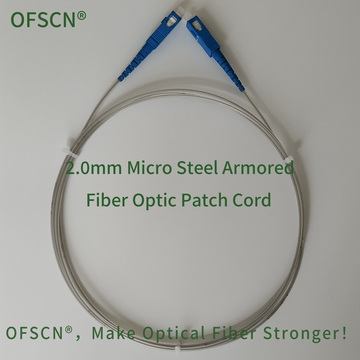
Figure 2: OFSCN® 2.0mm Micro Steel Armored Fiber Optic Patch Cord (ensuring dual robust protection for both physical and optical end faces)
Conclusion: Best Practices for Fiber End Face Maintenance
To maximize the lifespan of fiber optic patch cords and ensure measurement precision, engineers should strictly adhere to the following principles:
- Replace Immediately: After unplugging a connector, the dust cap must be replaced within 3\ \text{seconds}, and the inside of the dust cap must never be exposed to an unclean environment.
- Inspect Before Connecting: Before inserting any connector into an adapter (mating sleeve), follow the process of “inspect first, clean second, connect third” to ensure the end face is dust-free.
- Proper Cleaning: If the end face is contaminated, do not blow on it directly or wipe it with ordinary paper towels. Instead, use professional lint-free wipes, fiber optic cleaning pens, or high-purity isopropyl alcohol (IPA) for cleaning.
Though small, the dust cap is the “throat protector” that maintains the life of high-precision physical contact optical systems.