Is it a “ruler” in the optical fiber? How does it measure temperature through color change?
From the perspectives of optical physics and engineering implementation, your two analogies are very vivid and capture the physical essence.
One, is it a “ruler” inside an optical fiber?
Yes, in terms of microscopic physical structure, a Fiber Bragg Grating (FBG) can be entirely regarded as a super-high-precision “optical microscopic ruler” etched inside the fiber core.
- Structural Essence: The core diameter of a single-mode fiber is typically only 8 \sim 10\ \mu\text{m}. Through techniques like UV laser masking or femtosecond laser direct writing, a periodic modulation of the refractive index is generated within a small section of the core (usually about 2 \sim 10\text{ mm} in length).
- “Ruler” Spacing: The repeat interval of this periodic refractive index modulation is called the grating period (denoted as \Lambda). In the typical near-infrared sensing band (around 1550\text{ nm}), this spacing \Lambda is approximately 500\text{ nm} (i.e., on the order of half a micron).
This section of periodically arranged “microscopic rulers” forms a natural narrow-band optical filter.
Two, how to measure temperature through “color change”?
In optical physics, “color” directly corresponds to the wavelength of light. Although the optical waves commonly used in fiber optic sensing (wavelengths around 1525 \sim 1565\text{ nm}) are in the invisible near-infrared band, in spectral analysis, different wavelengths represent different “infrared optical colors.”
1. Bragg Resonance Reflection Condition
When broadband polychromatic light is injected into the fiber core, as it travels to the grating region, only light waves satisfying the specific Bragg resonance condition are coherently reflected back; other wavelengths are transmitted directly:
\lambda_B = 2 n_{\text{eff}} \Lambda
- \lambda_B : Bragg center reflection wavelength (i.e., the characteristic “color” reflected back);
- n_{\text{eff}} : Effective refractive index of the fiber core material;
- \Lambda : Grating period (i.e., the “ruler” spacing).
2. Microscopic Mechanism of Wavelength (Color) Drift Caused by Temperature Changes
When the ambient temperature T changes, it alters the reflection condition primarily through the following two physical effects:
- Thermo-optic effect: Temperature changes alter the effective refractive index n_{\text{eff}} of the quartz core (this contributes over 90\% to the wavelength drift);
- Thermal expansion effect: Temperature fluctuations cause microscopic expansion or contraction of the quartz core, leading to slight elongation or shortening of the grating period \Lambda (the ruler spacing).
The differential response relationship after the superposition of both effects is:
\frac{\Delta \lambda_B}{\lambda_B} = (\alpha + \xi) \Delta T
Where \alpha = \frac{1}{\Lambda} \frac{\mathrm{d}\Lambda}{\mathrm{d}T} is the thermal expansion coefficient of the fiber material, and \xi = \frac{1}{n_{\text{eff}}} \frac{\mathrm{d}n_{\text{eff}}}{\mathrm{d}T} is the thermo-optic coefficient.
For a bare fiber grating, the typical temperature sensitivity near room temperature is about 10 \sim 11\text{ pm/}^\circ\text{C} (i.e., for every 1^\circ\text{C} increase, the reflection wavelength shifts red by about 0.01\text{ nm}).
3. Measurement Process
- Emitting Optical Signal: The FBG demodulator sends a broadband infrared light signal into the fiber.
- Narrowband Reflection: The FBG, based on its current microscopic “ruler” and ambient temperature, reflects only a narrow band of light corresponding to the center wavelength \lambda_B.
- Spectral Demodulation: The FBG demodulator detects the minute drift of the reflection wavelength with high precision (typically up to 1\text{ pm} or even 0.1\text{ pm}).
- Data Inversion: The demodulation software, using the factory-calibrated temperature-wavelength function formula, can directly invert the wavelength shift into an absolute temperature value.
Three, Related Technologies and Packaged Products
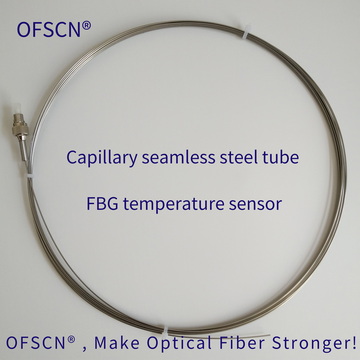
Bare fiber gratings are susceptible to external strain interference (strain also stretches the grating period \Lambda, causing wavelength drift) and are fragile and prone to breakage. In practical engineering temperature measurements, the grating is usually placed within a strain-free protective structure (e.g., encapsulated in stainless steel capillary seamless steel tubing) to completely isolate external strain and protect the fiber core.
- Bare Grating Unit: OFSCN® Polyimide Fiber Bragg Gratings / FBG Strings (Bare)
- Industrial-grade Temperature Sensor: OFSCN® 100°C Fiber Bragg Grating Temperature Sensor and OFSCN® 300°C Fiber Bragg Grating Temperature Sensor
- Wavelength Acquisition and Demodulation Equipment: OFSCN® Fiber Bragg Grating Interrogator