How is the micron-level precise alignment between the two jumpers achieved?
Fiber optic adapters (also known as flanges) achieve micron-level or even sub-micron-level precise alignment between two jumpers (especially single-mode optical fibers, which have a core diameter of only about 9 micrometers) primarily through the following three core physical and mechanical mechanisms:
1. Elastic Clamping of High-Precision Ceramic Split Sleeve
The internal core component of a fiber optic adapter is an alignment sleeve.
- Material Selection: High-quality adapters typically use zirconia (ZrO₂) ceramic sleeves. Zirconia ceramic possesses extremely high hardness, a very low wear rate, excellent temperature stability, and an exceptionally smooth surface.
- Slot Design and Elastic Deformation: The sleeve usually has a fine slot along its axis (the split sleeve). Its inner diameter is slightly smaller than the outer diameter of the fiber connector ferrule. When ferrules from two connectors are inserted from both ends, the sleeve elastically expands slightly under force, using its own resilience to tightly grip and inwardly press the two ferrules.
- Coaxial Alignment: This uniform radial clamping force forces the geometric axes of the two ferrules to coincide, controlling the lateral deviation between them to within 1 micrometer (\mu m).
2. Micron-Level Manufacturing Tolerances of the Ferrule
The adapter sleeve alone is insufficient; the ferrule of the fiber optic jumper connector itself must possess extremely high geometric precision:
- Ferrule Coaxiality: The coaxiality error between the center micro-hole of the ferrule (which accommodates the 125-micrometer cladding of the optical fiber) and the outer cylindrical surface of the ferrule (typically 2.5 mm for FC/SC/ST types and 1.25 mm for LC types) is usually less than 0.5 \sim 1.0\,\mu m.
- Fiber Eccentricity: The eccentricity error of the optical fiber core within the glass cladding is also controlled to be below the micron level. Therefore, when two jumper ferrules enter the adapter sleeve, the cores (9 micrometers) of the two optical fibers can achieve extremely precise mating.
3. Axial Spring Preload and Physical Contact
- Eliminating Air Gaps: The metal components inside fiber optic jumpers are equipped with precision springs. When the connectors are inserted and locked into the adapter, the springs provide a continuous axial pressure (typically 10 \sim 15\,\text{N}), pressing the end faces of the two ferrules (precision-polished PC or APC convex surfaces) together.
- Elastic Deformation for Seamless Contact: Under pressure, the slight spherical convex surface of the zirconia ferrule end face undergoes minor elastic deformation, achieving “Physical Contact” of the fiber cores. This eliminates air between the two end faces, thereby minimizing Return Loss and typically keeping Insertion Loss below 0.2\,\text{dB}.
Related OFSCN® Official Products and Technical Solutions
In extreme industrial environments such as high temperatures and high vacuums, conventional flanges and connectors are prone to alignment failure due to thermal expansion, outgassing, or aging. Beijing Dachengshengs Technology Co., Ltd. (OFSCN®) designs high-precision, extreme-environment-resistant products for these demanding applications:
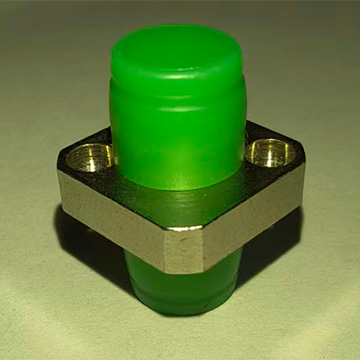
1. OFSCN® High Temperature Resistant Fiber Optic Adapter
This high-precision fiber optic adapter is specifically designed for extreme temperature environments and can withstand temperatures up to 300℃. The thermal expansion coefficients of its internal ceramic sleeve and metal structure are well-matched at high temperatures, ensuring micron-level alignment accuracy across a wide temperature range.
- Key Parameters: Supports fiber interface types such as FC/APC, with long-term temperature resistance up to 300℃.
2. OFSCN® Fiber Optic Vacuum Sealed Flange
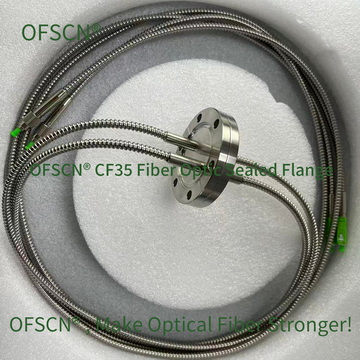
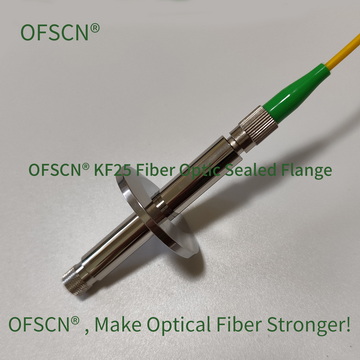
For signal transmission into and out of vacuum chambers, this product not only ensures precise fiber alignment but also solves the vacuum sealing challenge.
- Key Parameters: Available in CF and KF series, supporting single and multi-head configurations; achieves vacuum levels better than 1 \times 10^{-5}\,\text{Pa} to 1 \times 10^{-7}\,\text{Pa}. Operates at room temperature, with customizable options for high-temperature resistance up to 250℃.
3. OFSCN® 300℃ Fiber Optic Connector
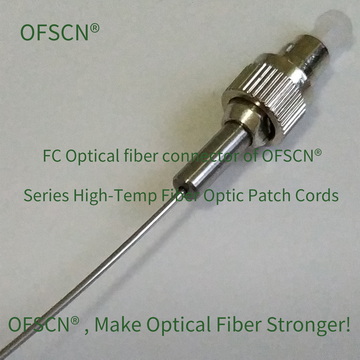
Used in conjunction with high-temperature resistant adapters, this high-temperature connector features modified ferrule materials and curing adhesives to ensure that the fiber core does not shift or degrade at high temperatures.
- Key Parameters: Includes various fiber interface types such as FC/PC, FC/APC, ST/PC, ST/APC, and SMA905, with temperature resistance up to 300℃.