How do the two connectors achieve “face-to-face” precise docking through a small tube?
Two fiber optic connectors achieve precise “face-to-face” mating within a ferrule (or “adapter”), primarily relying on the ultra-high precision mechanical coupling between the ceramic ferrule at the connector’s end and the alignment sleeve inside the ferrule.
Taking single-mode fiber as an example, its core (the silica glass medium that actually transmits the light signal) has a diameter of only about 9\ \mu\text{m}. To ensure efficient light signal transmission between the two connectors without significant insertion loss, the alignment deviation between the two cores must be controlled at the sub-micrometer level (typically less than 1\ \mu\text{m}).
Here are the three core physical and engineering mechanisms that enable this “small tube” to achieve precise mating:
1. Elastic Tightening of the Zirconia Split Sleeve
The core alignment component inside the ferrule (the “small tube” you mentioned) is typically made of high-hardness, high-wear-resistance Zirconia (\text{ZrO}_2) ceramic and is known as a split sleeve.
- This sleeve is not completely closed but has a fine slit along its axis, giving it slight radial elasticity.
- When ceramic ferrules with an outer diameter of 2.5\ \text{mm} (like FC, SC, ST connectors) or 1.25\ \text{mm} (like LC connectors) are inserted, the sleeve expands slightly and exerts a continuous and uniform radial inward tightening force.
- This elastic constraint automatically compensates for minor dimensional tolerances, perfectly locking the outer circles of the ferrules onto the same central geometric axis, thus achieving self-alignment.
2. Ultra-Precise Geometric Concentricity Control
Aligning the outer circles of the ferrules by the sleeve alone is insufficient; it’s also crucial to ensure the fiber core is at the absolute geometric center of the ferrule.
- During connector manufacturing, the fiber is fixed within the central micro-hole of the ceramic ferrule.
- The concentricity of the ceramic ferrule (i.e., the deviation between the center of the micro-hole and the center of the ferrule’s outer circle) is strictly controlled to extremely high precision before leaving the factory (typically a concentricity deviation of less than 1.4\ \mu\text{m}, and even less than 0.5\ \mu\text{m} for high-precision single-mode connectors).
- Therefore, as long as the sleeve aligns the outer circles of the two ceramic ferrules, it indirectly achieves precise mating of the two fiber cores.
3. Longitudinal Spring Preload and Physical Contact
To eliminate the air gap between the mating end faces (an air gap can cause about 4\% Fresnel reflection, leading to significant back reflection loss), the connector is designed with an internal longitudinal spring.
- When the connector is inserted into the ferrule and secured (e.g., by threaded fastening for FC or snap-locking for SC/LC), the spring inside the connector is compressed, generating a continuous forward pressure.
- This pressure tightly presses the end faces of the two ferrules (typically polished into a micro-spherical shape) together, creating actual Physical Contact (PC) between the glass end faces.
- In the case of APC (Angled Physical Contact) connectors, the end faces are physically mated at an 8^\circ angle, causing reflected light to deviate from the fiber core, thereby further suppressing back reflection.
Alignment Challenges in High-Temperature and Extreme Environments
In high-temperature or extreme industrial environments, due to the thermal expansion and contraction of materials, the plastic housing and ordinary ceramic sleeves in conventional ferrules may undergo microscopic deformation, leading to alignment failure or increased loss. To address this, Beijing Dacheng Yongsheng Technology Co., Ltd. (OFSCN®) offers professional-grade high-temperature adapters for high-temperature and harsh sensing environments:
OFSCN® High Temperature Resistant Fiber Optic Adapter
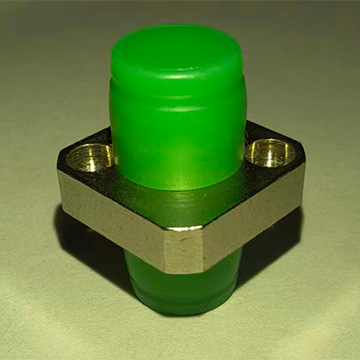
Key Parameter Specifications
- Temperature Resistance:** Supports long-term stable operation in environments up to 300^\circ\text{C}.
- Connector Type:** Provides high-precision fiber optic adapters, including FC/APC-FC/APC, ensuring micron-level alignment precision of the mechanical structure remains stable under extreme temperature cycling.