What are the colored thin wires seen when peeling back the outer sheath of a jumper wire? What protective function do they serve?
Inside the protective jacket (PVC/LSZH) of fiber optic patch cords (such as common 2.0\text{ mm} or 3.0\text{ mm} outer diameter patch cords) and the aramid fiber (yellow Kevlar) used for tensile strength, you will see one or more thin colored strands.
These colored strands are known as Tight-buffered Fiber in optical and telecommunications engineering, while at a deeper microscopic level, that colored outer layer is the fiber’s Primary/Secondary Coating and Coloring Layer.
I. Internal Physical Structure of Colored Strands
If we dissect this colored strand from the outside in, its structure typically consists of the following parts:
- Tight Buffer / Secondary Coating: Usually 900\ \mu\text{m} (micrometers) in outer diameter, made of plastic materials like PVC, LSZH, nylon, or polyester, providing a thicker mechanical buffer.
- Primary Coating: Inside the tight buffer, directly covering the surface of the quartz glass. The primary coating of standard single-mode optical fiber typically has an outer diameter of 245\ \mu\text{m} to 255\ \mu\text{m} and is commonly made of Polyacrylate.
- Coloring Layer: Usually a very thin layer of colored ink (only a few micrometers thick) applied to the surface of the coating layer, for easy identification and splicing in multi-core fiber optic cables.
- Cladding: Made of quartz glass with a standard outer diameter of 125\ \mu\text{m}.
- Core: The core channel for optical signal transmission, made of quartz glass. The core diameter of a single-mode fiber is only about 9\ \mu\text{m}.
II. Protective Functions of Coating and Tight Buffer
Quartz glass is very fragile. The coating layer is the physical foundation for the practical application of optical fibers and performs four crucial protective functions:
1. Preventing Microcrack Propagation (Providing Mechanical Strength)
During the high-temperature drawing process of quartz glass manufacturing, microscopic or even nanoscopic physical defects (microcracks) are inevitably created on its surface. If exposed to the air, moisture and mechanical tension can cause these microcracks to expand rapidly, leading to brittle fracture of the fiber under minimal external force. The coating is applied to the cladding surface immediately after fiber drawing and forming, effectively isolating moisture and air, preventing the formation and propagation of microcracks, and greatly improving the fiber’s tensile and bending strength.
2. Microbend Buffering and Stress Reduction
When optical fibers are laid or subjected to pressure, if the quartz surface directly bears uneven lateral pressure, it can cause slight deformations in the core axis, leading to severe Microbending Loss and signal leakage. The coating layer (typically a dual-layer polyacrylate structure with a soft inner and hard outer layer) acts as a cushioning pad, absorbing external physical impacts and maintaining the stability of the core’s geometry, thus ensuring transmission quality.
3. Physical and Chemical Corrosion Resistance
Optical fibers operate in complex environments. The coating layer resists physical erosion of the quartz glass by environmental acids, alkalis, salt fog, moisture, and various chemical solvents, ensuring the optical fiber has a service life of several decades (typically over 25 years).
4. Channel Identification (Color Coding Management)
In multi-channel fiber optic cables for communications and sensing, according to international standards, the coloring layer uses 12 standard colors (blue, orange, green, brown, gray, white, red, black, yellow, violet, pink, turquoise) to identify the fibers. This greatly facilitates grouping and alignment for field engineers during stripping, splicing, and maintenance.
III. Different Coating Technologies in Professional Industrial and Sensing Fields
In standard communication patch cords, Polyacrylate is typically used as the coating layer due to its lower cost and operating temperature range of -40\ ^\circ\text{C} to +100\ ^\circ\text{C}.
However, in harsh industrial, aerospace, and sensing environments with high temperatures, extremely low temperatures, or high pressures, ordinary polyacrylate coatings will melt or vaporize. In such cases, high-performance specialty coating materials are required:
1. Polyimide Coating
Polyimide is a high-performance polymer with excellent thermal and chemical stability. The polyimide-coated fiber provided by OFSCN®, with an outer diameter of only 155\ \mu\text{m} (thinner than the standard 255\ \mu\text{m}, offering excellent heat and force transfer properties, making it ideal for manufacturing high-precision temperature and strain sensors), can continuously protect the internal quartz fiber in extreme environments from -200\ ^\circ\text{C} to +350\ ^\circ\text{C}.
- OFSCN® G.652D Optical Fiber (Standard polyacrylate coating, outer diameter 255\ \mu\text{m})
- OFSCN® G.657 Optical Fiber (Bend-insensitive polyacrylate coating)
- OFSCN® 300℃ SM Polyimide Optical Fiber (High-temperature resistant polyimide coating, outer diameter 155\ \mu\text{m})
- OFSCN® 300℃ Small diameter optical fiber (Ultra-small diameter polyimide coating, outer diameter only 100\ \mu\text{m})




2. Gold-coated Coating
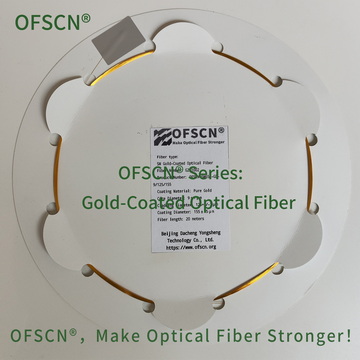
When the ambient temperature exceeds 350\ ^\circ\text{C} or even reaches 700\ ^\circ\text{C}, any polymer coating will carbonize and decompose. OFSCN® uses pure gold as the coating material, which not only acts as a sealing layer to isolate hydrogen and other chemical corrosion but also provides strong mechanical protection for the quartz glass at ultra-high temperatures.
- OFSCN® Gold-coated Optical Fiber (Gold-coated layer, temperature range -270\ ^\circ\text{C} to 700\ ^\circ\text{C})