Why can one fiber optic cable connect hundreds of sensors? Won’t they fight each other?
A single-mode fiber optic cable can accommodate dozens, hundreds, or even thousands of fiber optic sensors in series without interference (i.e., they “don’t fight”). This is primarily achieved through Optical Multiplexing and controlled light reflection energy.
On a physical level, the demodulation system achieves quasi-distributed demodulation by isolating signals in different physical dimensions such as wavelength, time, or optical frequency:
I. Core Separation Mechanisms for Signal “Non-Interference”
1. Wavelength Division Multiplexing (WDM) — “Each on its Own Path”
Fiber Bragg Gratings (FBGs) reflect light at specific wavelengths according to the Bragg reflection condition:
\lambda_B = 2 n_{\text{eff}} \Lambda
where n_{\text{eff}} is the effective refractive index of the fiber core and \Lambda is the grating period.
- Physical Mechanism: The demodulator injects a broadband light source (e.g., a 40 nm range from 1525\ \text{nm} \sim 1565\ \text{nm}) into the fiber. Each grating on the fiber is fabricated with a different grating period \Lambda, possessing distinct initial central reflection wavelengths (e.g., Grating 1 at 1530\ \text{nm}, Grating 2 at 1535\ \text{nm}, etc.).
- Preventing Crosstalk: As long as the wavelength drift caused by external physical factors (temperature or strain) does not exceed the safe channel spacing reserved between adjacent gratings, the reflected wavelengths from each grating remain spectrally separated and do not overlap when observed by an optical spectrometer.
2. Time Division Multiplexing (TDM) — “Queueing Up by Time”
If the number of sensors exceeds the capacity of the spectral bandwidth (e.g., when needing to connect hundreds or thousands of points in series), the constant propagation speed of light in the medium can be utilized:
v = \frac{c}{n} \approx 2 \times 10^8\ \text{m/s}
- Physical Mechanism: The demodulator emits extremely narrow light pulses. Gratings located at different physical positions along the fiber will have their reflected pulses return to the detector with a time difference given by:
\Delta t = \frac{2 \Delta L \cdot n}{c}
(where \Delta L is the physical spacing between gratings).
- Preventing Crosstalk: As long as the pulse width is shorter than the round-trip propagation delay between sensors, the reflected signals will be separated in the time domain. Even if all sensors use the exact same central wavelength, the system can accurately locate each sensor using “Time of Flight (ToF)”.
3. Optical Frequency Domain Reflectometry (OFDR) — “Frequency and Spatial Fourier Transform”
For high-density sensing (hundreds or thousands of points per fiber, with spacing down to centimeters or even millimeters):
- The demodulator employs a linear swept-frequency laser coupled with heterodyne interferometric coherent detection.
- The beat frequency signals generated by gratings at different locations are unique. Through Fast Fourier Transform (FFT), each reflection point is directly mapped to its corresponding spatial physical location in the frequency domain, enabling large-scale demodulation of ultra-high-density sensing points.
II. The Physical Prerequisite for Connecting Hundreds of Points: Ultra-Weak Reflectivity Control
If each sensor had high reflectivity (e.g., the typical 70\% \sim 90\%), the front-end sensors would reflect almost all light energy, and the multiple reflections (Shadowing Effect) caused by light oscillating between gratings would become severe.
To achieve cascading of hundreds or even thousands of points on a single fiber:
- Weak/Ultra-Weak Reflection: The reflectivity of each grating must be fabricated to be very weak (e.g., a reflectivity as low as -30\ \text{dB} \sim -50\ \text{dB}, meaning reflected energy is far below 0.1\% ).
- Extremely Low Insertion Loss: Light must smoothly pass through all preceding gratings and reach the farthest point before returning to the demodulator, ensuring balanced energy throughout the entire link and maintaining signal-to-noise ratio (SNR).
III. Official Related Products and Technical Implementation
In industrial and scientific research projects, Beijing Dacheng Yongsheng Technology Co., Ltd. (OFSCN®) directly inscribes multi-point Fiber Bragg Grating Strings (FBG Strings) onto a continuous, splice-free single-mode fiber using techniques such as UV-induced hydrogen-loaded preform masking or femtosecond laser direct writing, and implements multiplexing with multi-channel FBG demodulators.
-
OFSCN® Polyacrylate Fiber Bragg Gratings / FBG Strings (Bare)
-
OFSCN® Standard Femtosecond Fiber Bragg Gratings / FBG Strings (Bare)
-
OFSCN® Fiber Bragg Grating Interrogator


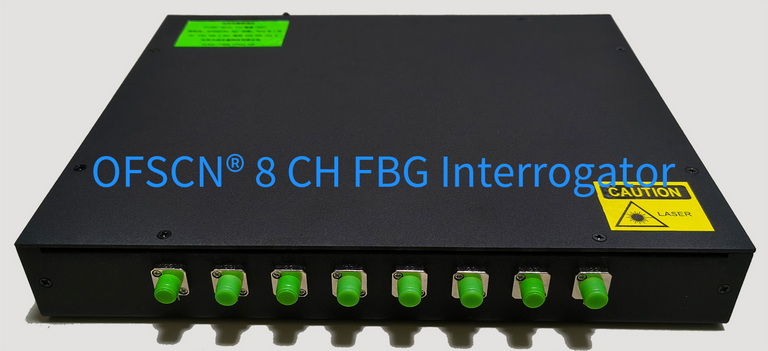
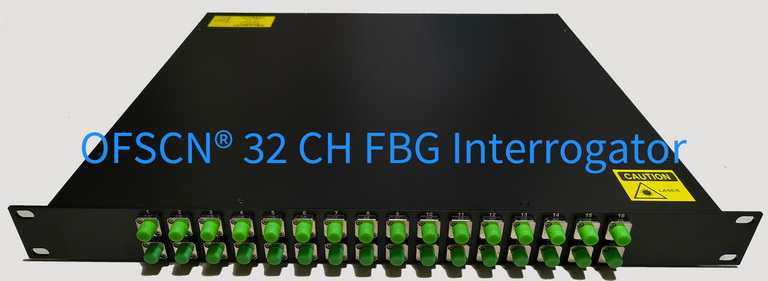
These systems, by combining WDM with multi-channel demodulators (e.g., 8-channel, 16-channel, 32-channel), enable a single demodulation unit to construct a fully passive fiber optic sensing network containing thousands of sensing points.