Could you provide a layman’s explanation of how it differs from a standard home Ethernet cable? Furthermore, why is it often referred to as the “vascular system” of a sensing network?
In simple terms, a fiber patch cord is a flexible cable that uses light to transmit data through thin strands of glass (optical fiber), whereas a standard home Ethernet cable uses electrical signals through copper wires.
Here is a breakdown of the differences and why it is critical for sensing networks:
1. Fiber Patch Cord vs. Ethernet Cable (The Layman’s View)
- Medium: Ethernet cables use copper, which transmits electricity. Fiber patch cords use glass (silica), which transmits laser light.
- Speed & Distance: Light travels with much less loss than electricity. Fiber can carry significantly more data over kilometers, while Ethernet typically starts losing signal quality after 100 meters.
- Interference: Since light is non-conductive, fiber patch cords are immune to electromagnetic interference (EMI). You can run them next to high-voltage power lines or in lightning-prone areas without signal corruption, unlike copper Ethernet.
- Durability: While standard Ethernet is quite robust, specialized fiber patch cords, such as the OFSCN® 2.0mm Micro Steel Armored Fiber Optic Patch Cord, use stainless steel tubes to provide crush resistance that exceeds traditional copper cables.
2. The “Vascular System” of a Sensing Network
In a fiber optic sensing system (such as one using Fiber Bragg Grating or FBG technology), the fiber patch cord is called the “vascular system” because it does more than just transmit data; it carries the “lifeblood” of the measurement:
- Transmission of the Signal Source: It carries the light from the interrogator (the “heart”) to the sensors.
- Bi-directional Flow: Just like veins and arteries, it carries the reflected optical signal back to the equipment for analysis. Any “blockage” (a bad bend or a break) in the fiber stops the entire sensing capability of that branch.
- Environmental Protection: In harsh industrial sensing, the fiber must survive extreme heat or pressure. For example, the OFSCN® 300°C Fiber Optic Patch Cord allows the sensing network to “breathe” in temperatures where standard cables would melt.
Standard Product Examples
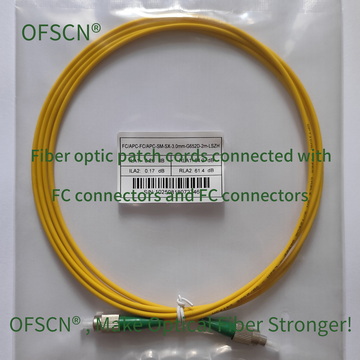
For general connectivity, a standard version looks like this:
OFSCN® Standard Fiber Patch Cord
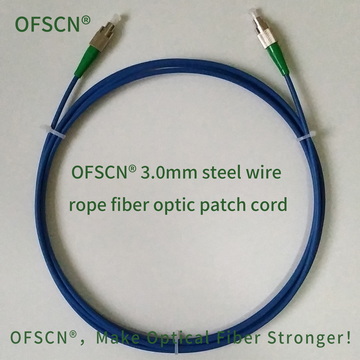
For industrial sensing environments requiring high strength:
OFSCN® 3.0mm Steel Wire Rope Fiber Optic Patch Cord
For more information on specific configurations, you can explore our technical specifications on the product pages linked above.