Can an FC connector be installed directly on the fiber optic cable on-site?
Yes, FC connectors can be installed directly on the construction site (job site).
Depending on the specific construction environment, equipment conditions, and performance requirements, there are primarily three technical routes for on-site FC connector installation, each with significant differences in their physical mechanisms, construction difficulty, and long-term reliability:
1. Field Assembly (Fast Connector / Field Assembly Connector)
This is a passive device designed for rapid deployment in the field.
- Physical Mechanism: The fast connector has a short fiber pre-embedded inside, with its end face (PC or APC) precisely ground and polished in the factory. During on-site construction, technicians only need to strip the cable jacket using a fiber stripper, cleave the bare fiber to a flat end face using a fiber cleaver, and then insert it into the connector. Inside the connector, the field fiber and the pre-embedded fiber are physically connected via index matching gel/paste, and secured by a micro-mechanical clamping structure (usually a V-groove or mechanical clip).
- Advantages:
- No fusion splicer required, no reliance on a power source, and simple installation tools.
- Extremely fast installation, suitable for emergency repairs or large-volume, low-cost civil communication access networks like FTTH (Fiber to the Home).
- Disadvantages:
- Slightly higher and less consistent loss: Due to reliance on the cleaving angle of the field cleaver and the alignment of the matching gel, insertion loss is typically around 0.3 dB to 0.5 dB, and return loss performance is also weaker than factory-polished connectors.
- Poor environmental adaptability: The internal matching gel can age, dry out, or shift under extreme temperatures (high or low), high humidity, or high vibration, leading to signal attenuation or even interruption.
- Not suitable for special cables: For instance, industrial special cables with seamless steel tube sheaths or steel wire rope stranded armor cannot be stripped and mechanically fixed using standard field assembly connectors.
2. Field Fusion Splicing Pigtails
This is the most common and reliable on-site termination method for industrial-grade and backbone optical communication networks.
- Physical Mechanism: Using a fusion splicer on-site, the laid optical cable fiber is fused with a pigtail (a fiber optic cable with a factory-made FC connector) through high-voltage discharge. The splice point is reinforced with a heat-shrink protective sleeve (containing reinforcing steel wires) and housed within a splice closure or terminal box.
- Advantages:
- Extremely low loss: Typical insertion loss at the splice point is <0.02 dB to 0.05 dB, offering the best optical transmission performance.
- High reliability: As the fibers are fused at the glass level and the end faces are polished to high factory standards, they exhibit excellent mechanical strength, aging resistance, and long-term temperature stability.
- Disadvantages:
- Requires carrying a precision fusion splicer, cleaver, and stripping tools, and needs a power source on-site.
- Requires sufficient operating space and a dust-free environment.
3. Field Polishing Connectors
- Physical Mechanism: Bare fiber is inserted into an unassembled FC connector ferrule on-site, secured with epoxy glue or instant adhesive, and then the end face is manually ground and polished using a portable polishing puck and multiple grits of sandpaper.
- Current Status: Due to the extremely high skill requirements for on-site manual polishing, the lengthy process, and the fact that airborne dust on-site can easily scratch the micron-level fiber end face, this method has been largely replaced in field engineering by fusion splicing pigtails or cold-splice fast connectors.
4. Professional Recommendations for Industrial and Fiber Optic Sensing Applications
If your application falls into high-reliability scenarios such as industrial transmission, mine deployment, high-temperature and high-pressure environments, or Fiber Bragg Grating (FBG) sensing, field assembly connectors (fast connectors) are generally not recommended due to their structural limitations and physical characteristics that are not resistant to extreme temperature and humidity. This is especially true when using optical cables with metal armored sheaths, where factory customization or field fusion splicing methods must be employed.
DaCheng YongSheng (OFSCN®) specializes in special fiber optics and sensor connections and does not produce general-purpose civil cold-splice fast connectors. For industrial or harsh environments, the following solutions are recommended:
1. Factory-Preterminated High-Reliability Fiber Optic Patch Cords
If the on-site length is controllable, it is recommended to custom order complete patch cords with high-strength protection and FC connectors directly from the factory:
-
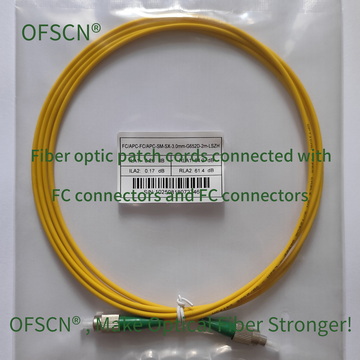
OFSCN® Standard Fiber Patch Cord: Suitable for industrial signal transmission in conventional environments.
-
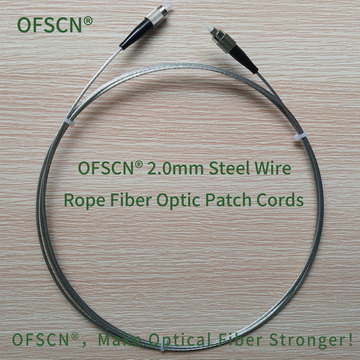
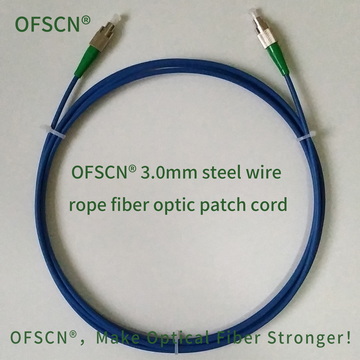
OFSCN® 2.0mm Steel Wire Rope Fiber Optic Patch Cord and OFSCN® 3.0mm Steel Wire Rope Fiber Optic Patch Cord: Offer extremely high tensile and compressive strength, suitable for complex cable routing on construction sites and environments with external pulling forces.
-
OFSCN® 300℃ Fiber Optic Patch Cord: Features a seamless stainless steel tube structure, resistant to pressure and tension, capable of operating in environments from −270°C to 300°C.

2. Use of Pre-terminated Special High-Temperature Connectors
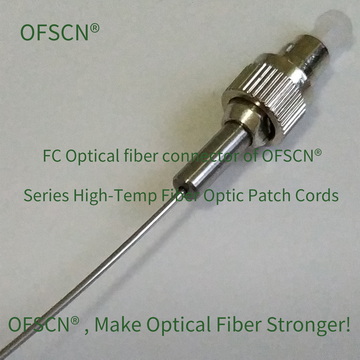
If the on-site environment has high temperatures, industrial-grade special FC connectors provided by DaCheng YongSheng should be custom ordered in advance:
In summary, FC connectors can indeed be installed directly on construction sites. For general civil broadband, cold splicing can be used, but it is best to use factory-polished fiber connectors; for regular communication or high-requirement sensing, it is recommended to use a fusion splicer on-site for fusion splicing pigtails; while in harsh industrial environments with high temperatures and pressures, it is imperative to use factory-customized steel tube or armored patch cords and pre-manufactured high-temperature-resistant special FC connectors.