When installed on the wall of a high-temperature chamber, how does the adapter ensure it won’t expand or deform from the heat?
When a high-temperature resistant adapter is installed on the wall of a high-temperature chamber, its stability and reliability are ensured through specific material selection and structural design.
To provide you with the most accurate technical explanation, I need to clarify a few details regarding your application:
- What is the maximum operating temperature of your chamber? (e.g., 100°C, 300°C, or higher?)
- Is the chamber under vacuum or pressure? (This determines whether you need a standard high-temperature adapter or a sealed flange/feedthrough.)
Technical Principles for Heat Resistance
Generally, DCYS (OFSCN) ensures the performance of high-temperature adapters through the following methods:
- Material Selection: Unlike standard plastic adapters that melt or deform, the OFSCN® High Temperature Resistant Fiber Optic Adapter uses high-grade metal alloys and specialized ceramics. These materials have extremely low coefficients of thermal expansion (CTE), meaning they experience minimal dimensional changes even as temperatures rise.
- Precision Machining: The internal alignment sleeve (usually zirconia or high-temp ceramic) is designed with tolerances that account for thermal expansion, ensuring that the optical fiber cores remain aligned without physical binding or signal loss.
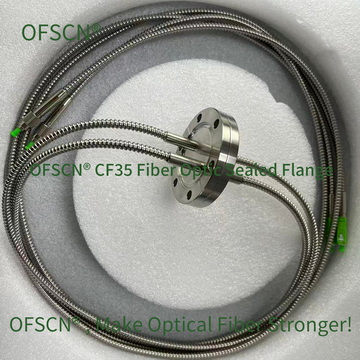
- Seal Integrity: If the application requires the chamber to be airtight, we utilize the OFSCN® Vacuum Sealed Flange. These are constructed with stainless steel (CF or KF series) and utilize metal-to-metal or specialized high-temp gaskets to prevent leakage caused by thermal cycling.
Standard Product Image:
Once you provide the temperature and pressure requirements, I can recommend the specific configuration best suited for your project.