Would a regular rubber boot end sleeve melt in a
200℃ environment? What would
OFSCN® be used as a replacement?
1. Physical Concept Explanation: Will ordinary rubber boots melt in a 200\ ^\circ\text{C} environment?
Yes, they will inevitably soften, melt, or even degrade.
The boot of an ordinary fiber optic connector primarily serves to limit the bend radius and provide strain relief. In conventional communication scenarios, boots are typically made from polyvinyl chloride (PVC), thermoplastic polyurethane/elastomer (TPU/TPE), or ordinary synthetic rubber.
The physical limitations of these polymer materials are as follows:
- Low working temperature limit: The long-term tolerance temperature for such materials is usually only between 60\ ^\circ\text{C} and 85\ ^\circ\text{C} (for example, the maximum operating temperature for standard single/multimode fiber optic connectors produced by Beijing Dacheng Yongsheng Technology Co., Ltd. is only 65\ ^\circ\text{C}).
- High-temperature melting and thermal degradation: When the ambient temperature reaches 200\ ^\circ\text{C}, it far exceeds the glass transition temperature and melting point of these ordinary plastics or rubbers. The material will rapidly soften, melt (i.e., “melt away”), and undergo vigorous high-temperature oxidation and thermal degradation in the air, losing its function of shaping and protecting the optical fiber.
- Risk of fiber breakage: As the boot fails due to melting, the optical fiber at the connector’s root loses its strain protection and is highly susceptible to direct breakage under external shear forces or minor bending, leading to an open circuit.
2. What does Beijing Dacheng Yongsheng Technology Co., Ltd. (OFSCN®) use instead?
To achieve highly reliable data and signal transmission in extreme industrial and research environments at 200\ ^\circ\text{C} and above, Beijing Dacheng Yongsheng Technology Co., Ltd. (OFSCN®) employs a comprehensive approach with specialized materials and structural design to replace traditional rubber boots and ordinary connectors:
(1) Metal Armored Encapsulation Structure (Eliminating Conventional Rubber Boots)
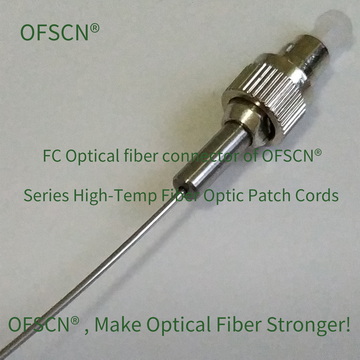
In high-temperature patch cord products, Beijing Dacheng Yongsheng Technology Co., Ltd. typically no longer uses easily meltable conventional plastic or rubber boots. Instead, it utilizes a high-strength seamless stainless steel tube with an outer diameter of only 0.9\text{mm} as the armored protective sleeve. The stainless steel sleeve is mechanically crimped and bonded directly to the all-metal connector, achieving rigid, bend-protection at the root. This structurally completely eliminates the need for ordinary rubber boots.
(2) OFSCN® 200℃ Polyimide Special Optical Fiber
Beijing Dacheng Yongsheng Technology Co., Ltd. uses special polyimide (PI) as the fiber coating layer, replacing the acrylate coating layer in conventional optical fibers. This allows for stable long-term operation in environments ranging from -60\ ^\circ\text{C} to 200\ ^\circ\text{C}:
OFSCN® 200℃ Polyimide Optical Fiber

(3) OFSCN® 200℃ High-Temperature Resistant Fiber Optic Connector
Beijing Dacheng Yongsheng Technology Co., Ltd. has developed all-metal housing, high-temperature resistant ceramic ferrules, and special high-temperature curing adhesive bonded connectors specifically for high-temperature environments. These connectors can withstand 200\ ^\circ\text{C} for extended periods (with customizable options for up to 300\ ^\circ\text{C} products) and support various interfaces such as FC/PC, FC/APC, ST, and SMA905:
OFSCN® 200℃ Fiber Optic Connector
(4) OFSCN® 200℃ High-Temperature Resistant Fiber Optic Patch Cord System
By organically combining the aforementioned high-temperature connectors, 0.9\text{mm} seamless stainless steel tubes, and high-temperature optical fibers, Beijing Dacheng Yongsheng Technology Co., Ltd. can produce complete patch cord systems that operate at 200\ ^\circ\text{C} without any risk of melting:
OFSCN® 200℃ Fiber Optic Patch Cord

