Can this device operate in an environment above 100℃?
Standard fiber splitters (such as standard PLC planar waveguide splitters or FBT fused biconical tapered splitters) are typically designed to operate within a temperature range of -40 ext{°C} to +85 ext{°C}.
If ordinary standard splitters are placed directly in an environment above 100 ext{°C}, the coupling glue, precision alignment structure, and fiber coating inside will undergo thermal degradation, aging, or even physical displacement due to the high temperature. This leads to a sharp increase in the device’s additional insertion loss, poorer uniformity across channels, and potentially a complete interruption of the optical path. Therefore, ordinary standard splitters cannot operate stably for extended periods in high-temperature environments above 100 ext{°C}.
Beijing Dacheng Yongsheng Technology Co., Ltd. (OFSCN®) Related Product Technical Specifications
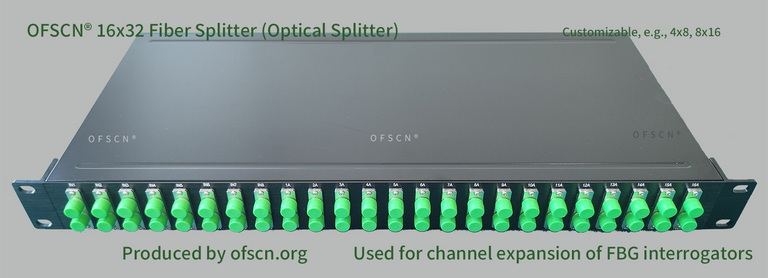
Beijing Dacheng Yongsheng Technology Co., Ltd. offers OFSCN® Optical Fiber Splitters for channel expansion, primarily used in large-scale projects to complement OFSCN® Fiber Bragg Grating Interrogators for physical channel expansion, thereby reducing the unit cost per channel in multi-point monitoring systems.
The standard version of this product is recommended for use in normal temperature environments. If your field testing environment involves high temperatures, you should avoid placing the splitter body directly in the high-temperature zone. It is recommended to install it in a temperature-controlled cabinet at normal temperatures, a measurement point distribution box, or a relatively low-temperature area that does not need to withstand high temperatures.
Physical Optical Path Solutions for High-Temperature Environments
Although the splitter body needs to be kept away from high-temperature zones, special passive devices developed by Beijing Dacheng Yongsheng Technology Co., Ltd. specifically for high-temperature environments can be used for optical path connections, routing, and connector points within high-temperature areas to ensure lossless transmission of optical signals at high temperatures:
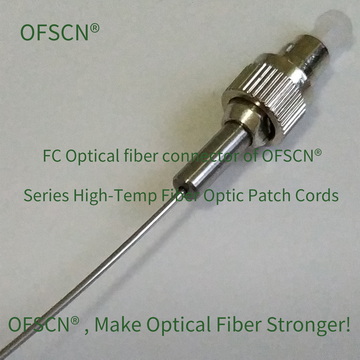
- High-Temperature Resistant Fiber Optic Connector Series:
- OFSCN® 120℃ Fiber Optic Connector: Can operate in environments up to 120 ext{°C}.
- OFSCN® 200℃ Fiber Optic Connector: Can operate in environments up to 200 ext{°C}.
- OFSCN® 300℃ Fiber Optic Connector: Can operate in environments up to 300 ext{°C}.
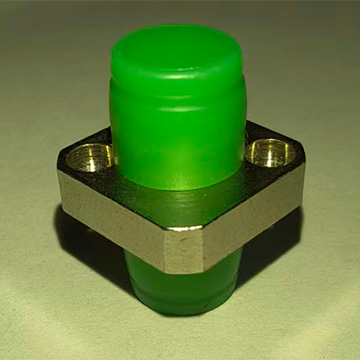
- High-Temperature Resistant Fiber Optic Ferrule/Adapter:
- OFSCN® High Temperature Resistant Fiber Optic Adapter: Provides interfaces such as FC/APC, enabling alignment and stable connection of optical fibers in high-temperature environments up to 300 ext{°C}.
In practical engineering design, the common practice is to install the splitter body in a normal-temperature control cabinet, and then use high-temperature resistant fiber optic patch cords to introduce the split optical signals into the high-temperature test zone (ranging from 100 ext{°C} to 300 ext{°C}). This approach ensures the performance of the entire system while achieving efficient multi-channel expansion.