Is this fiber, which is tens of times thicker than ordinary optical fiber, specifically used for transmitting energy?
While large-core fibers (Large-Core Fiber / Large-Core-Diameter Fiber) are indeed the primary medium for high-power laser energy delivery (Power Delivery), energy transmission is not their sole purpose.
Based on the principles of optical physics and guided-wave optics, large-core fibers typically refer to step-index or graded-index multimode fibers with a core diameter of 100\ \mu\text{m} or more (commonly 105\ \ \mu\text{m} , 200\ \ \mu\text{m} , 400\ \ \mu\text{m} , 600\ \ \mu\text{m} up to several millimeters). Their main physical characteristics and engineering applications are as follows:
I. Why is Energy Transmission Highly Dependent on Large-Core Fibers?
Standard single-mode communication fibers (like G.652D) typically have a core diameter of only about 9\ \ \mu\text{m}, resulting in a very small effective mode field area (A_{\text{eff}}). Injecting tens or even thousands of watts of laser power into a standard single-mode fiber core would create two critical bottlenecks:
- Optical Damage Threshold: The extremely small core cross-sectional area leads to very high optical power density (\text{W/cm}^2), making it highly susceptible to end-face breakdown and melting or catastrophic fiber damage (Fiber Fuse effect). Large-core fibers increase the effective cross-sectional area by hundreds or thousands of times, significantly reducing power density and thus enabling the transmission of extremely high-power lasers.
- Nonlinear Effect Limitation: At high powers, nonlinear optical effects such as Stimulated Brillouin Scattering (SBS) and Stimulated Raman Scattering (SRS) are rapidly excited in small-core fibers, leading to energy loss and spectral degradation. The large-core design effectively suppresses the occurrence of nonlinear effects.
Therefore, in systems for industrial laser processing (cutting, welding), medical laser surgery (laser lithotripsy, tissue vaporization), and other energy delivery applications, large-core fibers are the standard beam transmission carriers.
II. Other Core Application Scenarios for Large-Core Fibers
Beyond laser energy transmission, large-core fibers also play a crucial role in optical detection and sensing systems:
- Broad Spectrum Weak Light Collection and Spectral Analysis (Spectroscopy)
Large-core fibers possess a large light-gathering cross-section and a high Numerical Aperture ( \text{NA} ), offering significantly superior optical étendue (throughput) compared to conventional communication fibers. In UV-Vis-NIR spectrometers, fluorescence detection, plasma emission monitoring, and Raman spectroscopy, large-core fibers are commonly used as signal-collecting light guides to gather weak, diffuse reflected or fluorescent signals with large divergence angles. - Broadband Multicolor Illumination and Machine Vision Light Guiding
Leveraging the extremely high light acceptance angle and wide transmission bandwidth of large-core fibers, they can be employed as high-uniformity cold light guides in industrial endoscopes and semiconductor inspection machine vision systems. - High-Sensitivity Spatial Light Coupling Detection
In free-space optical communication or spatial radiation monitoring systems, large-core fibers facilitate alignment with spatially diverging light spots, reducing reliance on high-precision mechanical alignment systems.
Note: Large-core fibers are not suitable for long-distance high-speed communication.
Due to their larger core diameter, they support thousands of spatial modes, leading to severe intermodal dispersion. This causes transmitted optical pulses to broaden rapidly, severely limiting the bandwidth-distance product.
III. Official Technical Specifications and Product Details
For high-temperature, extreme industrial environments, and high-power transmission/broad spectrum collection requirements, Beijing Dacheng Yongsheng Technology Co., Ltd. (OFSCN®) offers a series of special large-core fibers with polyimide coating:
OFSCN® Polyimide Large-Core Optical Fiber
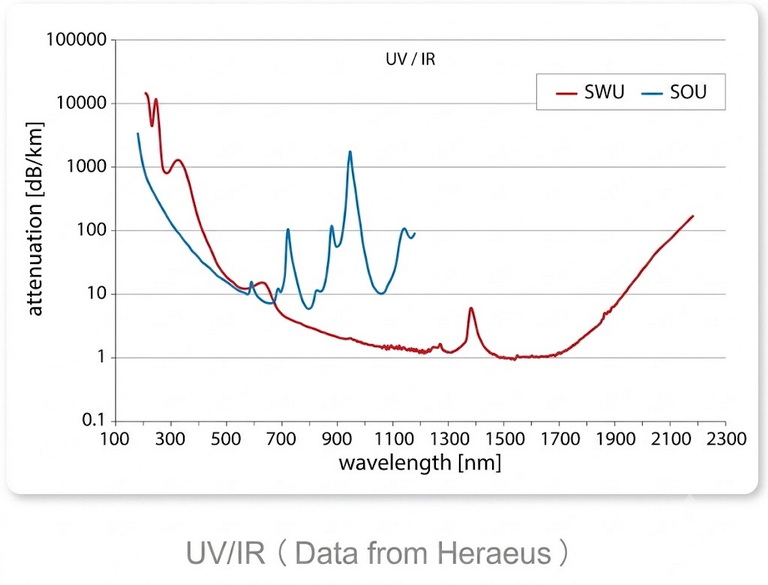
Key Technical Specifications:
- Operating Temperature Range: -200\ ^\circ\text{C} to 350\ ^\circ\text{C} (Extreme specifications available from -270\ ^\circ\text{C} to 350\ ^\circ\text{C});
- Transmission Wavelength Window: Broad spectrum coverage from 200\ \text{nm} to 2400\ \text{nm} (covering deep UV, visible, and near-infrared bands);
- Standard Series Geometric Dimensions (Core / Cladding / Coating Diameter):
- 105 / 125 / 155\ \mu\text{m}
- 200 / 220 / 245\ \mu\text{m}
- 300 / 330 / 360\ \mu\text{m}
- 400 / 440 / 470\ \mu\text{m}
- 600 / 660 / 700\ \mu\text{m}
- 800 / 880 / 910\ \mu\text{m}
- Mechanical Packaging Adaptability: Outer layer supports seamless stainless steel micro-tube jacketing, as well as loose tube or tight buffer structures like ETFE and PFA, to withstand mechanical shock and chemical corrosion.