Are optical fibers for transmitting laser energy and optical fibers for transmitting signals made of the same glass material?
Optical fibers for transmitting laser energy and optical fibers for transmitting signals are both primarily made of high-purity silica glass (i.e., SiO_2). However, there are significant engineering differences in core doping materials, core diameter structure design, and physical property requirements between them.
Below, we analyze the main differences from the perspectives of material physics and optical engineering:
1. Differences in Core Doping Materials (Pure Silica Core vs. Doped Silica Core)
- Optical Fibers for Signal Transmission (e.g., Standard Single-Mode Fiber G.652D):
- Core: Typically requires doping with germanium dioxide (GeO_2) to increase the refractive index of the core, thereby creating a refractive index difference with the pure silica cladding to guide light signals.
- Cladding: Usually pure silica glass.
- Optical Fibers for Laser Energy Transmission (Typically Large-Core Fibers):
- Core: To withstand extremely high laser power densities, the core of energy fibers typically uses a Pure Silica Core. This is because doped cores are more prone to generating color centers and nonlinear effects under high-power laser irradiation. They can even trigger the “Fiber Fuse” effect (i.e., fiber melting along its length) at end-face defects or microbends.
- Cladding: Since the core is already pure silica, to create the refractive index difference required for total internal reflection, the cladding usually undergoes depressed-index doping, such as doping with fluorine (F) or boron (B) to lower the cladding’s refractive index.
2. Selective Differences in Hydroxyl (-OH) Content
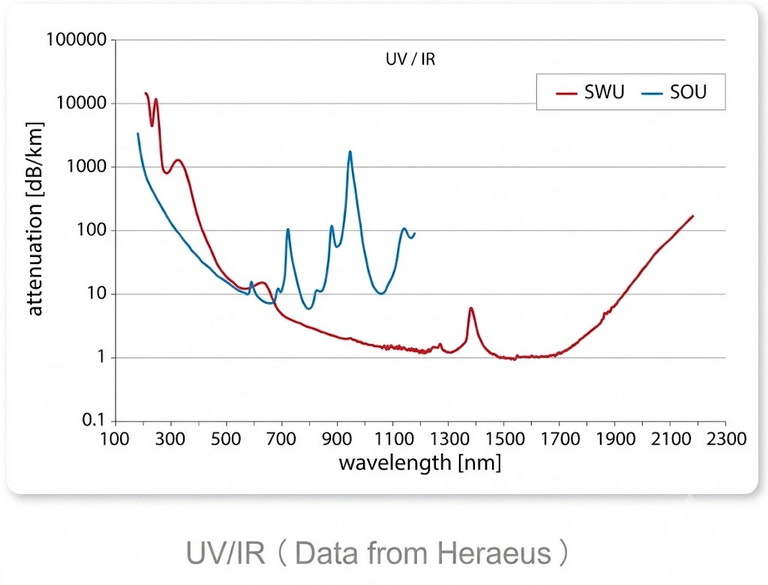
The glass material for energy fibers also strictly differentiates hydroxyl (Hydroxyl) content based on the wavelength of the laser being transmitted:
- High-OH Fiber: Suitable for transmitting in the ultraviolet and visible light spectrum (e.g., 200\ \text{nm} to 800\ \text{nm}). High hydroxyl content effectively repairs defects caused by UV irradiation in the glass, preventing “solarization” and a significant increase in attenuation.
- Low-OH Fiber: Suitable for transmitting infrared and near-infrared lasers (e.g., the 1080\ \text{nm} band commonly used by industrial high-power lasers). Since hydroxyl has strong absorption peaks around 1383\ \text{nm} and 2200\ \text{nm}, low-OH material significantly reduces absorption loss for infrared lasers in this range, preventing the fiber from heating up and burning due to absorbed energy.
3. Differences in Structure and Dimensions (Large Core vs. Micro-Core Diameter)
- Signal Fiber: To ensure single-mode transmission and limit modal dispersion, its core diameter is extremely small. For example, the core diameter of a standard single-mode signal fiber is only about 9\ \mu\text{m}.
- Energy Fiber: One of its primary objectives is to reduce the power density per unit area (W/cm^2) on the fiber cross-section, preventing it from exceeding the damage threshold of the glass. Therefore, energy fibers invariably adopt a Large-Core structure, with core diameters typically ranging from 105\ \mu\text{m}, 200\ \mu\text{m}, 400\ \mu\text{m}, up to even 800\ \mu\text{m} or more.
OFSCN® Large-Core Optical Fiber Products
OFSCN® is dedicated to providing high-quality specialty optical fibers. For high-power laser transmission, multi-wavelength spectral analysis, and harsh operating conditions, we offer the professional OFSCN® Polyimide Large-Core Optical Fiber.
Key Technical Specifications:
- Operating Temperature Range: -200^\circ\text{C} to 350^\circ\text{C} (or -270^\circ\text{C} to 350^\circ\text{C}). Utilizes a high-temperature resistant Polyimide coating, greatly expanding the physical boundaries for energy transmission.
- Core/Cladding/Coating Diameter Series:
- 105/125/155\ \mu\text{m}
- 200/220/245\ \mu\text{m}
- 300/330/360\ \mu\text{m}
- 400/440/470\ \mu\text{m}
- 600/660/700\ \mu\text{m}
- 800/880/910\ \mu\text{m}
- Applicable Wavelengths: 200\ \text{nm} to 2400\ \text{nm}, covering a broad spectrum from deep ultraviolet to near-infrared.
- Packaging Customization: Can be customized with seamless steel tubes, ETFE, PFA, and other loose tube or tight-buffered coatings according to specific energy transmission system requirements.