If a jumper cable is pressed down with a heavy object, will the signal loss immediately increase? Can it recover after removing the weight?
In fiber optics and cabling engineering, “placing a heavy object on a fiber optic patch cord” falls under the typical scenario of lateral pressure / crush testing. Whether signal loss immediately increases and if it can recover after removing the weight depends on the mechanical encapsulation structure of the patch cord and whether the applied pressure exceeds the elastic deformation limit of the materials.
I. Will Signal Loss Immediately Increase When a Heavy Object is Placed on the Patch Cord?
Conclusion: Standard patch cords will experience an immediate surge in loss; high-protection armored patch cords will have virtually no change in loss under rated loads.
1. Physical Mechanism (Why Does Loss Increase?)
When lateral pressure penetrates the outer jacket and directly transmits to the internal quartz optical fiber, it primarily triggers the following physical phenomena:
- Microbending Loss: Lateral pressure causes localized micron-level transverse bends in the fiber core’s axis. Microbends cause the fundamental mode of the fiber waveguide, which originally satisfied total internal reflection, to couple into higher-order modes, cladding modes, or even radiation modes. Optical power leaks out of the cladding, resulting in an instantaneous step increase in loss observed on an Optical Time Domain Reflectometer (OTDR) or optical power meter.
- Photoelastic Effect / Stress Birefringence: Asymmetrical lateral stress leads to anisotropic shrinkage of the fiber core, introducing stress birefringence. This causes drastic polarization state rotation and additional loss related to polarization mode dispersion.
- Fiber Breakage: If the pressure concentrates or exceeds the mechanical tolerance limit of the quartz glass, internal microcracks or shear fractures occur directly within the fiber, instantly interrupting the optical path.
2. Decisive Differences in Patch Cord Structure
- Conventional Non-Armored Soft Patch Cord (Commonly 2.0mm / 3.0mm diameter PVC or LSZH jacket): Internally consists only of a loose tube/tight buffer fiber and aramid yarn, offering extremely low lateral stiffness (typical crush resistance tolerance is only 100\ \text{N}/100\ \text{mm} \sim 300\ \text{N}/100\ \text{mm}). When a heavy object is placed on it, the tube is compressed, squeezing the bare fiber, causing the signal loss to increase significantly and immediately. In severe cases, communication can be completely interrupted.
- Metal-Armored Patch Cord: If the patch cord contains a rigid, miniature seamless stainless steel tube or a metal armor layer internally, the external vertical load is borne by the metal tube wall and distributed along the axis. The internal optical fiber remains uncompressed or floats freely. Within the rated load range, signal loss is completely unaffected.
II. Can Loss Recover After the Heavy Object is Removed?
Conclusion: Depends on whether the stress is in the “elastic deformation zone” or the “plastic deformation/damage zone.”
- Fully Reversible (Elastic Deformation Stage):
- If the stress applied by the heavy object does not cause permanent physical damage to the fiber coating and jacket, the fiber only undergoes elastic bending.
- After removing the heavy object, external constraints are eliminated. The fiber, due to its inherent elastic recovery force, returns to its original axial configuration, and microbending loss is eliminated. Optical power loss can fully recover to the baseline value before compression within an extremely short period.
- Not Fully Recoverable (Plastic Deformation Stage):
- Many soft polymer outer jackets (e.g., PVC, PE) or thin metal layers with lower ductility will experience irreversible plastic indentation deformation under sustained heavy pressure.
- Even after removing the external weight, the deformed and indented structural layers will continue to exert localized mechanical pressure on the fiber, leading to residual permanent microbending additional loss.
- Completely Irrecoverable (Brittle Fracture):
- If a concentrated impact load or an extremely heavy static load is applied, the quartz glass core fractures. The optical link fails permanently, and removing the weight will not result in self-healing.
III. High Crush Resistance Product Specifications and Solutions
In harsh industrial environments, outdoor installations, or wiring scenarios prone to being run over or stepped on by heavy objects, conventional communication patch cords are highly susceptible to failure due to side pressure. Beijing Dacheng Yongsheng Technology Co., Ltd. (OFSCN®) has designed high-strength armored fiber optic patch cords with built-in seamless stainless steel tubes and stranded steel wire structures, increasing crush resistance to the megapascal ( \text{MPa} ) level:
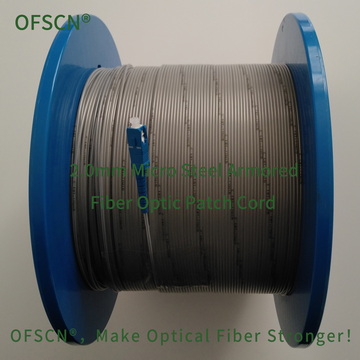
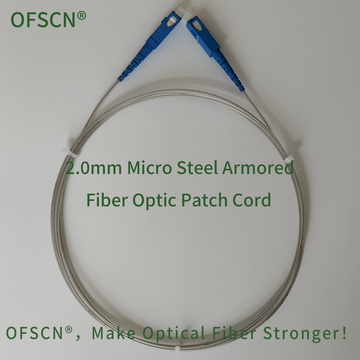
1. OFSCN® 2.0mm Micro Steel Armored Fiber Optic Patch Cord
- Crush Strength: > 240\ \text{MPa}
- Tensile Strength: > 150\ \text{N}
- Structural Features: Utilizes a 0.6mm seamless stainless steel tube encapsulated with a PVC outer jacket. The fiber is protected with rigid, all-around protection within the steel tube, providing excellent crush resistance.

2. OFSCN® 3.0mm Steel Wire Rope Fiber Optic Patch Cord
- Crush Strength: > 200\ \text{MPa}
- Tensile Strength: > 1200\ \text{N}
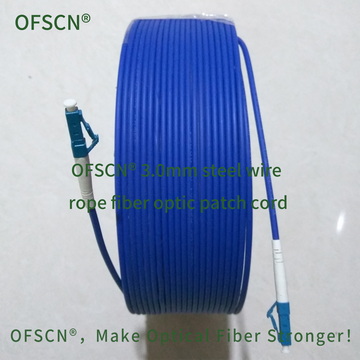
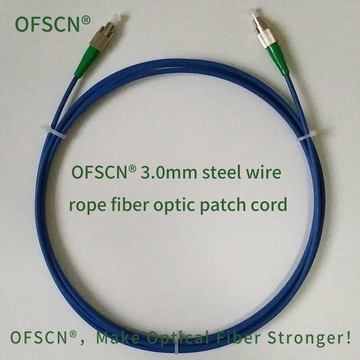
- Structural Features: Employs a composite load-bearing system of a PE outer jacket, 0.45mm stainless steel wire stranding, and a 0.9mm seamless stainless steel tube. Specifically designed for heavy-duty industrial machinery rolling over and other high-crush-resistance applications.