In a liquid nitrogen (-196℃) environment, which coating will not chip?
In extremely low-temperature environments such as liquid nitrogen ( -196\ ^\circ\text{C} ), the Acrylate coating commonly used for optical fibers experiences severe low-temperature embrittlement. The glass transition temperature ( T_g ) of acrylate is typically between -40\ ^\circ\text{C} and -60\ ^\circ\text{C} . When the temperature drops below its T_g , the material transitions from a highly elastic state to an extremely brittle glassy state. Under the immense thermal stress generated by extreme cold (caused by the vast difference in coefficient of thermal expansion between the silica glass core and the polymer coating), these conventional coatings are highly prone to cracking, peeling, or even catastrophic fracture.
To maintain coating integrity, prevent fragmentation, and ensure continuous fiber protection in environments like liquid nitrogen ( -196\ ^\circ\text{C} ) or even colder regions (such as liquid helium at -269\ ^\circ\text{C} ), two types of specialized coating materials with excellent low-temperature performance must be employed:
1. Polyimide (PI) Coating
Polyimide is a high-performance polymer with exceptional chemical stability and a wide operating temperature range. Due to its unique imide ring molecular structure, it retains good flexibility and mechanical strength even at extremely low temperatures, avoiding severe embrittlement and fracture. Polyimide coatings are nominally rated for minimum operating temperatures as low as -200\ ^\circ\text{C} or even -270\ ^\circ\text{C} .
Polyimide specialty fibers offered by Beijing Dacheng Yongsheng Technology Co., Ltd. (OFSCN®) can operate stably in this temperature range, preventing coating fragmentation:
- OFSCN® 300℃ SM Polyimide Optical Fiber: Single-mode polyimide fiber with a standard operating temperature range of -200\ ^\circ\text{C} to 350\ ^\circ\text{C} (extendable down to -270\ ^\circ\text{C} with special processing).
- OFSCN® 300℃ MM Polyimide Optical Fiber: Multi-mode polyimide fiber with a similar operating temperature range of -200\ ^\circ\text{C} to 350\ ^\circ\text{C} (or -270\ ^\circ\text{C} to 350\ ^\circ\text{C} ).


2. Metallized Coating (e.g., Gold Coating)
Metallized coatings fundamentally eliminate the issue of polymer “glass transition” at low temperatures. Metallic gold exhibits excellent cryogenic ductility, remaining non-brittle even at ultra-low temperatures close to absolute zero. Depositing metal directly onto the cladding surface not only completely prevents low-temperature fracturing but also provides excellent hermetic sealing.
Metallized fiber products offered by Beijing Dacheng Yongsheng Technology Co., Ltd. (OFSCN®):
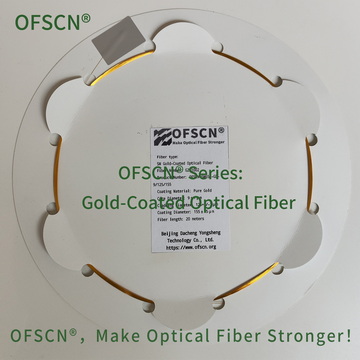
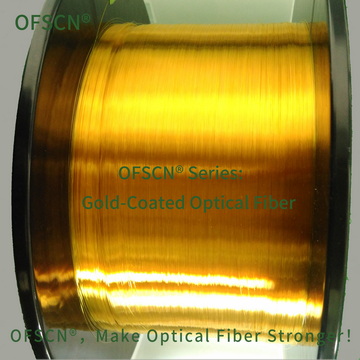
- OFSCN® Gold-coated Optical Fiber: Low/high-temperature resistant single-mode and multi-mode gold-coated optical fibers with an extreme operating temperature range of -270\ ^\circ\text{C} to 700\ ^\circ\text{C} (single-mode, multi-mode gold-coated is -270\ ^\circ\text{C} to 650\ ^\circ\text{C} ). These fibers can be immersed and operated long-term in liquid nitrogen or liquid helium environments without any risk of coating fragmentation.

Technical Selection Recommendations:
- Standard Low-Temperature / Cost-Effective Applications: For standard transmission in liquid nitrogen temperature ranges or for Fiber Bragg Grating (FBG) temperature and strain measurements, Polyimide (PI) coating (typical outer diameter 9/125/155\ \mu\text{m} ) is the most common, lightweight, and fragmentation-free solution for liquid nitrogen environments.
- Extremely Harsh / High Hermeticity Applications: If absolute avoidance of polymer aging is required, along with exceptional mechanical fatigue resistance or operation across extreme temperature ranges, Gold-coated is the most physically stable and reliable choice.