If I have 16 sensors, do I need to drill 16 holes? Or can they be integrated into one flange?
Using 16 fiber optic sensors in a vacuum environment eliminates the need to drill 16 holes in the vacuum chamber. From the perspectives of optical and vacuum engineering, there are typically two mature solutions for signal extraction and vacuum sealing:
Solution 1: Fiber Optic Multiplexing Technology (Requires only 1 Fiber / 1 Channel)
If using Fiber Bragg Grating (FBG) sensors, the Wavelength Division Multiplexing (WDM) principle can be employed.
- Physical Principle: 16 fiber optic grating sensors with different central wavelengths are connected in series on the same optical fiber, forming an “FBG sensor string.”
- Extraction Method: The signals from these 16 sensors are transmitted back to the demodulator via a single optical fiber. Therefore, you only need to install a single-channel (single-core) vacuum fiber flange on the vacuum chamber. This not only maximizes the sealing integrity of the vacuum chamber but also significantly simplifies wiring.
Solution 2: Multi-Channel/Multi-Core Integrated Vacuum Flange (1 Hole, Multi-Channel Integration)
If, due to sensor type limitations, insufficient wavelength range, or the need for high-speed independent signal acquisition, these 16 sensors must be extracted with independent optical fibers, there is still no need to drill 16 holes in the vacuum chamber.
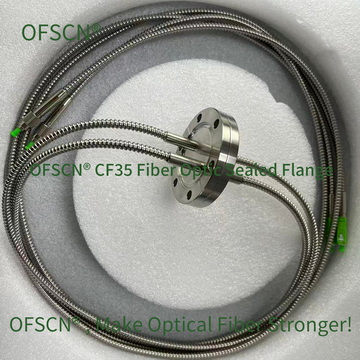
- Physical Principle: A multi-core (multi-channel) integrated vacuum flange can be used. During manufacturing, this flange integrates multiple independent fiber optic feedthroughs into a standard vacuum flange (e.g., KF25, CF35, etc.).
- Extraction Method: Only one corresponding flange port needs to be drilled in the vacuum chamber. By installing this single integrated flange, 16 independent optical fiber signals can be extracted simultaneously.
Related OFSCN® Official Product Introduction
For fiber optic signal transmission and sealing in vacuum environments, DahCheng YongSheng has designed specialized vacuum fiber optic sealed feedthroughs:
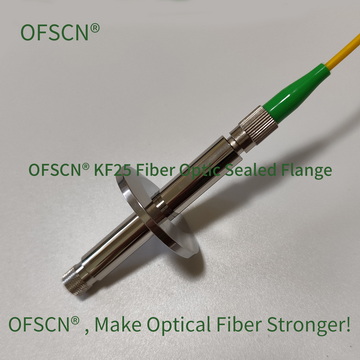
OFSCN® Fiber Optic Vacuum Sealed Flange
- Key Performance Indicators:
- Flange Standard: Available in CF and KF series (e.g., CF35, KF25, etc.), customizable as needed.
- Channel Configuration: Supports customization for single-head (single-channel) and multi-head (multi-channel integrated) configurations.
- Vacuum Performance: Excellent leak rate and sealing performance, with vacuum levels better than 1 \times 10^{-5}\ \text{Pa} and 1 \times 10^{-7}\ \text{Pa}.
- Temperature Range: Standard use at room temperature; high-temperature products resistant to 250\ ^{\circ}\text{C} can be customized.
- Connector Type: Can be female (sockets on both sides of the flange) or male (with patch cord structure).
Summary and Recommendations
In practical engineering design:
- Solution 1 is the preferred choice. If the sensors support serial connection, using a single-core vacuum flange offers the most reliable system at the lowest cost.
- If 16 optical fibers must be physically isolated, then Solution 2 should be adopted. Select a custom 16-channel integrated sealing flange, requiring only one flange port to be reserved on the chamber.