How does a demodulator find the most accurate peak in the wavy line?
In Fiber Bragg Grating (FBG) sensing technology, the raw optical signal received by the interrogator (captured by photodetectors such as linear CCD or PDA) is essentially a set of discrete light intensity data points. When connected, these points form a “wavy line” with a certain bandwidth – the reflection spectrum of the FBG (usually appearing as an asymmetric/symmetric peak resembling a Gaussian or sinc function).
To extract extremely precise physical quantities (like temperature, strain, etc.) from this line, the system must locate the center wavelength (the “peak”) corresponding to the highest reflectivity within this “wavy line”. The process of converting discrete data into a high-precision center wavelength using algorithms is known as “Peak-Searching Algorithm”.
Common peak-searching algorithms and their physical and mathematical principles are as follows:
1. Maximum Value Method
This is the simplest and most direct peak-finding method.
- Principle: Directly compare and find the sampling point with the maximum light intensity (I) among all discrete wavelength points collected by the detector. The wavelength corresponding to this point is the center wavelength (\\lambda_{\\max}).
- Limitations: Its accuracy is entirely limited by the hardware’s sampling interval. For example, if the system’s spectral sampling resolution is 100\\ \\text{pm}, the maximum wavelength resolution demodulated using the maximum value method can only be 100\\ \\text{pm}. Furthermore, this method is extremely sensitive to noise and is rarely used alone in actual high-precision sensing.
2. Centroid Algorithm
The centroid algorithm borrows the concept of the center of mass from mechanics, determining the center by calculating the “weighted average” of all light intensities within the spectral peak region.
- Mathematical Formula:\\lambda_c = \\frac{\\\sum_{i=1}^{n} \\lambda_i \\cdot I_i}{\\\sum_{i=1}^{n} I_i}Where \\lambda_i is the sampling wavelength point and I_i is the light intensity at that point. To avoid the influence of spectral baseline noise, a threshold is usually set for calculations, and only data with light intensity above this threshold is used.
- Characteristics: Extremely fast computation. When the reflection peak has good symmetry and high signal-to-noise ratio, it can easily surpass the hardware’s physical sampling limits, achieving ultra-high resolution at the sub-pixel level.
3. Gaussian Fitting Algorithm
In theory, the central region of an undistorted Fiber Bragg Grating reflection spectrum closely follows a Gaussian Distribution.
- Mathematical Principle: The light intensity distribution of the reflection spectrum can be approximated as:I(\lambda) = I_0 \\cdot \\exp\\left( -4\\ln 2 \\cdot \\frac{(\\lambda - \\lambda_0)^2}{\\Delta \\lambda^2} \\right)For ease of calculation, taking the natural logarithm (\\ln) on both sides transforms the original Gaussian curve into a standard quadratic polynomial in terms of wavelength \\lambda:\\ln I(\lambda) = A\\lambda^2 + B\\lambda + CBy using the Method of Least Squares to perform a linear fit on multiple sampling points near the peak, the coefficients A, B, and C are solved. At this point, the peak wavelength (center wavelength \\lambda_0) can be obtained using the following formula:\\lambda_0 = -\\frac{B}{2A}
- Characteristics: Excellent noise immunity. Even if the sensor is disturbed by uneven external fields causing slight spectral distortion, Gaussian fitting can still demodulate an extremely stable center wavelength. It is currently one of the most mainstream algorithms in high-precision interrogators.
4. Quadratic Polynomial Fitting
This method directly approximates the several discrete points near the reflection spectrum peak with a quadratic polynomial.
- Mathematical Expression: I(\lambda) = A\\lambda^2 + B\\lambda + C
- Principle: Similar to Gaussian fitting, it uses the Method of Least Squares to fit the local extremum region. By taking the derivative and setting \\frac{dI}{d\\lambda} = 0, the peak wavelength is found to be \\lambda_0 = -\\frac{B}{2A}.
- Characteristics: The computational complexity is slightly lower than Gaussian fitting. Since it only selects a few points at the very top of the spectrum (e.g., 3, 5, or 7 points) for fitting, it can effectively avoid side-lobe interference at the bottom of the spectrum.
Synergistic Mechanism of Hardware and Algorithms
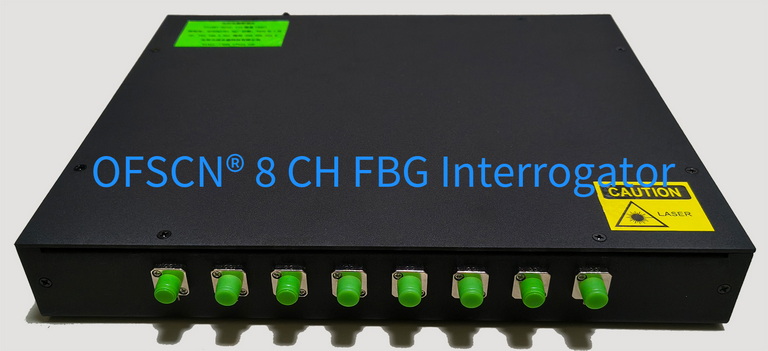
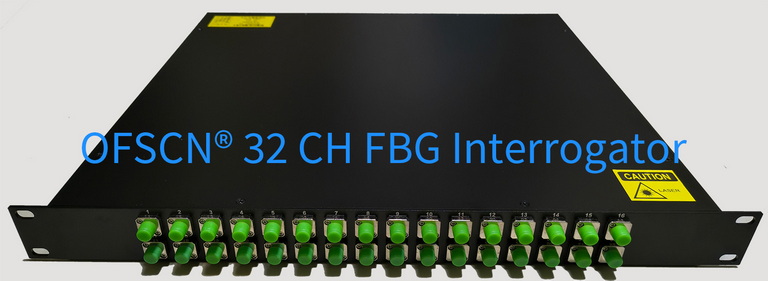
In practical industrial and academic applications, algorithms alone are insufficient. Taking the OFSCN® Fiber Bragg Grating Interrogator as an example, its high precision is the result of deep synergy between hardware and algorithms:
- Absolute Wavelength Reference (Hardware Calibration): The interrogator typically integrates a high-precision gas absorption cell (e.g., acetylene absorption cell) or a Fabry-Perot (F-P) etalon to provide an absolute physical wavelength reference for the system.
- High-Speed Real-Time Processing (DSP/FPGA Processing): The built-in high-speed Digital Signal Processor (DSP) or Field-Programmable Gate Array (FPGA) completes the aforementioned fitting and peak-searching algorithms within microseconds. It subdivides the physical wavelength points collected by the detector, thus outputting an ultra-high wavelength resolution, typically 1\\ \\text{pm} or even 0.1\\ \\text{pm}, within the default sweep range of 1525\\ \\text{nm} to 1565\\ \\text{nm} (or 1528\\ \\text{nm} to 1568\\ \\text{nm}).
Related Products and Official Links:
- OFSCN® Fiber Bragg Grating Interrogator | FBG Interrogator: Supports customized 4, 8, 16, 32 channels. Sampling frequencies include 10\\ \\text{Hz} / 50\\ \\text{Hz} / 100\\ \\text{Hz} options (users can reduce it to 1\\ \\text{Hz}), with default web-based B/S architecture software. Supports customer system integration via protocols such as TCP, UDP, and Modbus.