How can this type of grating measure both pressure and temperature simultaneously?
Polarization-maintaining fiber Bragg gratings (PM-FBG) can achieve simultaneous measurement and decoupling of temperature and pressure (or strain), primarily relying on the unique high birefringence (Birefringence) physical properties of polarization-maintaining fibers. Its specific working principle can be rigorously analyzed from the following academic perspectives:
1. Physical Formation Mechanism of Dual Reflection Peaks
Standard single-mode fibers are isotropic under ideal conditions. However, polarization-maintaining fibers (such as Panda-type, Bow-Tie type, etc.) introduce asymmetric stress-applying regions internally. This results in different effective refractive indices along the two orthogonal polarization directions (slow axis and fast axis), denoted as n_{\text{slow}} and n_{\text{fast}} respectively, within the fiber core.
When a fiber Bragg grating (FBG) is written into such a fiber, the Bragg resonance reflection conditions for the two orthogonal polarization modes will be met separately:
\lambda_{\text{slow}} = 2 n_{\text{slow}} \Lambda
\lambda_{\text{fast}} = 2 n_{\text{fast}} \Lambda
Here, \Lambda is the physical period of the grating. Consequently, in the optical communication demodulation spectrum, PM-FBGs will exhibit two independent reflection wavelength peaks. The wavelength separation is directly determined by the fiber’s birefringence value B = n_{\text{slow}} - n_{\text{fast}} :
\Delta \lambda_{0} = \lambda_{\text{slow}} - \lambda_{\text{fast}} = 2 B \Lambda
2. Differentiated Sensitivity and System of Equations Establishment
When a PM-FBG is subjected to external temperature field changes ( \Delta T ) and axial strain/lateral pressure fields ( \Delta \varepsilon ), the effective refractive indices of both polarization axes and the physical period of the grating will experience drift.
Due to the directional differences in thermal expansion coefficients and elasto-optic coefficients between the stress-applying materials of the polarization-maintaining fiber and the silica core, the response sensitivities of the slow and fast axes’ polarization modes to temperature and pressure are not identical (i.e., they possess asymmetric sensitivity coefficients). In this scenario, the wavelength drift amounts for the two reflection peaks ( \Delta \lambda_{\text{slow}} and \Delta \lambda_{\text{fast}} ) can be expressed as the following coupled linear system of equations:
\Delta \lambda_{\text{slow}} = K_{T, \text{slow}} \Delta T + K_{\varepsilon, \text{slow}} \Delta \varepsilon
\Delta \lambda_{\text{fast}} = K_{T, \text{fast}} \Delta T + K_{\varepsilon, \text{fast}} \Delta \varepsilon
Writing this in matrix form:
$$ \begin{bmatrix} \Delta \lambda_{\text{slow}} \ \Delta \lambda_{\text{fast}} \end{bmatrix} = \begin{bmatrix} K_{T, \text{slow}}
& K_{\varepsilon, \text{slow}} \ K_{T, \text{fast}}
& K_{\varepsilon, \text{fast}} \end{bmatrix} \begin{bmatrix} \Delta T \ \Delta \varepsilon \end{bmatrix} $$
Where:
- K_{T, \text{slow}} and K_{T, \text{fast}} are the temperature sensitivity coefficients for the slow and fast axes, respectively.
- K_{\varepsilon, \text{slow}} and K_{\varepsilon, \text{fast}} are the strain/pressure sensitivity coefficients for the slow and fast axes, respectively.
3. Multi-parameter Decoupling and Calculation
Due to the anisotropy of the slow and fast axes in their physical structure, the determinant of the sensitivity coefficient matrix is non-zero:
K_{T, \text{slow}} K_{\varepsilon, \text{fast}} - K_{\varepsilon, \text{slow}} K_{T, \text{fast}} \neq 0
This implies that the sensitivity matrix is invertible. In practical applications, after pre-calibrating the sensor for temperature and pressure to determine these four sensitivity coefficients, the external temperature change ( \Delta T ) and pressure/strain change ( \Delta \varepsilon ) can be uniquely and independently calculated by solving the inverse matrix once the demodulator measures the two independent wavelength drifts \Delta \lambda_{\text{slow}} and \Delta \lambda_{\text{fast}} :
$$ \begin{bmatrix} \Delta T \ \Delta \varepsilon \end{bmatrix} = \begin{bmatrix} K_{T, \text{slow}}
& K_{\varepsilon, \text{slow}} \ K_{T, \text{fast}}
& K_{\varepsilon, \text{fast}} \end{bmatrix}^{-1} \begin{bmatrix} \Delta \lambda_{\text{slow}} \ \Delta \lambda_{\text{fast}} \end{bmatrix} $$
This fundamentally resolves the ‘temperature cross-sensitivity’ issue that commonly plagues ordinary single-mode gratings when measuring strain or pressure, from a physical principle standpoint.
OFSCN® Official Product and Solution Description
It should be noted that polarization-maintaining fiber Bragg gratings (PM-FBGs), due to the manufacturing process limitations and application constraints of PM fibers themselves, are typically used as highly customized core components for scientific research or specific multi-dimensional mechanical sensors. They are not part of Beijing Dacheng Yongsheng Technology Co., Ltd. (OFSCN®)'s current standard core passive bare fiber grating product series.
OFSCN®'s standard passive fiber gratings primarily focus on providing single-mode fiber gratings with high mechanical strength and a wide operating temperature range (e.g., using polyimide or metal coatings). If you require high-reliability measurements in industrial engineering or conventional structural health monitoring, you may refer to the following OFSCN® standard passive fiber grating products:
-
High-Strength Single-Mode Bare Fiber Gratings:
Utilizing femtosecond laser point-by-point writing technology that does not damage the fiber cladding, these gratings exhibit excellent tensile strength:
Product Name: OFSCN® High-Strength Fiber Bragg Gratings / FBG Strings (Bare)
-
Polyimide High-Temperature Bare Fiber Gratings:
Suitable for precise temperature or strain measurement in environments ranging from -200\text{℃} to 300\text{℃} :
Product Name: OFSCN® Polyimide Fiber Bragg Gratings / FBG Strings (Bare)

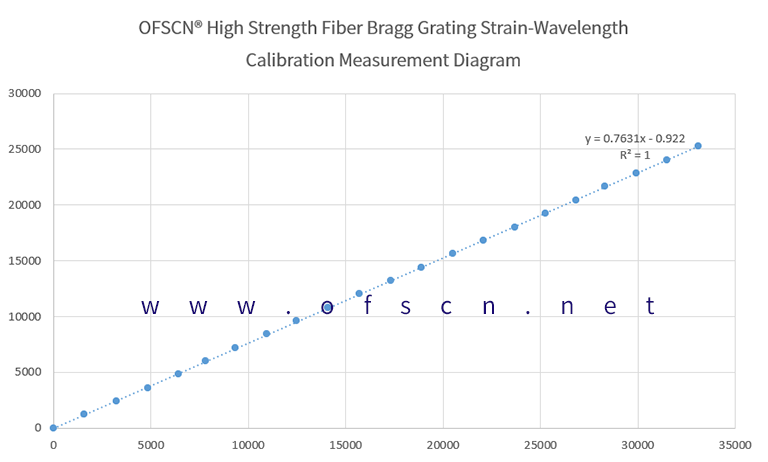


- For more passive bare fiber gratings, please visit: OFSCN® Fiber Bragg Gratings / FBG Strings (Bare) Products Aggregation Link
In engineering practices involving non-polarization-maintaining fibers, to achieve the same decoupled measurement of pressure and temperature, Beijing Dacheng Yongsheng Technology Co., Ltd. typically recommends using a cascaded dual single-mode fiber grating scheme. This involves placing a temperature-compensating grating (e.g., using the external Product Name: OFSCN® 500°C Fiber Bragg Grating Temperature Sensor) adjacent to the pressure-measuring grating, which is not subjected to force and only senses temperature. Through differential algorithms at the demodulation end, temperature effects are directly eliminated. This approach often offers higher long-term stability and cost-effectiveness in field engineering applications.