When pulling through conduit over long distances, is that small ring on the connector used for attaching a rope to pull it?
In long-distance duct installation or complex concealed conduit wiring, the “small loop” structure at the end of pre-terminated fiber optic cables is known in optical engineering as a Pulling Eye (or Pulling Loop).
1. Core Principle and Function of the Pulling Eye
Yes, this small loop is indeed used for attaching guide ropes or pulling ropes for axial pulling. However, its core engineering value lies not just in providing an attachment point for the rope, but more significantly in Strain Relief and Mechanical Protection:
-
Tensile Load Transfer:
During conduit installation, the fiber optic cable experiences significant axial pulling force F_{\text{pull}} . The glass fiber core and ceramic ferrule are extremely fragile and cannot withstand substantial tensile stress. Structurally, the pulling eye is firmly integrated with the cable’s outer mechanical reinforcement (such as steel wire strands, Aramid Kevlar, or metallic sheath), directly transferring the pulling force to the tensile strength layer. This completely isolates the internal core and fiber optic connector from the pulling force. -
Connector Protection and Dust Prevention:
Standard pulling eye structures are usually equipped with a rigid protection sleeve or a flexible pulling sock/mesh. This seals and encloses the fiber optic connector (e.g., FC, SC, LC) to prevent abrasion, impact, or contamination from mud and dust during conduit pulling.
2. Engineering Considerations in Conduit Installation (Tensile Stress Red Line)
- Absolutely Prohibit Direct Pulling by the Connector: If the fiber optic cable end does not have a standard pulling eye structure, never tie the pulling rope directly to the ceramic ferrule, tail sleeve, or the ordinary patch cord jacket of the fiber optic connector. Ordinary patch cords typically have a tensile strength of only a few tens to one hundred Newtons at their connection points. Direct pulling can lead to fiber breakage, ferrule detachment, or a sharp increase in loss.
- Maximum Pulling Force Limit: During conduit installation, the pulling speed and force should be controlled to avoid exceeding the cable’s nominal maximum allowable tension.
3. Technical Implementation of High Tensile Strength Fiber Optic Cables/Patch Cords
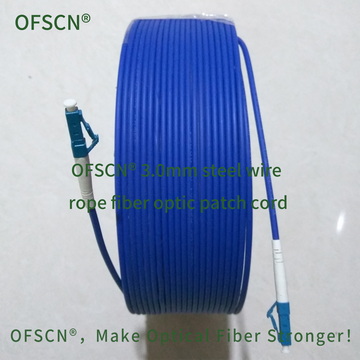
In scenarios lacking dedicated pulling eye components or for long-distance conduit installation, enhancing the inherent mechanical tensile strength of the fiber optic cable or patch cord is crucial for reliable installation, in addition to using pulling eye protective components. Beijing Dacheng Yongsheng Technology Co., Ltd. (OFSCN®) utilizes an integrated steel wire rope and seamless stainless steel tube encapsulation scheme in its high-tensile strength structured fiber optic products:
- OFSCN® 3.0mm Steel Wire Rope Fiber Optic Patch Cord: Protected by a 0.45\text{mm} stainless steel wire stranded structure and a 0.9\text{mm} seamless stainless steel tube, the tensile strength can reach > 1200\text{N} , and the compressive strength is > 200\text{MPa} , providing extremely high resistance to stretching and extrusion.
- OFSCN® 2.0mm Steel Wire Rope Fiber Optic Patch Cord: Features a 0.6\text{mm} galvanized steel wire stranded structure and a 1.0\text{mm} seamless stainless steel tube for all-metal protection, suitable for cable pulling in harsh environments.
In summary, the small loop on the connector for long-distance conduit installation is a specialized pulling eye designed for traction. Its primary mission is to protect the fragile fiber optic core and optical end-face from damage caused by installation tension.