Isn’t it made of glass? Can it withstand temperatures above 1000°C?
This is a classic physics question concerning the material science and thermodynamic properties of optical fibers. Simply put: Sapphire optical fibers are not made of glass; they can withstand temperatures above 1000\ \text{℃}, and this is precisely the core physics purpose for which they were developed.
Here’s an in-depth analysis from the perspectives of material physics and general engineering principles:
I. Are Sapphire Optical Fibers Made of Glass?
No.
Standard communication optical fibers are indeed made of fused silica glass (silicon dioxide, chemical formula \text{SiO}_2), which has an amorphous, non-crystalline structure (what we physicists refer to as a “glassy state”).
In contrast, Sapphire Optical Fiber is made of single-crystal aluminum oxide (single-crystal corundum, chemical formula \alpha\text{-Al}_2\text{O}_3). It is a single crystal with a highly regular, long-range ordered lattice structure, classified as a Crystal Fiber, and is not considered glass in terms of physical and crystallographic classification.
II. Can They Withstand Temperatures Above 1000\ \text{℃}?
Absolutely, and their operational limit far exceeds 1000\ \text{℃}.
- Extremely High Melting Point: Single-crystal sapphire has a melting point of approximately 2040\ \text{℃} to 2050\ \text{℃}. It maintains its lattice structure integrity and excellent mechanical strength even at extremely high thermodynamic temperatures.
- Actual Operating Temperatures: In ultra-high-temperature sensing applications, sapphire fibers typically operate in industrial or aerospace environments ranging from 1000\ \text{℃} to 1600\ \text{℃} (and even up to 1800\ \text{℃} in some extreme laboratory conditions).
- Limits of Fused Silica Optical Fibers: In comparison, standard fused silica optical fibers begin to soften and deform around 1000\ \text{℃} to 1100\ \text{℃}. Furthermore, dopant elements (like germanium) in the fiber core undergo severe diffusion. Additionally, at prolonged high temperatures, fused silica can undergo devitrification (transition from amorphous to crystalline state), causing the fiber to become opaque, brittle, and completely lose its light-guiding capability.
Therefore, in extreme high-temperature environments above 1000\ \text{℃}, standard fused silica optical fibers become unusable. Sapphire fibers are among the few direct optical waveguides capable of performing under such conditions.
III. Physical Characteristics and Technical Limitations of Sapphire Optical Fibers
While sapphire optical fibers offer unparalleled advantages in high-temperature resistance, they possess several significant limitations due to their physical properties in practical optoelectronic engineering applications:
- Extremely High Loss (Unsuitable for Long-Distance Transmission): Due to limitations in single-crystal growth processes, microscopic lattice defects, vacancies, and impurities are unavoidable within the crystal. This leads to very high optical scattering loss (typically in the range of 1\ \text{dB/m} to 10\ \text{dB/m}, whereas standard single-mode silica fiber has losses of only about 0.2\ \text{dB/km}). Consequently, sapphire optical fibers can only be used as the “sensing element” in high-temperature environments (usually only tens of centimeters to a few meters). The signal must then be spliced to silica fibers for transmission back to the demodulator.
- Lack of Ideal Cladding Structure: Commercially available sapphire fibers are often monolithic, unclad fibers. Their waveguide structure relies on the refractive index difference between the sapphire medium and the surrounding air, making them severely multimode waveguides. This results in very high mode field dispersion. Moreover, if the fiber surface accumulates dust or oxidizes at high temperatures, it can cause significant bending and surface leakage losses.
IV. Beijing Dacheng Yongsheng Technology Co., Ltd.'s (OFSCN®) High-Temperature Fiber Optic Sensing Technology
It is important to note that the core product line of Beijing Dacheng Yongsheng Technology Co., Ltd. (OFSCN®) does not include sapphire optical fibers.
In actual industrial settings (such as power plants, steel mills, metallurgy, and chemical plants), if your measurement environment temperature is below 800\ \text{℃}, silica fiber Bragg grating (FBG) sensors, protected by specialized manufacturing processes, remain a cost-effective and stable solution with excellent signal integrity.
For applications with a maximum operating temperature within 800\ \text{℃}, Beijing Dacheng Yongsheng Technology Co., Ltd. recommends the following products:
- Product Name: OFSCN® 800°C Fiber Bragg Grating Temperature Sensor
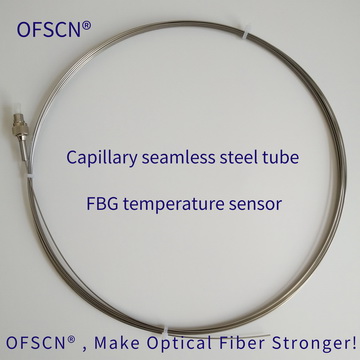
- Core Technology Description: This sensor utilizes advanced femtosecond laser point-by-point/surface-by-surface writing technology to directly inscribe fiber Bragg gratings (FBGs) into the core of specialized high-temperature resistant fibers (such as polyimide-coated or pure silica core fibers). After undergoing specialized annealing and stress-relief processes, the gratings can operate stably over a temperature range of -270\ \text{℃} to 800\ \text{℃} without wavelength drift or degradation. Simultaneously, the sensor is precisely encapsulated in a special seamless steel tube, providing high mechanical strength and long-term reliability at high temperatures.