Is there a package that can prevent temperature changes from affecting strain measurements?
In the field of Fiber Bragg Grating (FBG) strain sensing, environmental temperature fluctuations can be eliminated from pure strain measurement results through specific packaging structure design or multi-channel compensation mechanisms.
I. Analysis of Physical Principles
The Bragg reflection wavelength \lambda_B of an FBG is simultaneously affected by axial strain \varepsilon and environmental temperature changes \Delta T . The basic equation for wavelength shift is:
\Delta \lambda_B = K_\varepsilon \varepsilon + K_T \Delta T
Where K_\varepsilon is the strain sensitivity coefficient of the grating, and K_T is the temperature sensitivity coefficient (determined by the combined thermo-optic and thermal expansion effects of the fiber material). Physically, a single bare FBG cannot distinguish whether a wavelength shift is caused by stress stretching or temperature change, thus requiring temperature sensitivity stripping through engineering packaging structures or system demodulation algorithms.
II. Self-Compensating Packaging Structures and Implementation Mechanisms
In sensor engineering design, packaging structures that eliminate or offset temperature interference typically employ the following methods:
1. Dual-FBG Self-Compensating Structure
Two FBGs or two sets of FBGs are packaged within the same sensor housing or tube:
- Strain FBG: Pre-fixed to the sensor substrate or housing, it senses both structural mechanical strain and environmental temperature changes. Its wavelength shift is \Delta \lambda_1 = K_{\varepsilon 1} \varepsilon + K_{T1} \Delta T .
- Temperature Compensation FBG: Placed freely suspended/in a stress-free cavity within the same packaging chamber, it only senses environmental temperature changes and does not bear structural mechanical strain. Its wavelength shift is \Delta \lambda_2 = K_{T2} \Delta T .
The demodulation system can accurately eliminate temperature effects through wavelength differencing:
\Delta \lambda_{\text{pure strain}} = \Delta \lambda_1 - \frac{K_{T1}}{K_{T2}} \Delta \lambda_2 = K_{\varepsilon 1} \varepsilon
2. Mechanical Self-Compensation via Thermal Expansion
This method utilizes a combination of two materials with different coefficients of thermal expansion (CTE), such as different metals or alloys, to fabricate the sensor’s packaging base. When the temperature rises, the tensile displacement caused by the thermal expansion of the main material is offset by an equal and opposite displacement due to the thermal expansion of the auxiliary material. This ensures that the mechanical strain on the fiber, held between the fixed ends, remains unchanged under pure temperature variations.
III. OFSCN® Official Technical Implementations and Recommendations
Within the OFSCN® (Beijing Dacheng Yongsheng Technology Co., Ltd.) product portfolio, two engineering approaches are offered to address the cross-sensitivity issue between temperature and strain: customized built-in self-compensating structures and external independent compensation.
1. Customized Built-in Self-Compensating Structures
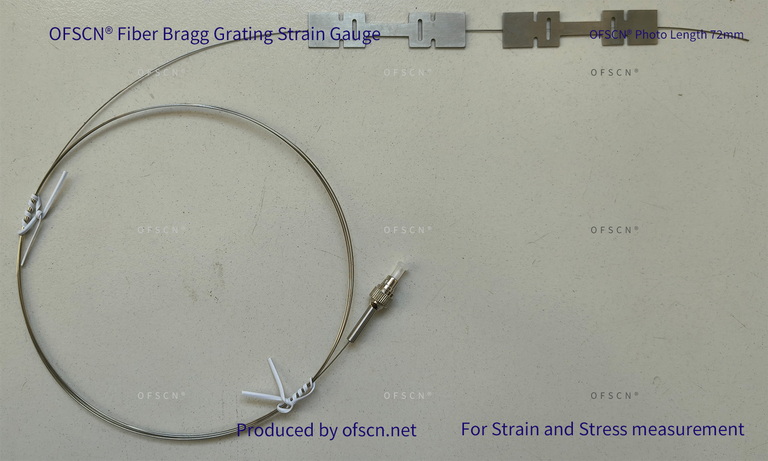
OFSCN® offers customized built-in self-compensating structures with temperature compensation for its main series of tubular and planar FBG strain sensors:
- OFSCN® Alloy Tube Packaged Fiber Bragg Grating strain sensor
- OFSCN® Polymer-encapsulated Fiber Bragg Grating Strain Sensor (1.5mm/2.3mm diameter)
- OFSCN® Fiber Bragg Grating Strain Gauge


2. Official Engineering Application Recommendations
While all types of strain sensors can be manufactured with built-in self-compensating structures, in practical engineering applications, it is more recommended to use an external, independent FBG temperature sensor in conjunction with the strain sensor for temperature compensation. The reason is that an external independent temperature compensation sensor adheres more closely to the measured structure, avoiding issues like heat transfer delay or uneven thermal gradients within a tube. This provides higher computational accuracy in environments with large spans or drastic temperature fluctuations.