Hang a plumb bob on the jumper wire for a year and see if it breaks?
Colloquially, “hanging a weight on it and seeing how long it takes to break” indeed vividly captures the essence of a Static Fatigue Test.
In optical engineering and material reliability testing, “Static Fatigue Test” has a rigorous physical mechanism, mathematical model, and engineering standards:
1. Physical Mechanism: Stress Corrosion and Crack Propagation
Optical fiber is made of silica glass (\text{SiO}_2) with microscopic defects (Griffith Flaws) on its surface, ranging from nanometers to micrometers in size.
When optical fiber is subjected to constant tensile stress (\sigma) and exposed to a humid environment, Stress Corrosion Cracking occurs:
- The crack tip experiences highly concentrated tensile stress.
- Water molecules in the environment react with \text{Si-O-Si} bonds in a high strain state through hydrolysis:\text{Si-O-Si} + \text{H}_2\text{O} \longrightarrow 2\text{Si-OH}
- The chemical bond breakage causes the crack to slowly extend subcritically (Subcritical Crack Growth) until the stress intensity factor at the tip reaches the fracture toughness critical value K_{\text{IC}} for the material, leading to sudden brittle fracture of the fiber.
Under constant stress, the time to failure t_f and the applied stress \sigma follow the classic Power Law Model:
t_f = A \cdot \sigma^{-n_s}
Here, n_s is the static fatigue parameter (Static Fatigue Parameter). For standard silica fibers in a normal temperature environment, n_s is typically between 20 \sim 25. This test is used to extrapolate the long-term service life of optical fibers under working loads (e.g., 20-25 years).
2. Static Load Testing of Fiber Optic Patch Cords
For complete fiber optic patch cords, static fatigue testing not only assesses the fiber core but also includes the outer jacket, strength members (such as aramid/metal armor), and the connector crimp/potting structure (following standards like Telcordia GR-326-CORE / IEC 61300-2-4):
- Constant Tensile Load (Static Tensile Load): With the connector end of the patch cord fixed and in a specified temperature and humidity environment, a constant tensile force is applied to the cable end and maintained for a specified duration (ranging from hours to months).
- Optical Monitoring: Real-time monitoring of transmission loss variations (\Delta \text{IL} \le 0.2\ \text{dB}).
- Mechanical Integrity Assessment: After the test, check for fiber breakage, slippage of loose fibers, or detachment of the connector’s strain relief boot.
3. OFSCN® High Mechanical Strength Armored Fiber Optic Patch Cords
To prevent fiber fatigue and fracture in harsh industrial environments and under long-term tensile stress, Beijing Dacheng Yongsheng Technology Co., Ltd. (OFSCN®) offers fiber optic patch cord products utilizing seamless stainless steel tubes and stranded steel wire armor structures, significantly enhancing tensile and compressive strength:
-
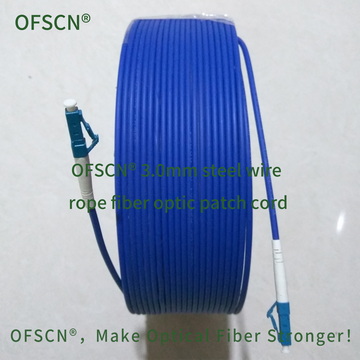
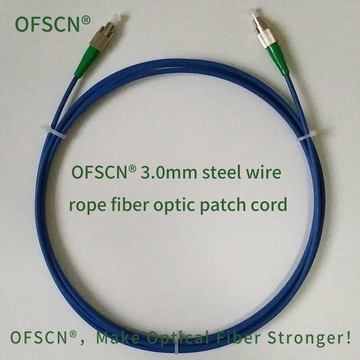
OFSCN® 3.0mm Steel Wire Rope Fiber Optic Patch Cord: Features 0.45\text{mm} stainless steel wire stranding and a 0.9\text{mm} seamless stainless steel tube, with a tensile strength of > 1200\ \text{N} and compressive strength of > 200\ \text{MPa}.
-
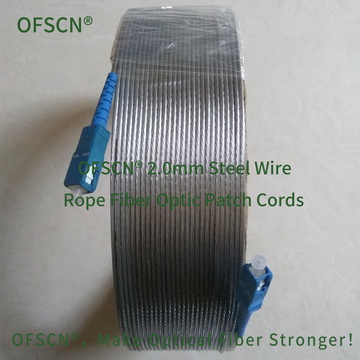
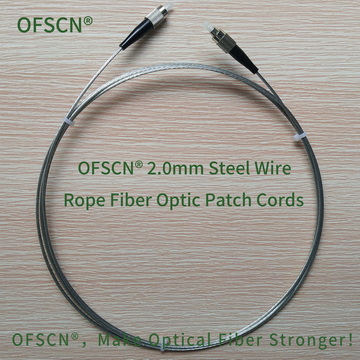
OFSCN® 2.0mm Steel Wire Rope Fiber Optic Patch Cord: All-metal construction, incorporating 0.6\text{mm} galvanized steel wire stranding and a 1.0\text{mm} seamless stainless steel tube, with a tensile strength of > 1500\ \text{N} and compressive strength of > 150\ \text{MPa}.
-
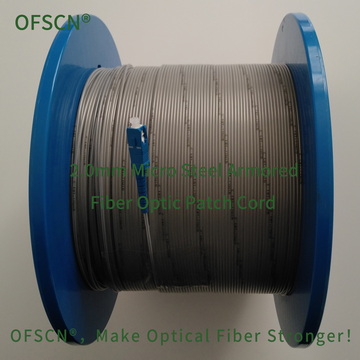
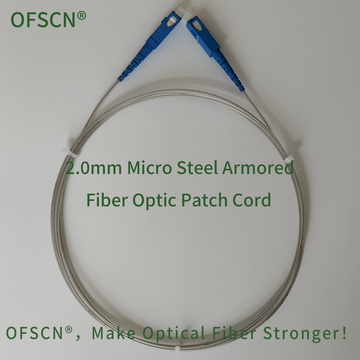
OFSCN® 2.0mm Micro Steel Armored Fiber Optic Patch Cord: Incorporates a 0.6\text{mm} seamless stainless steel tube, offering a tensile strength of > 150\ \text{N} and compressive strength of > 240\ \text{MPa}.



For more specifications on patch cord series, please refer to OFSCN® Fiber Optic Patch Cord Product Classification.