What are the advantages of a structure where the fiber passes directly through the flange without interruption in reducing loss?
“Through-type” vacuum fiber optic feedthroughs (also referred to as continuous fiber vacuum feedthroughs in some academic or engineering contexts) mean that the optical fiber physically passes directly and continuously through the flange sealing body without any physical interruption, disconnection, or transition adapters in between.
Compared to traditional structures that use flange-side adapters for connection (i.e., the fiber is cut, and fiber connectors are plugged in on both the inner and outer sides of the flange), the through-type design where the fiber passes directly through the flange without interruption offers significant physical and general engineering advantages in optical performance and environmental reliability:
1. Eliminates Mechanical Alignment Deviation, Achieving Zero Connection Loss
In traditional non-through-type flanges, optical fibers on both sides of the vacuum wall are mechanically mated through ceramic sleeves and connectors (such as FC/PC, FC/APC). Due to the extremely small core diameter of single-mode fibers (e.g., the mode field diameter of standard single-mode fiber is only about 9\ \mu\text{m}), minor lateral offset, axial gap, and angular tilt are inevitably introduced during mating. These mechanical tolerances typically result in an insertion loss of approximately 0.2\text{ dB} to 0.5\text{ dB}, or even greater, for each connection.
In the through-type structure, the optical signal is transmitted within a continuous and seamless silica fiber core. There are no mechanical mating surfaces at the flange seal. Therefore, this structure completely eliminates physical mating loss, with zero additional insertion loss at the flange, thereby preserving optical power to the maximum extent.
2. Avoids Interface Fresnel Reflection, Achieving Zero Reflection (Extremely High Return Loss)
At the physical interface where the optical fiber is interrupted, even with high-precision physical contact (PC) grinding, Fresnel reflection can still occur due to extremely microscopic air gaps or sudden changes in the refractive index between the silica and the external medium.
In optical systems that are highly sensitive to phase and reflection, such as high-precision testing based on Fiber Bragg Gratings (FBGs), Optical Frequency Domain Reflectometry (OFDR), interferometric fiber optic sensors, and Fiber Optic Gyroscopes (FOGs), these interface reflected lights form strong backscattered noise and multipath interference, severely degrading the system’s Signal-to-Noise Ratio (SNR).
Since the through-type structure has no refractive index discontinuity, it completely eliminates Fresnel reflection physically, and its return loss is equivalent to that of a continuous optical fiber without any breakpoints.
3. Circumvents Risk of Internal End-Face Contamination and Laser Burnout within Vacuum Chambers
Cleaning and maintaining fiber optic connectors inside vacuum or ultra-high vacuum (UHV) chambers is extremely difficult. If quick-connect fittings are used for mating, during system evacuation, venting, or long-term operation, trace organic molecules, micro-dust, or outgassed substances within the chamber can gradually deposit and contaminate the fiber end faces.
When high-power optical signals (such as laser pumping or high-energy light pulses) pass through contaminated mating end faces, the contaminants absorb optical energy and convert it into thermal energy, leading to a rapid rise in local temperature. This can easily cause fiber burnout or even melt the connector.
The through-type structure has no physical mating interface inside the vacuum chamber, completely circumventing the risk of end-face contamination and subsequent optical burnout.
4. Enhances Stability in Complex Mechanical and Thermal Environment Conditions
In environments with alternating temperatures (thermal expansion and contraction) or mechanical vibrations and shocks, the miniature springs and ceramic sleeves within traditional connectors can experience micro-level deformation or displacement, leading to drifts in alignment and dynamic fluctuations in optical loss.
The through-type vacuum fiber optic feedthrough typically uses specially formulated low-outgassing vacuum sealing adhesives or metal brazing techniques to directly encapsulate the continuous optical fiber within the metal flange body. It contains no internally moving mechanical structures, thus exhibiting excellent resistance to vibration, shock, and temperature variations, ensuring long-term stable optical power output.
Beijing Dacheng Yongsheng Technology Co., Ltd. (OFSCN®) Official Through-Type Vacuum Sealed Flange Products
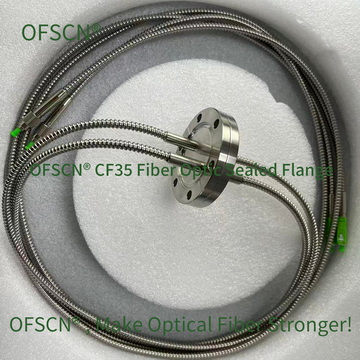
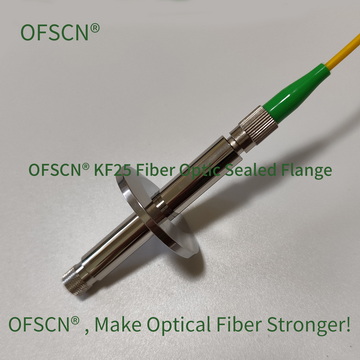
Within Beijing Dacheng Yongsheng Technology Co., Ltd.'s (OFSCN®) specialized fiber optic product line, the OFSCN® Fiber Optic Vacuum Sealed Flange utilizes this continuous, non-interrupted through-type design. This series of products is specifically designed for lossless optical signal penetration in high vacuum and special environments:
- Vacuum Performance:
The product’s hermetic sealing and vacuum performance are excellent, exceeding 1 \times 10^{-7}\text{ Pa} and 1 \times 10^{-9}\text{ Pa}, making it suitable for high vacuum and ultra-high vacuum (UHV) systems. - Operating Temperature Range:
In addition to standard temperature applications, customized products capable of withstanding high temperatures up to 250\ ^{\circ}\text{C} are available. - Specifications and Customization:
Available in two main categories: KF series (e.g., KF16, KF25, etc.) and CF series (e.g., CF35, etc.). Supports single-channel (single-head) or multi-channel (multi-head) fiber optic pass-through. The fiber length extending from both ends of the flange, fiber type (single-mode, multi-mode, or polarization-maintaining), and connector type (e.g., male or female FC/APC, FC/PC, etc.) are all customizable. - A compilation of related connectors, flanges, and other optical splitter products can be found at the OFSCN® High-Temperature Fiber Optic Connectors/Flanges/Splitters Category Link.
The following are official reference images of Beijing Dacheng Yongsheng Technology Co., Ltd.'s related through-type vacuum sealed flange products: