One moment it’s extremely cold, the next extremely hot. Will the fiber optic and its packaging crack?
Whether optical fibers and their packaging crack or get damaged in extreme cold and hot temperature alternations (i.e., Thermal Cycling) depends on material compatibility, temperature zone resistance rating, and packaging structure design.
I. Core Physical Mechanisms Causing Fiber and Packaging Cracking
-
Thermal Expansion Coefficient (CTE) Mismatch and Shear Stress
- The coefficient of thermal expansion of fused silica (\text{SiO}_2) fiber is extremely low, approximately \alpha_{\text{glass}} \approx 0.5 \times 10^{-6}\ \text{K}^{-1}.
- Common packaging structural materials (such as stainless steel \alpha_{\text{steel}} \approx 16 \times 10^{-6}\ \text{K}^{-1}, polymer adhesives \alpha_{\text{polymer}} \approx 30 \sim 100 \times 10^{-6}\ \text{K}^{-1}) have CTEs that differ by orders of magnitude from that of silica fiber.
- During rapid temperature increases and decreases, metal or polymer structures expand and contract significantly. If the interior of the packaging is rigidly fixed with adhesive, the interface will bear alternating thermal shear stress, which can easily lead to coating delamination, adhesive cracking, or even fiber breakage.
-
Material Low-Temperature Embrittlement and High-Temperature Pyrolysis
- Coating Failure: The standard UV-cured acrylate coating used for communication fibers undergoes glass transition below -40\ ^{\circ}\text{C}, becoming hard and brittle. Above +85\ ^{\circ}\text{C}, it tends to soften and degrade. Repeated cycling can cause the protective coating to crack and peel off.
- Special Coatings: Polyimide coatings can withstand temperatures from -270\ ^{\circ}\text{C} to +300\ ^{\circ}\text{C}, while gold-plated/metal-plated coatings can tolerate extreme temperature zones above -270\ ^{\circ}\text{C} to +700\ ^{\circ}\text{C}.
II. Packaging Engineering Design to Avoid Thermal Cycling Cracking
To maintain structural integrity and stable optical performance under severe thermal cycling tests (e.g., from cryogenic liquid nitrogen temperatures of -196\ ^{\circ}\text{C} to hundreds of degrees Celsius), optical sensing packaging typically employs the following engineering strategies:
- Strain-free Loose-tube Structure: In temperature sensor designs, the fiber core/grating region is placed inside a micro metal protective tube and kept in a free-suspension state. The space between the tube wall and the fiber provides clearance for thermal expansion and contraction, preventing the metal tube’s thermal changes from exerting direct axial stress on the fiber.
- High-Temperature Resistant Special Fiber Substrate: Using polyimide-coated fibers or gold-coated fibers that can withstand wide temperature ranges eliminates the risk of coating cracking at extremely low temperatures or charring at extremely high temperatures from the material source.
- Seamless Metal Capillary Packaging: Eliminates welding stress and material seams, resisting the propagation of micro-cracks caused by thermal fatigue.
III. Official Related Wide-Temperature Resistance Packaging Products
Beijing Dacheng Yongsheng Technology Co., Ltd. (OFSCN®) has developed a full series of seamless steel-tube packaged temperature-resistant sensors for extreme temperature cycling and alternating high and low-temperature environments:
1. Point Fiber Bragg Grating Temperature Sensor Series
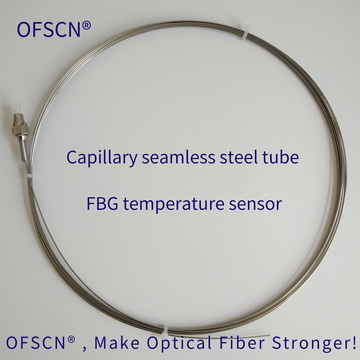
- OFSCN® 300°C Fiber Bragg Grating Temperature Sensor
- Operating temperature range: -200\ ^{\circ}\text{C} \sim +300\ ^{\circ}\text{C}. It uses single-layer seamless steel-tube packaging and polyimide fiber, possessing excellent resistance to thermal shock and thermal fatigue.

- OFSCN® 800°C Fiber Bragg Grating Temperature Sensor
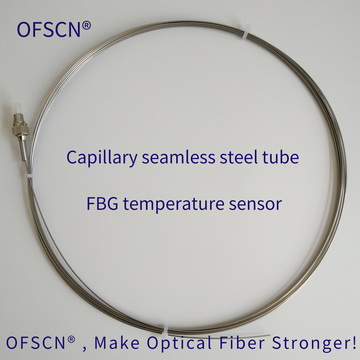
- Operating temperature range: -270\ ^{\circ}\text{C} \sim +800\ ^{\circ}\text{C}. It utilizes high-temperature resistant seamless alloy/steel-tube packaging technology, suitable for extreme thermal cycling conditions from deep cryogenic to ultra-high temperatures.
2. Distributed Metal-Packaged Fiber Temperature Sensor Series
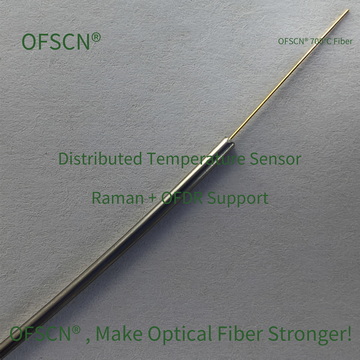
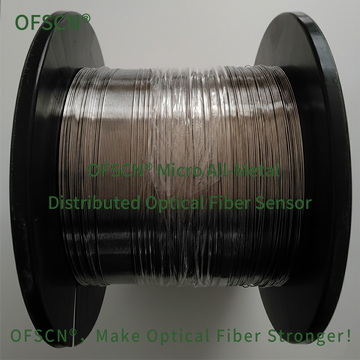
- OFSCN® 700°C Distributed Fiber Temperature Sensor
- Operating temperature range: -270\ ^{\circ}\text{C} \sim +700\ ^{\circ}\text{C}. It employs gold-coated fiber internally combined with 316L seamless steel-tube micro-packaging, completely eliminating the risk of organic coating failure in alternating temperature zones.