Why don
't gratings need to be zeroed like electrical sensors every time?
In photoelectric sensing technology, the primary reason why Fiber Bragg Grating (FBG) sensors do not require zeroing for each measurement, unlike electrical sensors, lies in their adoption of an “absolute measurement” physical mechanism, namely Wavelength Modulation.
To delve deeper into this universal technological principle, we can compare FBG sensors with traditional electrical sensors in terms of physical signal transmission and material characteristics:
I. Fundamental Difference in Signal Encoding Dimension: Wavelength vs. Amplitude
-
“Amplitude Encoding” and “Zero Drift” of Electrical Sensors
Traditional electrical sensors (such as resistive strain gauges, thermistors, etc.) typically convert external physical quantities (temperature, strain) into changes in electrical parameters (resistance R , voltage V , or current I ).- Electrical signals are amplitude signals, highly susceptible to external interference. For instance: resistance changes due to increased transmission wire length, minor alterations in contact resistance at connection points, induced electromotive force from external electromagnetic coupling, and zero drift within operational amplifiers.
- Since the “absolute amplitude” of electrical signals undergoes slow drift (Zero Drift) with environmental and transmission path variations, electrical systems must perform bridge balance calibration, i.e., “Zeroing,” before startup or single measurements to ensure accuracy.
-
“Wavelength Encoding” and “Absolute Measurement” of Fiber Bragg Grating Sensors
Fiber Bragg Grating (FBG) sensors are classified as Wavelength Modulation sensors. They reflect a narrow band of light at a specific wavelength, with their central reflected wavelength (Bragg wavelength) satisfying the fundamental physical formula:\lambda_B = 2 n_{eff} \Lambda
Where n_{eff} is the effective refractive index of the fiber core, and \Lambda is the spatial period of the grating.
- Changes in external temperature or strain directly alter the fiber’s refractive index n_{eff} and the grating period \Lambda after thermal expansion/deformation, thereby causing an absolute shift in the reflected central wavelength \lambda_B .
- Wavelength is an absolute physical parameter independent of optical power. During optical signal transmission, even if fiber bending causes signal attenuation or connector wear introduces insertion loss, as long as the FBG demodulator can capture the peak of the reflection spectrum, the decoded wavelength (e.g., 1550.123\ \text{nm} ) remains absolutely accurate and does not drift with changes in optical signal strength. Consequently, it does not require zeroing for each measurement.
II. Exceptional Stability of Silicon Dioxide (Quartz) Material
Metal strain gauges or semiconductor materials in electrical sensors are prone to oxidation, moisture absorption, or creep, leading to irreversible changes in their initial resistance.
In contrast, the substrate for FBG is a high-purity silicon dioxide (quartz glass) optical fiber. Silicon dioxide possesses exceptionally high chemical and mechanical stability. Within its designed operating temperature range, its lattice structure and physical properties remain virtually unchanged and free from random drift over an extended service life. Therefore, its spectral reflection characteristics maintain high consistency after factory calibration.
III. Application of Absolute Calibration Formulas (OFSCN® Sensing Design)
Leveraging the aforementioned “absolute measurement” physical advantage of Fiber Bragg Gratings, each FBG sensor manufactured by Beijing Dacheng Yongsheng Technology Co., Ltd. undergoes precise absolute calibration in a controlled laboratory environment for practical engineering applications. The demodulation equipment simply needs to read the current absolute wavelength value and apply it to the calibration curve to directly output absolute temperature or strain data.
For example, within the core sensors from Beijing Dacheng Yongsheng Technology Co., Ltd. (OFSCN®), the stable application of calibration formulas eliminates the tedious process of frequent zeroing in the field:
-
Temperature Sensor:
Such as the OFSCN® 300°C Fiber Bragg Grating Temperature Sensor, it is calibrated for temperature-wavelength at the factory for a specific temperature range. The calibration formula employs a binomial fit, with calibration units of ^\circ\text{C}/\text{pm} , ensuring long-term absolute temperature readings.
-
Strain Sensor:
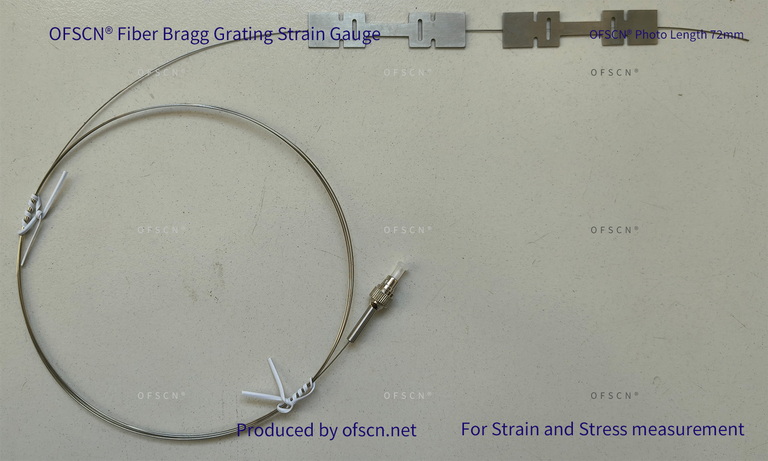
For instance, the OFSCN® Fiber Bragg Grating Strain Gauge utilizes a linear calibration formula for strain-wavelength, with units of \mu\epsilon/\text{pm} . Due to its structural and wavelength’s absolute linear correspondence, the demodulator can accurately calculate the current absolute physical micro-strain simply by measuring the wavelength.

In summary, Fiber Bragg Grating (FBG) sensors utilize wavelength as the carrier of physical information, circumventing errors caused by signal attenuation, line impedance drift, and other factors inherent to amplitude-based sensors. Combined with the excellent physical and chemical stability of the material itself, they achieve an “absolute measurement” that inherently eliminates the need for frequent zeroing.