It measured 100 degrees, what could the actual temperature be?
In metrology and sensor technology, when your temperature sensor or measurement system displays a reading of 100^\circ\text{C}, the actual temperature is not an absolute, single value, but rather a probabilistic distribution value falling within a specific confidence interval.
The actual temperature could be, entirely depending on the Accuracy and Measurement Uncertainty of the measurement system you are using.
The fundamental physical and mathematical correspondence is as follows:
1. Physical Formula for Actual Temperature
The actual temperature can be represented by the following mathematical formula:
T_{\text{actual}} = T_{\text{measured}} \pm \Delta T
Where:
- T_{\text{measured}} is the displayed reading of the instrument (i.e., your 100^\circ\text{C}).
- \Delta T is the maximum permissible limit error of the measurement system (usually determined by the superposition of calibration accuracy of the sensor itself, electrical/optical errors introduced by the demodulation instrument, and environmental interference errors).
2. Examples of Actual Temperature Ranges Under Different Accuracies
-
Case A: Calculated by Absolute Error
If the comprehensive accuracy index of your temperature measurement system is \pm 0.5^\circ\text{C}:- When the measured temperature is 100^\circ\text{C}, the actual temperature is between 99.5^\circ\text{C} and 100.5^\circ\text{C}.
-
Case B: Calculated by Relative Error of Full Scale (% F.S.)
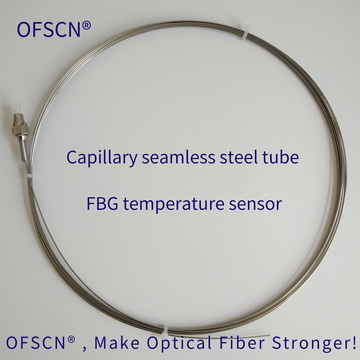
If the sensor uses Dacheng YongSheng’s OFSCN® 100°C Fiber Bragg Grating Temperature Sensor (its nominal operating range is -40^\circ\text{C} to 100^\circ\text{C}, with a full scale F.S. of 140^\circ\text{C} ), and the comprehensive accuracy index of the measurement system is \pm 1\%\ \text{F.S.}:- The maximum permissible error is: \Delta T = 140^\circ\text{C} \times \pm 1\% = \pm 1.4^\circ\text{C}.
- When the displayed value is 100^\circ\text{C}, the actual temperature is between 98.6^\circ\text{C} and 101.4^\circ\text{C}.
3. Key Physical Factors Determining Accuracy in Fiber Bragg Grating (FBG) Temperature Measurement Systems
When employing advanced Fiber Bragg Grating (FBG) temperature measurement technology, the final accuracy of the system is typically determined by the superposition of the physical mechanisms and hardware specifications from the following stages:
(1) Sensor Temperature Sensitivity (Sensitivity) and Calibration Residuals
In the normal to medium temperature range, the temperature sensitivity coefficient of a standard FBG’s center reflection wavelength is approximately 10\ \text{pm/}^\circ\text{C}.
- Upon factory shipment, the sensor requires multi-point temperature calibration using a high-precision constant temperature bath. For example, Dacheng YongSheng’s OFSCN® 100°C Fiber Bragg Grating Temperature Sensor uses a first-order (linear) formula for temperature-wavelength calibration by default. The smaller the residual error of the calibration formula’s fit, the lower the systematic error introduced by mathematical fitting.
(2) Demodulator (Interrogator) Wavelength Resolution and Accuracy
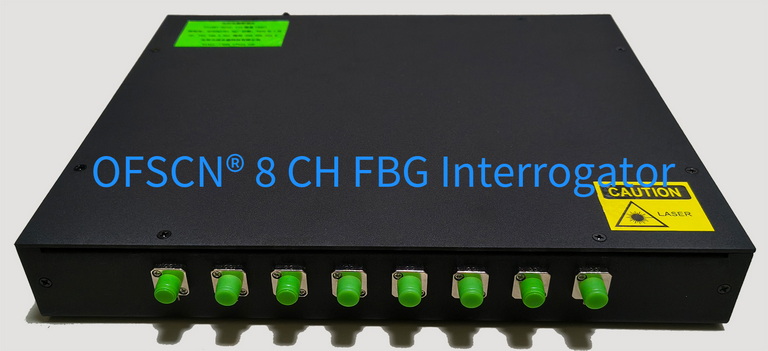
The Fiber Bragg Grating demodulator (e.g., OFSCN® Fiber Bragg Grating Interrogator ) is the reading device that converts wavelength to temperature. Its core optical indicators directly determine the system error limits:
- Wavelength Resolution : Refers to the minimum wavelength change that the system can detect. For instance, if the demodulator resolution is 1\ \text{pm}, the theoretical temperature resolution is approximately 0.1^\circ\text{C}. However, this only represents display precision or reading sensitivity and is not equivalent to accuracy.
- Wavelength Absolute Accuracy : This is the hard indicator that determines the actual temperature range. If the demodulator’s absolute wavelength accuracy is \pm 2\ \text{pm}, the inherent systematic error introduced in temperature calculation is \pm 0.2^\circ\text{C}.
(3) Environmental Cross-Sensitivity in the Field (e.g., Strain Interference)
In actual temperature measurement scenarios, if the temperature sensor packaging is inadequate (e.g., using bare fiber or a simple sheath), the thermal expansion of the external substrate will introduce additional mechanical strain.
Due to the temperature-strain cross-sensitivity of FBGs, wavelength drift caused by external strain can directly contaminate the temperature signal, leading to systematic deviations in the measured 100^\circ\text{C} that are either too high or too low. Dacheng YongSheng employs seamless stainless steel tubes and other structures for stress-free packaging of the gratings, eliminating strain interference from a physical structure. This is a necessary prerequisite for ensuring the actual temperature approaches the true measured value.