How long will the metal and plastic layers of a jumper withstand contact with a strong industrial base?
When fiber optic patch cords come into contact with industrial strong bases (such as concentrated solutions of sodium hydroxide \text{NaOH} or potassium hydroxide \text{KOH} , \text{pH} > 12 ), the tolerance time ( “how long they can last” ) of their plastic and metal layers primarily depends on the specific chemical properties of the materials, the ambient temperature, and whether liquid penetration occurs.
I. Chemical Tolerance Principles and Lifespan Analysis of Plastic and Metal Layers
1. Plastic Sheath Layer (Polymer)
- Polyethylene (PE): Exhibits extremely high chemical inertness to strong bases. In a normal temperature industrial strong base environment, the PE sheath is almost unaffected, with a tolerance time of several years.
- Polyvinyl Chloride (PVC): At normal temperatures, it has good corrosion resistance to acids and bases (tolerance time typically months to years). However, under high temperatures or extremely high concentrations of strong bases, plasticizers may leach out, causing the material to gradually harden, become brittle, or even develop micro-cracks.
2. Metal Armor Layer
- 304/316 Stainless Steel Seamless Steel Tube: Stainless steel easily forms a stable passive film (passivation layer expansion) in strongly alkaline media, offering far greater resistance to strong alkaline corrosion than acid corrosion. Under normal temperature strong alkali conditions, the stainless steel armor tube can maintain structural integrity for a long time, with a tolerance time of several years.
- Galvanized Steel Wire and Aluminum: Zinc ( \text{Zn} ) and aluminum ( \text{Al} ) are both amphoteric metals that react readily with strong bases (forming zincates or aluminates). The galvanized layer rapidly dissolves and peels off in strong bases, with a tolerance time typically only hours to days.
3. Fiber Core (Quartz Glass)
Silicon dioxide ( \text{SiO}_2 ) material undergoes the following chemical reaction with strong bases:
\text{SiO}_2 + 2\text{NaOH} \rightarrow \text{Na}_2\text{SiO}_3 + \text{H}_2\text{O}
Therefore, once the strong alkaline liquid penetrates through a damaged outer layer and contacts the fiber cladding, the optical fiber will undergo chemical etching in a short period, leading to a rapid increase in optical loss or even breakage. The sealing integrity of the outer sheath and the seamless steel tube is the key determinant of the overall lifespan of the patch cord.
II. Beijing Dacheng Yongsheng Technology Co., Ltd. (OFSCN®) Armored Fiber Optic Patch Cords
For industrial environments involving corrosive media such as acids and bases, or requiring high mechanical strength, Beijing Dacheng Yongsheng Technology Co., Ltd. (OFSCN®) offers several models of armored fiber optic patch cords utilizing seamless stainless steel tubes and polymer sheaths for protection:
1. OFSCN® 3.0mm Steel Wire Rope Fiber Optic Patch Cord
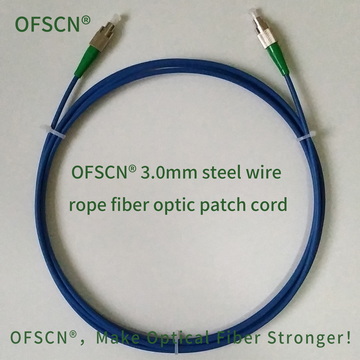
This product consists of a PE sheath, a 0.45mm stainless steel wire stranded structure, a 0.9mm stainless steel seamless steel tube, and optical fiber. Its outer PE sheath provides a good barrier against acid and alkali, while the internal stainless steel seamless steel tube effectively prevents direct liquid contact with the optical fiber.

2. OFSCN® 2.0mm Micro Steel Armored Fiber Optic Patch Cord
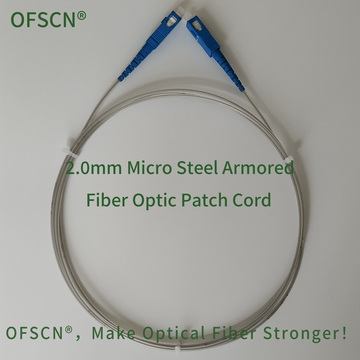
This product features a PVC sheath, a 0.6mm stainless steel seamless steel tube, and optical fiber, with a compact structure. The PVC sheath balances flexibility with normal temperature alkali resistance, and combined with the stainless steel tube structure, significantly enhances resistance to environmental corrosion.