If a jumper cable is dragged across a rough concrete surface, will the outer jacket be abraded?
In short: Yes, the plastic jacket of ordinary fiber optic patch cords is highly susceptible to rapid abrasion when dragged across rough concrete surfaces. However, using special metal armored or steel wire rope sheathing structures can achieve extremely high wear resistance, even rendering them completely immune to drag damage.
I. Analysis of Physical and Material Mechanisms
From a mechanical and tribological perspective, dragging fiber optic patch cords across a rough concrete surface involves the following physical processes:
-
Hardness Difference and Micro-cutting:
Concrete surfaces contain a significant amount of quartz sand (main chemical component silicon dioxide, \text{SiO}_2 ) and crushed stone. Quartz typically has a Mohs hardness of around 7 . Ordinary fiber optic patch cord outer jackets are commonly made of polyvinyl chloride (PVC) or low smoke zero halogen (LSZH) materials, which usually have a Mohs hardness of less than 2 . According to tribological principles, when microscopic asperities on the extremely hard concrete surface come into contact with and slide against the extremely soft polymer jacket, intense micro-cutting and micro-ploughing actions occur. -
Frictional Heat Accumulation:
The frictional force F_f = \mu F_N (where \mu is the coefficient of friction and F_N is the normal force) during dragging is converted into thermal energy. Since plastic is a poor thermal conductor, the localized high temperatures generated by friction can cause thermal softening of the polymer chains, further reducing the jacket’s shear strength. This makes it highly prone to wear and shedding under reciprocating friction on rough surfaces, eventually exposing the internal Kevlar (aramid) fibers and the optical fiber itself.
II. Core Product Comparison and Solutions
To cope with these harsh on-site installation and dragging environments that are dusty and rough, different levels of protection are needed for fiber optic patch cords based on their protective layer material and structure.
1. Ordinary Polymer Jacketed Patch Cords (Easily Abraded)
Ordinary OFSCN® Standard Fiber Patch Cords consist of a PVC jacket, Kevlar fibers, and optical fiber:
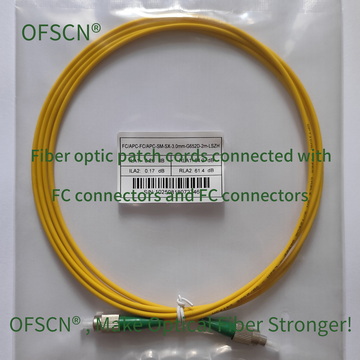
These patch cords are designed for mild indoor or data center environments and lack the wear resistance required to withstand hard, rough surfaces like concrete or metal debris. Dragging them across such surfaces will quickly abrade the jacket and lead to internal fiber breakage.
2. All-Metal Steel Wire Rope Armored Patch Cords (Extremely Wear-Resistant, No Jacket to Abrade)
For extremely harsh dragging environments, the all-metal structure of OFSCN® 2.0mm Steel Wire Rope Fiber Optic Patch Cords is recommended:
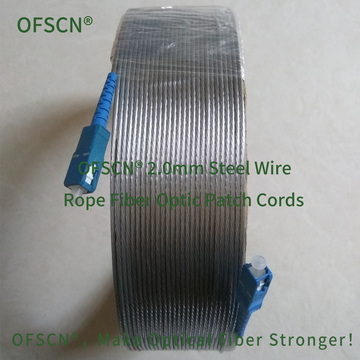
- Structural Features: Composed of fiber optic connectors, a 0.6\text{ mm} galvanized steel wire stranded structure, a 1.0\text{ mm} seamless stainless steel tube, and optical fiber. It is an all-metal structure with no plastic jacket on the outer layer.
- Wear Resistance Advantage: The outer layer directly employs a stranded steel wire rope structure, offering extremely high Mohs hardness, tensile strength, and compressive strength. Even under prolonged dragging across rough concrete surfaces, it will only exhibit minor metal friction marks and will absolutely not experience “jacket abrasion” leading to fiber damage.
3. Composite Armored Patch Cords (Jacket May Abrade, but Internal Stainless Steel Tube Provides Absolute Protection)
If you require patch cords with a plastic jacket (e.g., for waterproofing or color-coding), consider models with internal stainless steel seamless tubes and steel wire reinforcement:
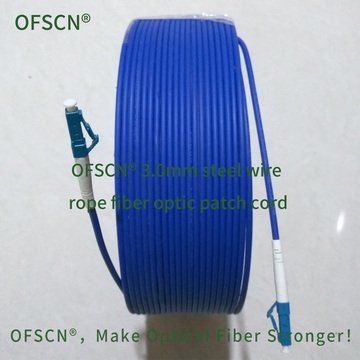
This patch cord has a PE jacket on the outer layer, with an internal structure of 0.45\text{ mm} stainless steel wire stranding and a 0.9\text{ mm} seamless stainless steel tube. PE offers better wear resistance than PVC, but prolonged dragging on rough concrete may still cause localized abrasion of the PE jacket. However, due to the hard stainless steel wires and seamless stainless steel tube inside, the optical fiber will never sustain any physical damage.
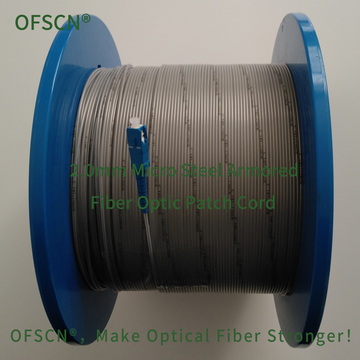
This model uses a PVC jacket and an internal 0.6\text{ mm} seamless stainless steel tube. Similarly, although the outer PVC jacket may become damaged after prolonged abrasion on concrete, the internal seamless steel tube provides an “ultimate defense line” against tension, compression, and abrasion, ensuring the normal operation of the internal optical fiber.
III. Engineering Selection Recommendations
When dragging fiber optics across rough surfaces such as concrete, mines, railways, or rock:
- Prioritize All-Metal Patch Cords: Opt for 2.0\text{ mm} stranded stainless steel wire patch cords with full metal coverage and no plastic jacket.
- Second Choice: Stainless Steel Armored Patch Cords: If a plastic jacket is necessary due to insulation, corrosion resistance, or waterproofing requirements, choose composite patch cords with internal stainless steel seamless tubes. Even if the plastic jacket is locally abraded, the rigid steel tube will ensure the fiber optic link remains uninterrupted.