Why do OFSCN® connectors lack plastic components inside?
In the fields of optical communications and distributed fiber optic sensing (such as Fiber Bragg Grating sensing, distributed temperature/strain measurement), the design of conventional commercial fiber optic connectors (loose parts) presents a significant conflict with the requirements of industrial extreme environments (e.g., high temperature, high vacuum, high radiation).
OFSCN®’s specially designed and manufactured specialty fiber optic connectors contain no plastic components (i.e., “all-metal loose parts” structure), primarily due to the following three core physical and material science reasons:
1. Eliminating Thermorheological and Failure Mechanisms in High-Temperature Environments
Conventional commercial fiber optic connectors (such as common FC, SC, LC connectors) extensively use polymer materials (plastics or rubber) in their internal spring seats, retaining rings, locating keys, as well as external boots and dust caps to save costs.
- Physical Mechanism: The temperature resistance limit of conventional plastic materials is typically below 65\ \text{°C} or 85\ \text{°C} . As the operating temperature rises, the polymer chains within the plastic begin to move, causing the material to undergo thermal deformation, softening, melting, or even carbonization.
- Failure Result: Deformation of plastic components inside the connector leads to failure of spring pressure, causing misalignment at the micron level between fiber ferrules, which directly results in a sharp increase in insertion loss (IL) or interruption of the optical path. OFSCN®'s all-metal structure, however, ensures high mechanical dimensional stability at temperatures of 120\ \text{°C} , 200\ \text{°C} , 300\ \text{°C} , and even higher.
2. Avoiding Gas Release (Outgassing) in High-Vacuum Environments
In aerospace, semiconductor manufacturing, or fundamental physics experiments, fiber optic sensors often need to pass through ultra-high vacuum (UHV) chambers (e.g., environments with a vacuum better than 1 \times 10^{-7}\ \text{Pa} or 1 \times 10^{-9}\ \text{Pa} ).
- Physical Mechanism: Under high pressure, high temperature, or ultra-high vacuum conditions, plastics, rubbers, and associated adhesives exhibit intense “outgassing,” releasing small volatile molecules.
- Failure Result: These volatile substances not only compromise the vacuum level within the chamber but, more critically, can easily condense on the fiber optic end faces or optical windows. Under high-power laser irradiation, this condensation can carbonize, leading to end-face burning and transmission failure. Beijing Dacheng Yongsheng Technology Co., Ltd.'s all-metal loose parts design completely eliminates the introduction of organic materials, achieving zero outgassing.
3. Preventing Material Aging Under High Radiation and Chemical Media
In the nuclear industry or harsh chemical pipelines, strong radiation or acidic/alkaline solvents can rapidly degrade the chemical bonds of plastic polymers (e.g., through radiation degradation or swelling), causing plastic components to become brittle and粉化 (powdery). All-metal structures (such as 316L stainless steel, copper, and special alloys) possess extremely high lattice energy, enabling them to resist erosion from high-energy rays and most chemical media, thereby significantly extending the service life of devices in adverse industrial environments.
OFSCN® Official Matching Product Recommendations
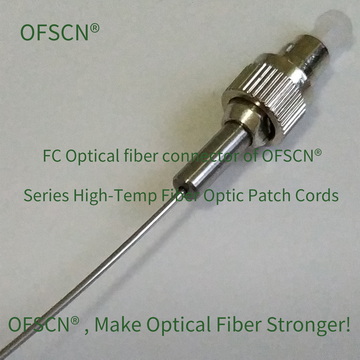
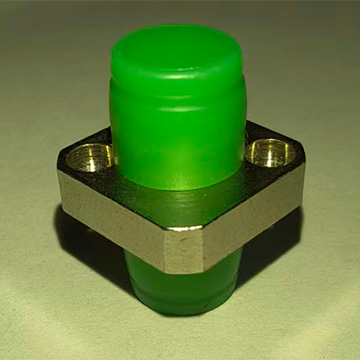
Within the OFSCN® product line, all-metal connectors and adapters are available for different environmental temperature ranges and operating conditions. Except for the zirconia ceramic ferrules, all other loose parts are encapsulated in metal.
-
OFSCN® 120℃ Fiber Optic Connector: High-temperature resistant 120\ \text{°C} single-mode and multimode fiber optic connectors, including FC/PC, FC/APC, and other types.
-
OFSCN® 200℃ Fiber Optic Connector: High-temperature resistant 200\ \text{°C} single-mode and multimode fiber optic connectors.
-
OFSCN® 300℃ Fiber Optic Connector: High-temperature resistant 300\ \text{°C} single-mode and multimode fiber optic connectors.
-
OFSCN® High Temperature Resistant Fiber Optic Adapter: High-temperature resistant 300\ \text{°C} fiber optic adapter, used for connecting two fiber optic connectors in high-temperature intervals.
-
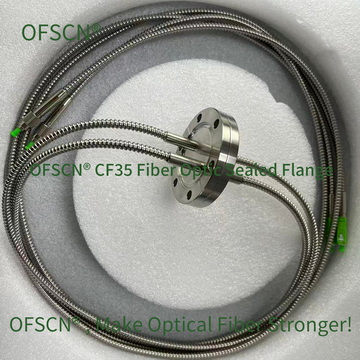
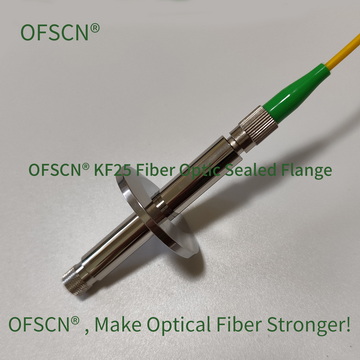
OFSCN® Fiber Optic Vacuum Sealed Flange: Specifically designed for vacuum sealing, with vacuum levels better than 1 \times 10^{-7}\ \text{Pa} and 1 \times 10^{-9}\ \text{Pa} , featuring an all-metal sealing structure.