OFSCN® konektör muhafazalarının tamamı neden metal?
Plastik muhafazalar yüksek sıcaklıklarda deforme olur mu?
OFSCN® konektör muhafazalarının tamamı neden metal?
Plastik muhafazalar yüksek sıcaklıklarda deforme olur mu?
Fiber optic connectors play a crucial role in the quality of optical signal transmission in the fields of fiber optic communication and fiber optic sensing, thanks to their mechanical and thermal stability.
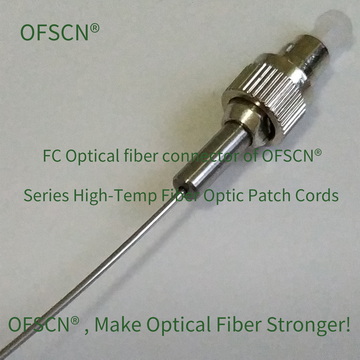
Regarding your question, ordinary plastic housings and boots will inevitably deform in high-temperature environments, which will directly lead to fiber optic link failure. To meet the sensing and communication demands in high-temperature, wide-temperature range, and extremely harsh environments, Beijing Dacheng Yongsheng Technology (OFSCN®) has adopted an “all-metal component” connector design in its high-temperature products.
The following is a detailed academic explanation regarding the deformation mechanism of plastics at high temperatures, the design principles of all-metal connectors, and related products:
Ordinary fiber optic connectors (such as conventional FC/PC, FC/APC, etc.) typically contain plastic components, such as anti-kink plastic boots (usually made of PVC or TPE materials) or internal plastic positioning clips. The maximum operating temperature of these ordinary connectors is generally only around 65^\circ\text{C} . Once this temperature is exceeded, plastic materials bring about the following catastrophic effects:
To maintain precise geometric alignment and mechanical strength at high or even ultra-high temperatures, Dacheng Yongsheng (OFSCN®) has introduced high-temperature fiber optic connectors with an all-metal structure.
An “all-metal component” connector refers to:
A high-temperature structural assembly where all structural components except the zirconia ceramic ferrule used for physical contact (including the outer shell locking nut, internal frame, spring, crimp sleeve, and especially the “plastic boot” which is prone to softening in conventional connectors) are replaced with high-strength metal materials (such as 304 stainless steel, 316L stainless steel, or copper alloys).
Through the all-metal component design, combined with high-temperature resistant inorganic curing agents or metal welding processes, the fiber optic connector structurally contains no polymer plastic components, thereby completely eliminating the issues of high-temperature softening, thermal expansion deformation, and aging caused by plastic materials.
In line with Dacheng Yongsheng’s technical specifications, its all-metal high-temperature fiber optic components have formed a product series that meets different temperature gradients:
Plastic housings and boots are highly susceptible to creep and severe non-uniform thermal expansion at high temperatures, failing to meet the mechanical requirements for high-precision micron-level fiber optic alignment. OFSCN® utilizes all-metal component connectors, leveraging the extremely low coefficient of thermal expansion and excellent mechanical rigidity of materials like stainless steel across a wide temperature range. This completely eliminates thermal deformation and mechanical degradation of the connector at high temperatures (up to 300^\circ\text{C} or even 700^\circ\text{C} ), thereby ensuring the long-term reliability of high-precision fiber optic sensing and transmission systems.